
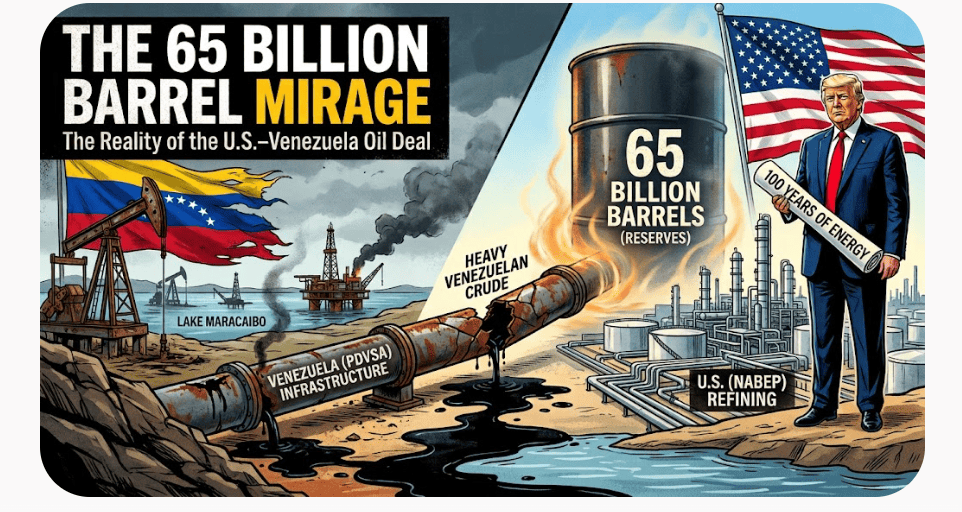
Sixty-five billion barrels
That enormous number sits at the center of the new U.S.–Venezuela oil agreement, and it helps explain why the Trump administration has called it “the biggest oil deal in world history.”
The agreement followed an extraordinary change in the relationship between the two countries: in January 2026, the United States launched Operation Absolute Resolve, a military operation in Caracas that resulted in the capture and removal of Nicolás Maduro. Seven months later, the administration announced an oil agreement involving 17 Venezuelan fields described by the administration and the parties to the agreement as containing approximately 65 billion barrels of proven reserves.
At the center of the arrangement is North American Blue Energy Partners, or NABEP, a private company with operations in Venezuela. Under the terms announced publicly, NABEP received rights to develop the fields, while the U.S. government received rights to a 35% equity stake in NABEP’s corporate parent, preferential access to 20% of the company’s production at cost, and the right of first refusal to purchase the remaining production.
The White House says the agreement will strengthen American energy security, help lower gasoline prices, and support U.S. “energy dominance” for the next century. Those are enormous claims, and before deciding what the agreement means for the United States, we need to answer a much simpler question:
What did America actually get?
Source: White House Historic Oil Agreement
65 Billion Barrels Is Not 65 Billion Barrels of Available Oil
The headline number is real, but it is also easy to misunderstand. A proven reserve does not mean billions of barrels sitting in tanks waiting to be shipped to American refineries. It means geological and engineering evidence indicates that petroleum exists underground and can be recovered under specified economic and operating conditions. And there is a vast difference between petroleum thousands of feet underground and gasoline ready to go into a car.
Venezuela demonstrates that difference particularly well. The country possesses some of the largest known petroleum reserves on Earth, but its oil industry has deteriorated after decades of underinvestment, political interference, corruption, loss of skilled workers, economic crisis, sanctions, and crumbling infrastructure.
NABEP says the agreement is expected to involve nearly $100 billion in investment to rebuild and expand Venezuelan oil infrastructure — and that number tells us something important all by itself: getting access to oil and actually producing that oil are two very different accomplishments. Wells must be repaired or drilled. Pipelines and other infrastructure must function. Skilled workers are needed. Capital has to be raised and spent. Oil has to be transported and refined.
Venezuela’s crude presents one more challenge: much of it is extremely heavy and high in sulfur. That can be valuable to sophisticated U.S. refineries, particularly along the Gulf Coast, but it is not interchangeable with every other barrel of crude produced around the world.
In fact, that subject answers one of the strangest questions in American energy policy: If the United States produces so much oil, why do we still import millions of barrels from other countries?
We tackle that separately in Oil Isn’t Just Oil: Why America Imports Oil Even When It Produces So Much.
For this agreement, the important point is simpler: 65 billion barrels underground and 65 billion barrels available for use are two very different things.
How Did Venezuela End Up With So Much Oil — But So Little Production?
Venezuela’s petroleum industry did not collapse overnight. The country nationalized its oil industry in 1976, and by the late 1990s production had reached roughly 3.4 million barrels per day. But enormous oil wealth existed alongside inequality, corruption, economic frustration, and growing distrust of the country’s political establishment — conditions that helped Hugo Chávez win the presidency in 1998.
Chávez promised to redirect more of Venezuela’s oil wealth toward ordinary Venezuelans, and during years of high oil prices his government expanded social programs and subsidies. His government also increased political control over PDVSA, and following the 2002–03 oil strike, roughly 18,000 employees were dismissed from the state oil company, including many experienced technical and professional workers. Over time, Venezuela became increasingly dependent on oil revenue while investment, institutional capacity, and the industry’s skilled workforce deteriorated.
Under Nicolás Maduro, falling oil prices exposed those deeper weaknesses, while mismanagement, corruption, deteriorating infrastructure, declining investment, sanctions, and the continued loss of skilled workers compounded the damage.
By 2026, Venezuela still possessed extraordinary petroleum resources. It simply could not produce them at anything close to its former capacity. That history matters here because it explains why opening Venezuelan fields to investment is not the same thing as turning on a faucet — and it deserves a fuller telling of its own.
In How Venezuela Got Here, we look more closely at why Chávez originally attracted so much support, what happened to Venezuela’s oil wealth, how Maduro inherited and deepened the crisis, and how the country eventually reached the extraordinary moment when the United States removed its president by military force.
So What Did the United States Actually Get?
The answer is quite a lot — just not 65 billion barrels of American-owned oil.
Venezuela still owns the petroleum beneath its territory. NABEP received contractual rights to develop and produce oil from the covered fields, while the U.S. government’s financial interest is in NABEP’s corporate parent and its preferential purchasing rights apply to oil that is actually produced.
Specifically, the government has rights to a 35% equity stake in NABEP’s corporate parent — and we now know more about how that stake works. Reuters reported in September, citing a U.S. official, that the position was structured through what are known as “penny warrants.” In simple terms, those give the U.S. government rights to obtain shares for a nominal price and are designed to protect its 35% position from being diluted as NABEP raises additional capital.
The United States also receives preferential access to 20% of NABEP’s production at production cost, plus the right of first refusal to purchase the remaining 80%. If Venezuelan production increases substantially, access to crude at production cost could give the United States another source of supply during shortages or disruptions, and the administration has suggested some of the oil could be used to replenish the Strategic Petroleum Reserve.
But notice what the agreement does not say. The United States does not own every barrel underneath those 17 Venezuelan fields. That distinction gets lost very easily when an enormously complicated energy agreement is compressed into a political slogan.
The Claim and the Reality
About Those 100 Years: We Know More Now
When the agreement was first announced, there was an obvious contradiction. The White House described NABEP as receiving 100-year concessions, while Venezuela’s interim president, Delcy Rodríguez, publicly described the agreement as lasting 25 years.
Those statements initially appeared difficult to reconcile — but we now have a better explanation.
On September 7, PDVSA president Héctor Obregón said the contract is initially signed for 25 years but can be renewed by mutual agreement for additional periods.
The duration described publicly by the White House.
The duration described publicly by Delcy Rodríguez.
That distinction matters. A renewable 25-year contract is not quite the same thing as an unconditional contract guaranteeing the same arrangement through 2126, and 100 years is an extraordinary amount of time.
A century ago, in 1926, Calvin Coolidge was president. Commercial television, nuclear power, the interstate highway system, and human travel to the Moon all lay in the future. Imagine someone in 1926 predicting American energy technology, transportation, international alliances, environmental priorities, and petroleum consumption in 2026 — and then look the same distance forward. Administrations, governments, technology, laws, and even the role of petroleum itself will change along the way.
None of that makes a long-term agreement inherently unusual. Companies investing billions of dollars often need decades to recover those investments. But the distinction between 25 years with possible renewals and 100 years guaranteed is worth understanding.
The agreement may ultimately endure for a century; that does not mean a century is already written in stone.
Something Important Has Happened Since the Announcement
The Venezuela story has not stopped moving, and one of the most important developments is that NABEP is no longer the only company making major plans for Venezuela’s energy sector.
Chevron says its Venezuelan joint ventures plan to invest more than $7 billion over five years, with the goal of more than doubling production to approximately 600,000 barrels per day. On September 16, Continental Resources signed a memorandum of understanding with Venezuela’s state oil company PDVSA involving the Ayacucho 2 block in the Orinoco Belt. And on September 19, Venezuela signed another memorandum of understanding with France’s TotalEnergies, although details of that agreement have not yet been publicly disclosed.
Not all of these agreements are final, and announced investment is not the same thing as money actually spent or oil actually produced. But the pattern matters: Venezuela is attempting to attract outside capital back into an oil industry that desperately needs it.
That gives us something we did not have when the original agreement was announced — early evidence that the opening of Venezuela’s petroleum sector is attracting broader international interest.
It still does not tell us how successful that rebuilding effort will be.
Why Hasn’t 65 Billion Barrels Transformed the Oil Market?
Because the oil market operates on a different clock.
Political announcements can happen in a day; oil production cannot. A barrel that might become available several years from now does not affect today’s market in the same way as a barrel that can be delivered next month.
Markets therefore care about questions that sound much less dramatic than “65 billion barrels”: How quickly can production increase? How much capital will actually be invested? What condition are the wells, pipelines, roads, ports, and other infrastructure in? Will contracts survive future political changes? And most importantly, how many additional barrels will actually reach buyers — and when?
None of this means the Venezuela agreement is meaningless. It means the political and physical clocks are different. The administration can announce access to an enormous petroleum resource today; turning that resource into a reliable stream of additional oil is a project measured in years.
Energy Security Is Not the Same as Controlling Gas Prices
There is one more distinction worth making before we decide what this agreement means.
Oil is traded in a global market, and a war in the Middle East, an OPEC production decision, sanctions on a major producer, a hurricane affecting Gulf Coast infrastructure, or a disruption along an important shipping route can alter prices even if the United States itself is producing enormous quantities of petroleum.
That is why energy security and energy independence are not necessarily the same thing.
Adding another large potential source of crude in the Western Hemisphere could make the United States more resilient during disruptions — a genuine potential benefit. But access to Venezuelan oil cannot make the international oil market disappear.
We explore that much more closely in Oil Isn’t Just Oil, including why American refineries sometimes need crude from other countries even while the United States is one of the world’s largest petroleum producers.
So What Should We Make of the 65-Billion-Barrel Promise?
The answer is more interesting than either extreme.
The agreement is not meaningless simply because 65 billion barrels cannot immediately reach American consumers. Venezuela possesses extraordinary petroleum resources, and the United States has obtained a significant financial interest in the company developing some of them, preferential purchasing rights to future production, and governance rights that could have substantial strategic value.
New international investment is already beginning to follow.
But none of that makes 65 billion barrels equivalent to 65 billion barrels of American oil ready for use.
The reserves are real.
The agreement is real.
The potential strategic value is real.
But reserves are not production. Production is not gasoline. And access to oil does not give any government complete control over the global price of oil.
The real test of this agreement will not be whether 65 billion barrels exist beneath Venezuelan soil — they do. The questions are how much of that oil actually comes out of the ground, how long it takes, what it costs, and who ultimately benefits when it does.
Continue the Series
Oil Isn’t Just Oil
Why America imports petroleum even while producing enormous quantities of its own — and why “energy independence” is much more complicated than it sounds.
Article 2 — publishing with this article.
How Venezuela Got Here
Why Hugo Chávez once attracted enormous support, what happened to Venezuela’s oil wealth, how the petroleum industry deteriorated, and how the country eventually reached the 2026 U.S. intervention.
Coming Soon
Who Benefits This Time?
Who is receiving opportunities in Venezuela’s new oil economy, what the United States receives, what Venezuelans receive, and how to distinguish legitimate questions about political connections from claims the evidence does not prove.
Coming Soon
Join the Discussion
- When you first hear “65 billion barrels,” what does that number make you assume — and did your understanding change after reading about the difference between reserves and actual production?
- If the United States is already one of the world’s largest oil producers, what should “energy independence” mean in a global oil market?
- How much weight should we give promises about lower gasoline prices when the additional oil may take years to reach the market?
- Does knowing that the agreement begins with a 25-year term that can be renewed change how you interpret the claim that it could last 100 years?
- What would you watch over the next few years to decide whether this agreement is actually working — investment, oil production, gasoline prices, benefits to Venezuelans, U.S. energy security, or something else?




No discussions yet
Be the first to join the discussion and share your thoughts with the community.