
People Are Asking
Who actually runs the government?
Career civil servants in federal agencies do the daily work — processing Social Security checks, inspecting food, forecasting weather — under laws Congress writes and the President enforces.
Can unelected officials make rules that bind me?
Yes, but only within the authority Congress gives them. Many regulations go through a public comment process, and agency rules can be challenged in court.
Isn’t this the “deep state”?
The term is often used to suggest that unelected government employees secretly control policy. In reality, most federal employees are career professionals who carry out laws and government programs under elected leadership. That doesn’t mean agencies are beyond criticism or oversight.
What can I do about any of this?
You can comment on proposed rules before they take effect, vote for the people who fund and oversee agencies, and look up any rule yourself online.
Opening: The School Analogy
Imagine running a large school with hundreds of students, dozens of teachers, cafeterias, and buses. You can’t check every classroom, taste-test every lunch, or settle every hallway argument yourself.
So you rely on a principal, department heads, teachers, and staff. Each has responsibilities, rules to follow, and a budget to work within. Together, they keep the school running.
Now scale that up to a country of more than 330 million people. Someone has to inspect food, process Social Security payments, manage national parks, regulate air travel, approve medications, and enforce environmental laws.
Congress passes laws, and the President oversees their execution. But neither personally handles the daily work. That’s where federal departments and agencies come in.
Let’s break down how that works.
Key Takeaway: Government agencies carry out the laws Congress passes. Congress gives agencies their jobs and powers; the President’s branch ensures they follow through; courts make sure they stay inside their lane.
Important Rule: Agencies cannot make up whatever rules they want. They only have the power the law gives them.
Part 1: What Is a Federal Agency?
Let’s clear up the alphabet soup. Americans constantly hear terms like Department, Agency, Administration, Bureau, Commission, and Office. They sound interchangeable, but they aren’t necessarily the same thing.
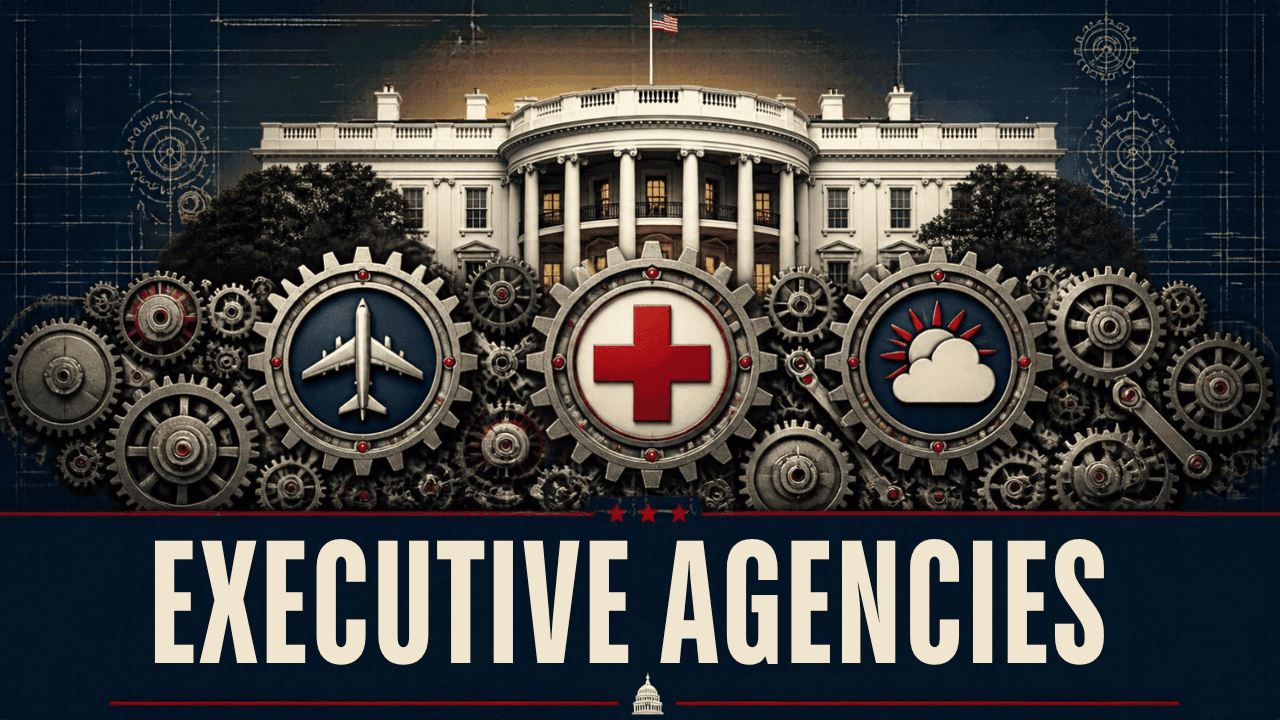
– Departments: The 15 major executive departments are led by Cabinet secretaries, including the Departments of Transportation, Education, and Defense.
– Agencies Within Departments: One department can oversee several smaller agencies. The Department of Transportation, for example, includes the Federal Aviation Administration (FAA), Federal Highway Administration (FHWA), and National Highway Traffic Safety Administration (NHTSA).
– Independent Agencies: These operate outside Cabinet departments. Examples include the Federal Trade Commission (FTC) and Federal Reserve. Congress designed some independent agencies with protections that limit direct presidential control, although the degree of independence varies.
Good to Know: How Many Federal Agencies Are There?
You might think the government knows exactly how many agencies it has. Surprisingly, there’s no single agreed-upon number.
The Federal Register lists hundreds of departments, agencies, offices, and other government units. But not everything on that list qualifies as a separate federal agency.
The confusion isn’t necessarily about government secrecy. It’s about how we define an agency.
Part 2: What Do Agencies Actually Do?
Most Americans interact with federal agencies far more often than they realize. You might never visit Washington, but the medicine in your cabinet, the airplane you board, and the weather warning on your phone all connect to work done by federal agencies.
– Administer Programs: The Social Security Administration (SSA) processes retirement and disability benefits, making sure eligible Americans receive their payments.
– Protect Health and Safety: The Food and Drug Administration (FDA) reviews medications for safety and effectiveness, while the Centers for Disease Control and Prevention (CDC) monitors disease outbreaks.
– Enforce Laws: The Environmental Protection Agency (EPA) enforces pollution laws, while Department of Labor investigators examine violations of wage and overtime protections.
– Regulate Activities: The Federal Aviation Administration (FAA) establishes aviation safety standards, while the Securities and Exchange Commission (SEC) oversees securities markets and investigates potential violations.
– Provide Services and Information: The Federal Emergency Management Agency (FEMA) coordinates federal disaster assistance, while the National Weather Service provides forecasts and warnings that help communities prepare for severe weather.
Fun Fact: The federal government employs millions of civilian workers, including doctors, scientists, engineers, air traffic controllers, and park rangers. Many work far from Washington, D.C., providing services in communities across the country.
Part 3: Where Do Agencies Get Their Power?
Federal agencies don’t get to invent their own powers. Their authority comes from laws passed by Congress, which establish what agencies can do and the limits they must follow.
Here’s how it generally works:
Congress passes a law → The President signs it → An agency receives authority → The agency carries out the law.
For example, Congress may pass a law requiring cleaner air. The Environmental Protection Agency (EPA) then develops and enforces standards within the authority Congress provided.
But having authority doesn’t mean having unlimited freedom. Agencies must follow the law, and their decisions can be challenged in court.
Congress Controls the Funding
Congress also holds considerable power through the federal budget. It decides how much funding many agencies and programs receive, influencing what they can accomplish.
However, not every agency relies entirely on annual appropriations. Some receive funding through fees, permanent appropriations, or other arrangements established by law.
The President Oversees the Executive Branch
The President sets administration priorities, appoints agency leaders, and directs much of the executive branch’s work. But presidential authority also has legal limits, and some independent agencies have additional protections from direct presidential control.
Presidents manage the machinery; they don’t own it.
Part 4: Who Works at These Agencies?
When a new President takes office, the people running federal agencies may change. But most of the employees doing the everyday work remain.
Federal workers generally fall into two categories:
– Political Appointees: These include Cabinet secretaries, agency heads, and other officials selected to help carry out the President’s agenda. Some require Senate confirmation, while others do not. Many leave when a new administration takes office.
– Career Civil Servants: These include doctors, engineers, scientists, lawyers, and air traffic controllers. They are generally hired through merit-based processes rather than political connections. Their job is to carry out government responsibilities regardless of which party controls the White House.
This system is designed to provide continuity. Elections can change government priorities, but essential services still need to operate.
Good to Know: A Presidential Assassination Changed Government Hiring
In 1881, President James Garfield was shot by Charles Guiteau, a disgruntled office seeker who believed he deserved a government position.
At the time, political connections often mattered more than qualifications. Under the spoils system, winning politicians rewarded supporters with government jobs.
Garfield’s assassination helped build support for reform. In 1883, Congress passed the Pendleton Civil Service Act, introducing merit-based hiring for certain federal positions.
Imagine if every new administration could replace government scientists, inspectors, and other career employees simply because they supported the opposing party. The civil service system was designed to reduce that kind of political favoritism and keep essential government services running.
Part 5: What Is a Federal Regulation?
Congress passes laws, but laws don’t always spell out every detail needed to make them work. That’s where federal regulations come in.
Think about the workplace. Congress generally doesn’t vote on the specific limits for factory noise, the protective equipment workers need, or the detailed rules for handling dangerous chemicals. Imagine how long Congress would spend debating every safety requirement!
Instead, Congress authorizes agencies like the Occupational Safety and Health Administration (OSHA) to develop detailed standards within the limits of the law.
That’s why a federal regulation can affect your workplace even though Congress never voted on that specific requirement.
Law vs. Regulation
| Law | Regulation | |
|---|---|---|
| Who creates it? | Congress, through the legislative process | Federal agency acting under legal authority |
| What does it do? | Establishes legal requirements and authority | Provides more specific requirements |
| How can it change? | Through legislation or judicial review | Through agency action, legislation, or judicial review |
How Regulations Are Made
Federal agencies generally follow a public process known as notice-and-comment rulemaking, established under the Administrative Procedure Act of 1946.
Here’s how it typically works:
Before adopting many regulations, agencies must give the public an opportunity to comment. Agencies must consider relevant feedback, although they aren’t required to accept every suggestion. Final rules are published in the Federal Register, where anyone can read them.
Good to Know: Not every regulation follows the full notice-and-comment process. Federal law allows exceptions in certain circumstances, including some emergency situations. And even after a rule takes effect, courts can review whether an agency acted within its legal authority.
Part 6: Who Keeps Agencies in Check?
Federal agencies have considerable authority, but they don’t operate without oversight. Congress, the President, the courts, and independent watchdogs all play a role in holding them accountable.
– Congress: Creates agencies, controls much of their funding, investigates their activities, and can change the laws governing them. Under the Congressional Review Act, Congress can also overturn certain agency rules, subject to presidential approval or a veto override.
– The President: Appoints agency leaders, sets administration priorities, and oversees much of the executive branch. However, the President’s authority varies depending on the agency and the limits established by law.
– The Courts: Review legal challenges to agency actions. Judges can block or overturn regulations that exceed an agency’s legal authority or violate other legal requirements.
– Inspectors General: Serve as internal watchdogs, investigating waste, fraud, abuse, and mismanagement. They report findings to agency leadership and Congress.
A Major Supreme Court Decision Changed the Rules
For 40 years, courts followed a principle called Chevron deference, which generally required judges to accept an agency’s reasonable interpretation of an ambiguous law.
In 2024, the Supreme Court overturned that principle in Loper Bright Enterprises v. Raimondo. Judges must now independently interpret federal laws rather than automatically defer to agencies when the law is unclear.
Supporters say this strengthens accountability. Critics worry judges may lack the technical expertise needed to evaluate complicated regulations.
The bottom line: Agencies can still regulate, but courts now have greater independence when reviewing their interpretations of federal law.
Part 7: Why This Matters Right Now
Federal agencies are at the center of today’s political debates, particularly over government spending, presidential authority, and the size of the federal workforce.
During 2025–2026, the federal government experienced substantial workforce reductions. Supporters argue that a smaller government can reduce waste, improve efficiency, and increase accountability. Critics worry that losing experienced employees could weaken services Americans depend on, from processing benefits to inspecting food and responding to disasters.
The real question isn’t simply whether government should be bigger or smaller.
Part 8: What You Can Do
You don’t have to work in Washington to have a say in how federal agencies operate.
1. Comment on proposed rules. Visit Regulations.gov to share your opinion during public comment periods. Agencies must consider relevant comments, even if they don’t adopt your suggestions.
2. Look up regulations yourself. Visit FederalRegister.gov to read proposed and final rules. Sometimes the actual regulation tells a different story than the headline.
3. Follow the money. Congress controls much of the funding agencies receive. Pay attention to budget decisions and congressional oversight hearings.
4. Vote with agencies in mind. Elections determine who leads the executive branch and who serves in Congress, influencing how agencies are managed, funded, and held accountable.
Federal agencies affect our everyday lives, but how much power should they have? We’d love to hear what you think.
Join The Discussions
1. Should Congress write more detailed laws, or should agencies have flexibility to work out the specifics?
2. Did the Supreme Court’s 2024 Loper Bright decision strengthen government accountability or give judges too much power?
3. When federal agencies lose employees, how can Americans tell whether government is becoming more efficient or simply providing fewer services?
Sources
- Office of Personnel Management — federal workforce data (data.opm.gov)
- Partnership for Public Service — federal workforce reports (ourpublicservice.org)
- U.S. Government Accountability Office — agency workforce reports (gao.gov)
- Federal Register — agency index (federalregister.gov)
- USA.gov — government agencies index (usa.gov/agency-index)
- U.S. Supreme Court — Loper Bright Enterprises v. Raimondo (2024)
- Administrative Procedure Act (1946) — Federal rulemaking requirements
Continue Reading


No discussions yet
Be the first to join the discussion and share your thoughts with the community.