
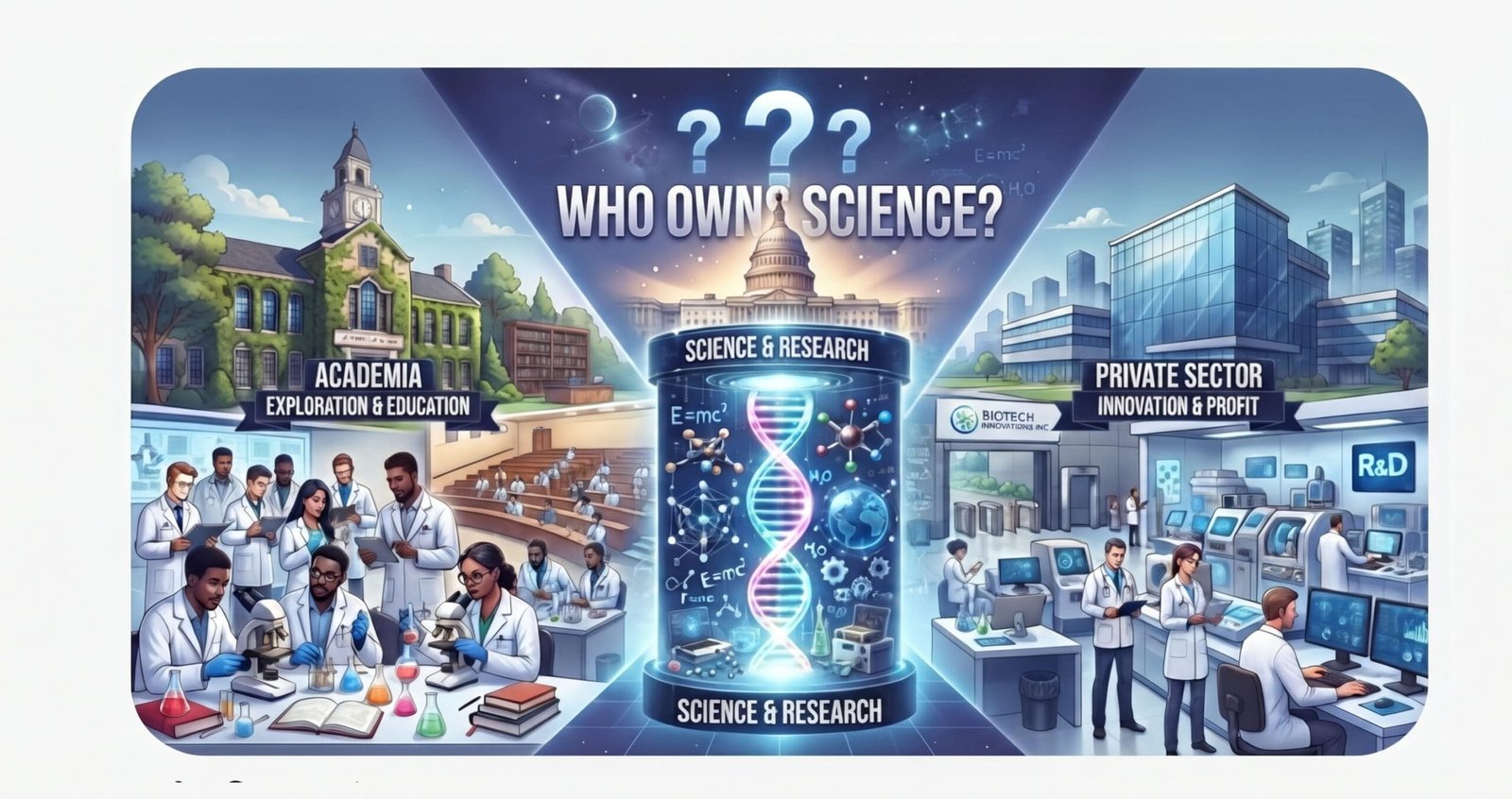
The discoveries your taxes help fund may change your life. But who decides what gets discovered—and who benefits?
Imagine a scientist working on a treatment for a rare childhood disease. The research could take twenty years, cost millions of dollars, and never produce a profitable drug. A private company might decide the investment isn’t worth the risk. But a university researcher, supported by federal funding, can pursue the question because the potential benefit to society matters even when the financial return is uncertain.
For decades, that has been part of America’s scientific bargain: taxpayers help fund research that private companies may be unwilling to pursue, universities train the next generation of scientists, and discoveries eventually benefit the broader economy.
Now that bargain is being reconsidered.
In 2026, the Trump administration outlined a new vision for American science, emphasizing emerging technologies, different approaches to funding researchers, and greater private-sector participation. Supporters see an opportunity to modernize an expensive system. Critics worry that weakening universities could jeopardize the very research that helped make America a scientific leader.
But beneath the debate over budgets and bureaucracy lies a much bigger question: When Americans pay for scientific discoveries, who should decide what gets researched — and who benefits from the results?
People Are Asking
“What is ‘basic research,’ anyway?” Research done for knowledge’s sake, without a product in mind. The internet began as a way for universities to share files. GPS came from tracking satellites. Nobody was selling anything when that work started — which is exactly why no company was lining up to fund it.
“Is anyone stopping this?” Yes, and the distinction matters. Congress rejected many of the Trump administration’s deepest proposed science cuts. For 2026, lawmakers approved $8.75 billion for the National Science Foundation—far more than the administration requested, although slightly less than the previous year.
But approving money and getting it into researchers’ hands are two different things. The NSF still withheld $1.4 billion in research funding, while courts have intervened in some university grant disputes. Congress has pushed back, but the fight over how that money is spent is far from over.
“Will my tuition go up because of this?” Maybe, but not automatically. When federal research dollars leave a university, the school loses the facility and equipment reimbursements that keep labs running. Someone can fill that gap — the state, donors, or students. It’s a real pressure, not a certainty.
The 1945 Bargain: How America Became a Scientific Powerhouse
In 1945, as World War II ended, American scientist Vannevar Bush presented a report titled Science: The Endless Frontier. His argument was simple: private companies are good at developing products they can sell, but who pays scientists to explore questions that might take decades to pay off — or never do?
Bush’s answer was the federal government, working through universities where researchers could pursue discoveries while training the next generation. That idea helped build modern American science — and the internet, GPS, MRI machines, and the science behind mRNA vaccines all trace back to it.
The arrangement was never perfect: universities competed for grants, researchers fought bureaucracy, and private companies often profited from taxpayer-funded work. But one principle endured for eighty years: Some discoveries are too important to depend entirely on whether someone can make money from them.
And that brings us to 2026, when the Trump administration proposed a different vision.
💡 Good to Know
Between 2021 and 2025, inventions developed through federally supported university and nonprofit research contributed as much as $577 billion in U.S. economic output, according to the Bayh-Dole Coalition.
That’s not money deposited into the Treasury. It’s the estimated economic activity generated when research becomes products, businesses, and jobs.
The bigger point? Publicly funded science doesn’t just cost money. It can help create wealth.
What’s Changing in 2026?
In July 2026, the Trump administration introduced Science: A New Golden Age, a blueprint for reshaping American scientific research.
The report, led by White House science adviser Michael Kratsios, argues that America’s research system has become too bureaucratic and too dependent on established universities. It calls for new approaches to funding individual scientists, stronger partnerships with private industry, and greater emphasis on technologies such as artificial intelligence, quantum computing, robotics, and nuclear energy.
On paper, some of those ideas sound reasonable. Researchers have complained about complicated grant applications and administrative requirements for years. And private companies have contributed enormously to American innovation.
But there is a difference between improving how research is funded and reducing the resources available to conduct it.
Where Project 2025 Fits In
The debate did not begin in 2026.
Since the Reagan era, influential conservative policymakers have advocated reducing Washington’s role in education. Project 2025, developed by the Heritage Foundation and its partners, continued that tradition. Its education chapter calls for eliminating the federal Department of Education, ending the Public Service Loan Forgiveness program, and eventually transferring Title I funding responsibilities for low-income schools to the states.
The Trump administration’s 2026 science blueprint is a separate document. But the two share a broader philosophy: questioning the federal government’s traditional relationship with established educational institutions and seeking a greater role for alternatives, including private organizations.
That distinction matters. Project 2025 addresses education policy, while Science: A New Golden Age proposes changes to scientific research funding. They are not interchangeable, but both raise questions about who should control public resources and which institutions should receive them.
The administration describes its approach as a way to accelerate innovation. Critics worry that changing who receives public research funding could also change who influences scientific priorities.
Follow the Money: What’s Happening to Research Funding?
A scientific discovery rarely begins with a breakthrough. It begins with funding: money for laboratory equipment, graduate students, researchers, and experiments that might fail dozens of times before producing an answer.
That is why changes to federal research grants matter. And this year, the changes have been concrete, not theoretical. The National Science Foundation withheld $1.4 billion that Congress had designated for research — roughly one-fifth of its primary research budget, according to internal data reviewed by the New York Times. The money was carried into the next fiscal year rather than permanently canceled. The NSF and White House say that was permitted under Congress’s two-year funding arrangement, although critics argue the decision undermined Congress’s spending priorities.
In April 2026, the NSF placed holds on new research awards to Harvard, Yale, Princeton, and Duke. The agency lifted those restrictions for Harvard, Yale, and Duke in late May, although Princeton’s hold remained in place at that time. Meanwhile, at UC Berkeley, at least 18 research grants were suspended despite a federal court injunction restricting certain grant cancellations.
The NSF awarded 2,500 graduate research fellowships for the 2026–27 academic year. But its next competition, for fiscal year 2027, anticipates just 1,500 awards — a planned 40% reduction in opportunities for young scientists entering the research workforce.
And the effects do not stop at the laboratory door.
Federal research grants support the equipment, facilities, and personnel needed to conduct scientific work. When that funding disappears, universities postpone projects, cut research positions, or hunt for other sources of support. Graduate students and younger researchers are especially vulnerable because their training and employment depend on those grants.
Meanwhile, the administration argues that the existing system needs reform. Its newer science initiatives emphasize emerging technologies, partnerships, and different ways of supporting innovation.
But new investments in selected areas do not necessarily replace funding lost elsewhere. A major AI initiative, for example, cannot automatically sustain a laboratory studying childhood cancer or environmental contamination.
The question is not simply how much America spends on science. It is which research gets funded, which projects are left behind, and who makes those decisions.
Who Actually Owns the Discoveries?
When your tax dollars fund a scientific breakthrough, you don’t necessarily own the results.
Under the 1980 Bayh-Dole Act, universities and other eligible research organizations can generally retain patent rights to inventions developed with federal funding and license them to private companies.
Think of it this way: Taxpayers help plant the seeds, universities grow the discoveries, and private companies often turn them into products people can buy.
This arrangement has helped move inventions out of laboratories and into everyday life. But it also raises questions about affordability and public benefit. The federal government retains certain rights in federally funded inventions, but those protections do not guarantee that resulting products will be affordable.
🤔 Think About It
Imagine two research proposals.
One could lead to a technology worth billions of dollars. The other investigates a rare childhood disease affecting only a few thousand people.
A private company might see a strong business opportunity in the first. But the second could be life-changing for the families affected.
If profitability helps determine which research gets funded, who makes sure the second project gets a chance?
What Does This Mean for You?
Most Americans will never apply for a federal research grant. But nearly everyone benefits from discoveries that began in a university laboratory.
For students and families, federal research funding supports more than experiments. It helps train graduate students, provides undergraduate research opportunities, and supports laboratories where future scientists, engineers, and medical researchers gain experience. When grants disappear, those opportunities disappear with them. Universities may also face additional financial pressure, although that does not automatically mean higher tuition.
For your health, the consequences may be harder to see. Research into cancer, Alzheimer’s disease, rare childhood illnesses, and emerging infections often begins years before a treatment reaches patients. Private companies play an essential role in developing medicines, but early discoveries depend on public funding. Cutting that research today means fewer possibilities to explore tomorrow.
For America’s economy, scientific research develops the technologies and skilled workers that businesses need. Universities train researchers who eventually work in hospitals, manufacturing, technology companies, and government laboratories.
By the Numbers
Of respondents to a 2025 Nature poll said they were considering leaving the United States.
More than 1,600 U.S.-based researchers responded. The voluntary poll does not represent all U.S. scientists.
None of this means every university deserves unlimited funding or that private companies cannot conduct valuable research. The question is whether reforms improve America’s scientific capabilities — or weaken the institutions that helped build them.
What You Can Do
You don’t need a science degree to have a say in how America spends its research money. Here’s a plan that fits into a normal week:
Five minutes, today
Visit USAspending.gov and search for a university in your state. See how much federal research funding it receives and which projects that money supports. Those discoveries—and the jobs connected to them—may be closer to home than you think.
Ten minutes, before November 3
Congress controls federal appropriations, making research funding a question worth raising before the midterm elections. Find out where your representatives and the candidates on your ballot stand. Ask: “Do you support sustained federal funding for basic scientific research? How will you ensure Congress’s funding decisions are carried out?”
Whenever you read science news
When you hear about a new research initiative or a funding cut, ask three questions: Who decides what gets studied? Who benefits financially if it succeeds? And who supports the research that isn’t commercially profitable?
Step 1 — Five minutes, today: Visit USAspending.gov and search for a university in your state. See how much federal research funding it receives and which projects that money supports. Those discoveries—and the jobs connected to them—may be closer to home than you think.
Step 2 — Ten minutes, before November 3: Congress controls federal appropriations, making research funding a question worth raising before the midterm elections. Find out where your representatives and the candidates on your ballot stand. Ask: “Do you support sustained federal funding for basic scientific research? How will you ensure Congress’s funding decisions are carried out?”
Step 3 — Whenever you read science news: When you hear about a new research initiative or a funding cut, ask three questions: Who decides what gets studied? Who benefits financially if it succeeds? And who supports the research that isn’t commercially profitable?
These questions help you look beyond the headlines and understand the choices shaping America’s scientific future.
The Discoveries We May Never See
America did not become a scientific powerhouse by accident. Generations of taxpayers helped fund research whose value was not always obvious at the time. Some discoveries eventually transformed medicine, communication, transportation, and everyday life.
That system was never perfect, and reform is not necessarily a bad thing. But changing how science is funded also changes which questions scientists can afford to ask — and potentially whose interests shape the answers.
The consequences may not appear in tomorrow’s headlines. A laboratory closes. A promising researcher changes careers. An experiment never begins. Years later, a discovery that might have changed someone’s life simply doesn’t exist.
The question isn’t whether America can afford to invest in scientific discovery. It’s what America might lose if it stops.
COMING NEXT | The Visa Tightrope
America’s research system depends not only on funding but also on the scientists and engineers who do the work. Many came from other countries.
What happens when immigration policies make it harder for researchers to study, work, or build their careers in the United States?
Next, we’ll examine the H-1B visa debate, the concerns of American workers, and what’s at stake for the country’s scientific future.
Join the Discussion
Scientific discoveries can take decades to develop, and the people who pay for the research aren’t always the ones who profit from the results. So who should have the final say?
1. If taxpayers help fund a scientific discovery, should the public have a say in how it’s used or priced? Or should universities and private companies make those decisions?
2. Should the government continue funding research that may never make money? Think about rare diseases, environmental research, or discoveries whose benefits might not appear for decades. Where should we draw the line?
3. If you could change one thing about how America funds scientific research, what would it be? Less bureaucracy? More accountability? Greater investment in universities? More partnerships with private companies? Something else?
There are no easy answers. We’d love to hear what you think.
Additional Sources
Graduate fellowship cuts: Hechinger Report
Science: A New Golden Age report: White House PDF · STAT
Project 2025 education chapter: Inside Higher Ed · Brookings · The Fulcrum
Government spending lookup: USAspending.gov · NSF.gov
Related Articles
Why It Matters: The Visa Tightrope — What’s Really Happening to H-1B Workers (companion piece, coming next week)
Why It Matters: Weekly News Explained, October 9, 2026
Civics 101: How Congressional Appropriations Work (coming soon)


No discussions yet
Be the first to join the discussion and share your thoughts with the community.