
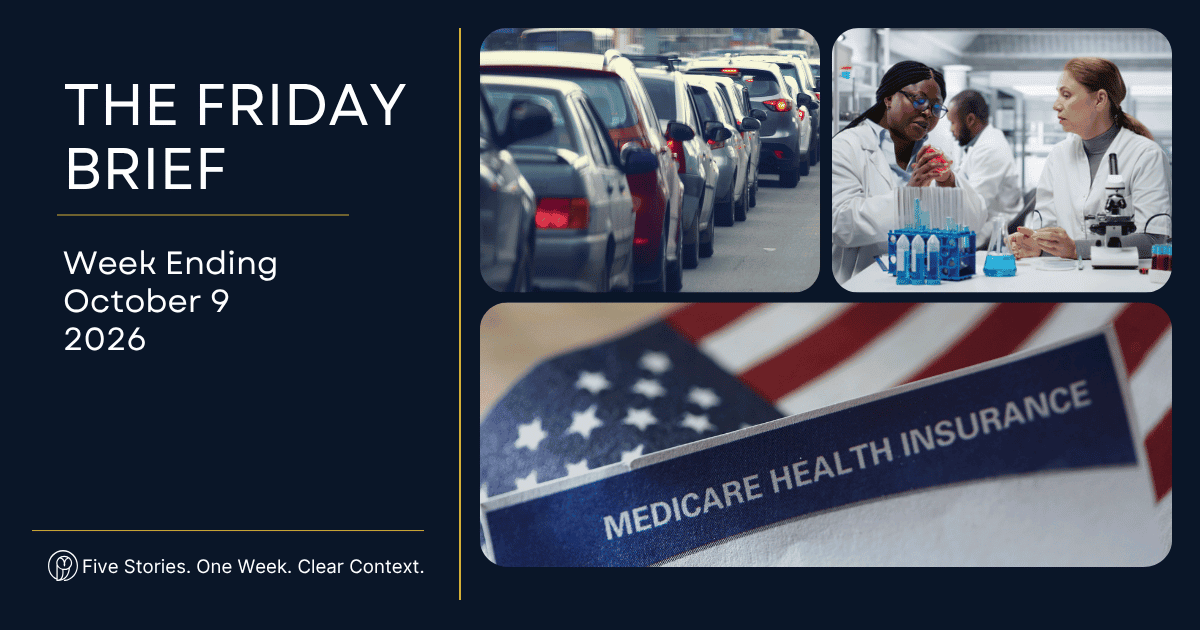
This week, the headlines offered a reminder that decisions made thousands of miles away — or behind closed doors in Washington — can have consequences much closer to home.
The war with Iran is affecting fuel prices and household budgets. A disappointing jobs report sent stocks higher, even as job seekers faced a more difficult market. President Trump’s remarks about American cities sparked controversy, while a new Medicare payment raised questions about what meaningful healthcare relief actually looks like. And changes to federal science funding could shape discoveries for years to come.
Five stories, five different issues, and one question connecting them: What do these developments actually mean for the people living with their consequences?
Here’s what mattered this week, and why.
1. The Iran War Reached Your Gas Pump — and Your Grocery Bill
What’s Happening: The war with Iran is putting renewed pressure on global energy supplies. Attacks on oil tankers near the Strait of Hormuz have intensified, disrupting one of the world’s most important shipping routes. Oil prices climbed again this week.
The G7 agreed to coordinate the release of 100 million barrels of emergency oil and fuel reserves over four months, although some of those supplies were already scheduled for release. The move is intended to ease pressure on energy markets as attacks near the Strait of Hormuz continue to disrupt shipping.
Why It Matters: You don’t have to follow international politics to feel the consequences of this war. Diesel powers the trucks that deliver groceries, the equipment farmers use to harvest crops, and much of the machinery that keeps goods moving. When fuel becomes more expensive, businesses face higher costs, some of which eventually reach consumers.
Emergency fuel reserves may provide temporary relief, but they cannot eliminate the uncertainty created by attacks on shipping. The longer the disruptions continue, the harder it becomes to keep those costs from reaching American households.
A Familiar Financial Squeeze
For Americans who remember the years leading up to the 2008 financial crisis, today’s rising fuel and grocery costs may feel uncomfortably familiar. During the George W. Bush administration, gasoline prices climbed as the Iraq War continued, although growing global oil demand and limited supplies were major drivers of the increase.
Under President Biden, gasoline briefly exceeded $5 a gallon in 2022 as the world recovered from COVID-19 and Russia invaded Ukraine. Prices subsequently declined as demand eased and supplies improved.
Today, the war with Iran is again disrupting global energy markets. These are different crises with different causes, but they share one consequence: families paying more for everyday necessities and having less money left over for everything else.
Good to Know: Why Hormuz Matters
The Strait of Hormuz is a narrow waterway between Iran and Oman through which roughly one-fifth of the world’s oil consumption normally passes. Think of it as a major highway for the global oil supply. When that highway becomes dangerous, shipments slow, insurance becomes more expensive, and oil prices can rise.
That’s how a conflict thousands of miles away can eventually affect what you pay at the gas station and supermarket.
2. The Jobs Report Was Weak — and Markets Went Up Anyway
What’s Happening: The September jobs report showed the U.S. economy added just 29,000 jobs, far below the roughly 90,000 economists expected. Unemployment edged up to 4.2%, and revisions to earlier reports erased approximately 60,000 previously estimated jobs.
Yet Wall Street rallied. Investors interpreted the weaker numbers as a sign that the Federal Reserve might hold off on another interest rate increase, making stocks more attractive.
Why It Matters: Here’s the strange part: what’s reassuring to investors isn’t necessarily good news for someone looking for work. Higher interest rates make borrowing more expensive, so investors welcomed the possibility that the Fed might pause.
But for job seekers, the picture is less encouraging. Employers aren’t laying off workers in large numbers, yet many aren’t hiring aggressively either. Economists call this a low-hire, low-fire economy. If you already have a job, that may offer some reassurance. If you’re trying to find one, the search could take longer.
Good to Know: Why Jobs Numbers Change
The government’s first employment report is an estimate, not a final count. As additional information arrives from employers, the Bureau of Labor Statistics revises its figures. Sometimes the numbers go up; sometimes they go down.
Revisions aren’t automatically evidence that someone manipulated the data. They’re part of how economists build a more complete picture of the labor market.
3. Trump’s Los Angeles Remark: What He Said and Why It Matters
What’s Happening: At an October 5 rally in Nebraska, President Trump defended rising gasoline prices resulting from the war with Iran, calling them a small price to pay for keeping America safe.
Then he made a remark that sparked national controversy: “Let them take out Los Angeles. Let them take out San Diego.” Some audience members applauded. California Governor Gavin Newsom condemned the remarks.
The White House said Trump was warning about the consequences of Iran potentially acquiring nuclear weapons, not encouraging an attack on American cities. Trump subsequently reiterated that explanation, including in remarks on October 8.
Why It Matters: Words matter, particularly when they come from the commander in chief during wartime. FactCheck.org and PolitiFact reviewed the full speech and found that Trump appeared to be arguing that higher gasoline prices were worth paying to prevent a future attack on American cities.
But that doesn’t erase the controversy over how he expressed it. His remarks also raised questions about Iran’s actual ability to strike the United States, a threat experts have not established as imminent.
The larger issue is how Americans distinguish what a president says, what he intends, and what the evidence supports. Context can explain a statement without making the words themselves irrelevant.
There’s another detail worth considering: the audience applauded. That doesn’t necessarily mean those cheering wanted harm to come to Los Angeles or San Diego. In group settings, people sometimes respond to a speaker’s tone or the reactions of those around them without stopping to consider the literal meaning of the words.
Psychologists call this social conformity. It raises an interesting question: Were people cheering because they agreed with what Trump said, or simply because everyone around them was cheering?
4. A $90 Medicare Payment — But Not for Every Senior
What’s Happening: The Trump administration is distributing a one-time $90 payment to approximately 20.8 million people enrolled in Original Medicare Part B, using money from the Medicare Improvement Fund.
Eligible recipients should receive the money automatically through direct deposit or a mailed check. However, millions of other Medicare beneficiaries, including those enrolled in Medicare Advantage plans, are excluded.
For Medicare recipients: If you’re unsure whether you qualify, call 1-800-MEDICARE (1-800-633-4227). Never provide your Medicare number or banking information to someone who contacts you unexpectedly promising to arrange a payment.
Why It Matters: For seniors living on fixed incomes, $90 can provide welcome relief. But a one-time payment doesn’t necessarily make healthcare more affordable. Monthly premiums, prescription costs, and doctor visits continue long after the money is spent. Someone paying a $50 specialist copay could use the entire payment in just two appointments.
There’s also a larger question about how the government spends money intended for Medicare. The payment comes from a fund originally established to support improvements to the program. Giving money directly to seniors provides immediate assistance, but it also means those dollars aren’t available for other Medicare improvements unless additional funding is provided.
With the midterm elections approaching, the timing has attracted political attention. The administration describes the payments as relief for seniors, while critics question whether temporary assistance addresses the underlying cost of healthcare.
Civics Connection: A Fund Created in 2008
Congress established the Medicare Improvement Fund in 2008 to support improvements to Original Medicare. Interestingly, the Congressional Budget Office reported that, as of 2023, Medicare officials had never directly spent money from the fund, although Congress had repeatedly added and removed funding over the years.
The Trump administration is now using approximately $2 billion from that fund for one-time payments to eligible seniors. This isn’t the creation of a new Medicare benefit, nor does it mean the entire fund is being eliminated.
The question worth asking: Is a one-time payment the best use of money set aside to improve Medicare, or could those resources do more to reduce healthcare costs over time?
5. Who Gets to Decide the Future of American Science?
What’s Happening: The Trump administration is proposing significant changes to how the federal government supports scientific research. At a White House science summit this week, officials announced new initiatives emphasizing artificial intelligence, partnerships with private companies, and alternative ways of funding researchers.
Meanwhile, reporting has raised questions about money already approved for scientific research. The National Science Foundation reportedly carried over approximately $1.4 billion rather than awarding it during the previous fiscal year. The agency maintains that the money remains available for administration priorities under existing funding rules.
Why It Matters: Scientific discoveries often begin long before anyone knows whether they will become profitable. Universities and publicly funded laboratories conduct research that can eventually contribute to new medicines, safer technology, and advances in agriculture and energy.
The administration argues that new funding models and private partnerships can accelerate discoveries and reduce bureaucracy. Critics worry that shifting resources away from traditional research grants could leave important but less commercially attractive projects behind.
The question isn’t whether private companies should help fund science. They already do. It’s whether the government can change how research is funded without weakening the independent scientific work that has helped make American innovation possible.
Civics Connection: Who Controls Research Funding?
Congress decides how much federal money to appropriate for scientific research, while agencies such as the National Science Foundation decide how to distribute grants within the law.
Presidents can establish research priorities, but their authority to redirect congressionally approved funding has limits. The current dispute raises a familiar constitutional question: Where does presidential discretion end and Congress’s power over federal spending begin?
Stories That Almost Made It
The Supreme Court Takes Up a Major Climate Case
On October 5, the justices heard arguments about whether federal law prevents state and local governments from suing oil companies over climate-related damages. The case could determine whether communities can pursue compensation for costs associated with climate change. A ruling is expected later in the Court’s term.
Disaster Relief Becomes an Election-Year Controversy
An Associated Press investigation examined President Trump’s references to disaster assistance alongside political endorsements and election outcomes. Critics worry that disaster aid could become politicized, while the White House disputes that characterization.
The broader question is whether emergency assistance is being distributed according to need, regardless of how a state votes.
What to Watch
Hurricane Isaias Heads Toward the Gulf Coast
Hurricane Isaias strengthened to Category 2 on Thursday, with landfall forecast for late Friday or early Saturday along the northern Gulf Coast. Forecasters warn of dangerous storm surge, flooding, damaging winds, and possible tornadoes.
The storm has also disrupted offshore oil production, potentially adding pressure to already strained energy markets.
A Mysterious Death at Russia’s Plague Laboratory
A 28-year-old researcher at a Siberian institute studying dangerous infectious diseases died after developing pneumonia of unknown origin. Russian authorities insist there is no outbreak and say thousands of tests have found no dangerous pathogens.
But the World Health Organization is asking for more information about her death and the precautionary quarantines that followed.
Health experts currently consider the risk of a wider outbreak low. The bigger question is transparency: When a potentially dangerous infectious disease is involved, how quickly should governments share information with the rest of the world?
One Final Thought
This week’s news offers an important distinction: a headline tells us what happened, but understanding the consequences takes a little more work.
A rising stock market doesn’t necessarily mean workers are thriving. A payment to seniors doesn’t automatically make healthcare more affordable. And a change in government spending can have effects long after the announcement fades from the news.
That’s why we look beyond the headlines — not to tell you what to think, but to give you the context to decide for yourself.
Stay curious. Keep asking questions. And we’ll see you next Friday.
Sources & Further Reading
Story 1 — Iran War and Energy Prices
Reuters — G7 Emergency Oil Reserves | U.S. Energy Information Administration — Strait of Hormuz
Story 2 — September Jobs Report
Bureau of Labor Statistics — September Employment Report
Story 3 — Trump’s Los Angeles Remarks
Los Angeles Times — Nebraska Rally Remarks | Washington Post — Subsequent Explanation
Story 4 — Medicare’s $90 Payment
CMS — Official Rebate FAQ | Congressional Budget Office — History of the Fund
Story 5 — Federal Science Funding
National Science Foundation — New Research Initiatives | American Institute of Physics — Research Funding and Carryover
Stories That Almost Made It
Supreme Court — October 5 Climate Case | Associated Press — Disaster Relief and Elections
What to Watch
National Hurricane Center — Hurricane Updates | Reuters — Russian Laboratory Investigation


No discussions yet
Be the first to join the discussion and share your thoughts with the community.