
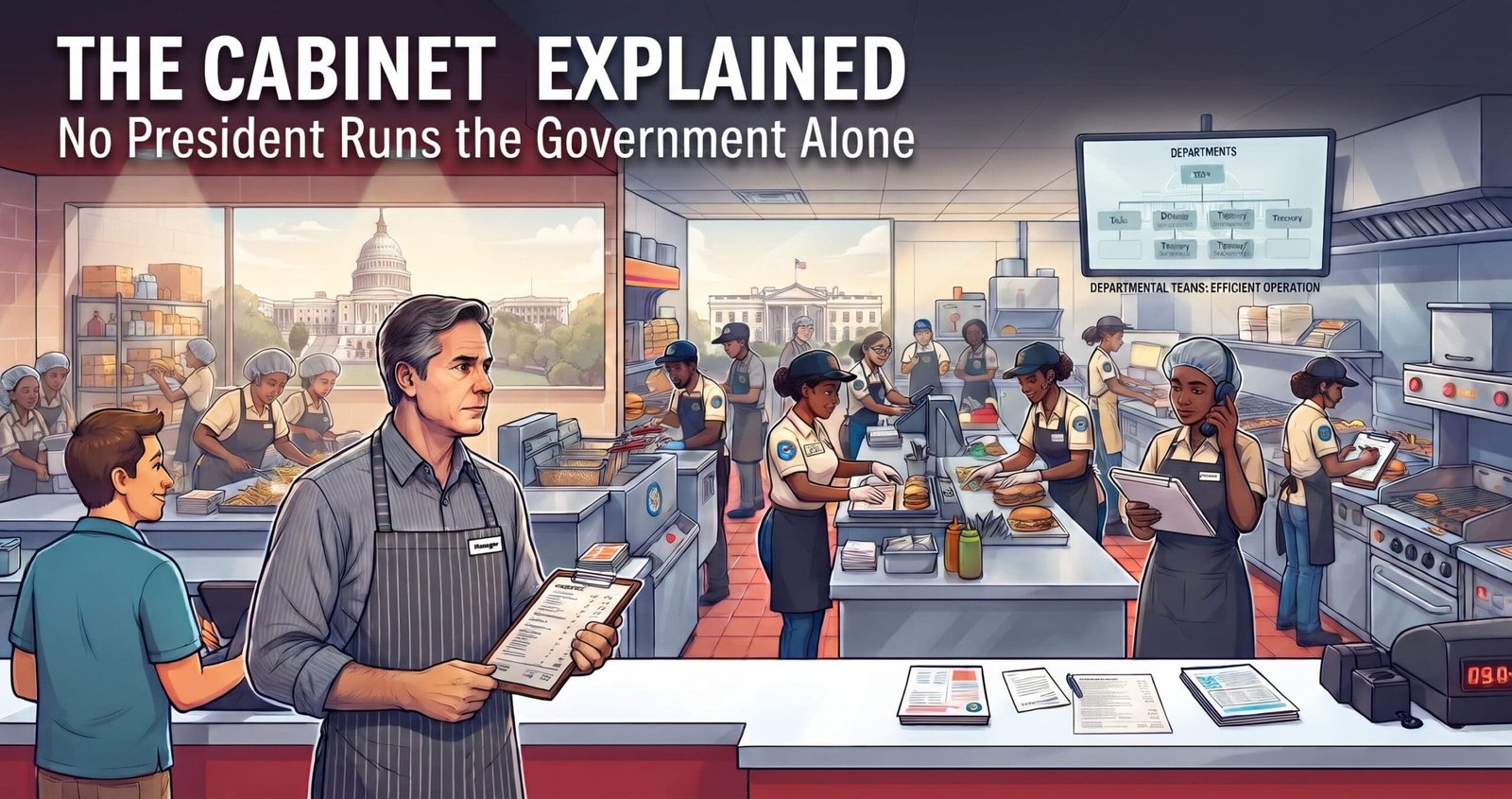
The Fast-Food Lesson in Running a Country
Have you ever wondered how McDonald’s or KFC gets your hot, fresh food to the counter within a couple of minutes of ordering?
It feels effortless — you order, you pay, food appears. But behind the counter, there’s a massive, mostly invisible operation at work. Somebody buys the potatoes. Somebody inspects the chicken for safety. Somebody balances the company’s books. The person handing you your fries isn’t doing all three jobs at once, because no one person could.
Now scale that up.
If a multibillion-dollar fast-food chain can’t be run by one person, how could one person run a country of more than 340 million people?
When a crisis strikes — an economic downturn, a national security threat, a public health emergency — the President can’t handle every part of the response alone. That is why every modern President depends on the Cabinet.
We hear these titles in the news all the time: Secretary of State, Attorney General, Secretary of Defense, Treasury Secretary. But who are these people, really? Are they presidential advisers, or are they government managers running enormous departments?
The answer is: they’re both.
The President Can’t Run the Government Alone
The Constitution divides the federal government into three branches:
- Legislative branch (Congress): makes the laws
- Executive branch (led by the President): carries out and enforces the laws
- Judicial branch (the courts): interprets the laws and resolves legal disputes
The President sits at the top of the executive branch, but the work of the federal government is far too large and complicated for one person to manage. So that work is divided among departments and agencies. The 15 major executive departments are each headed by a Cabinet secretary, except the Department of Justice, which is headed by the Attorney General.
What Is the Cabinet?
Here’s something that surprises a lot of people: the Constitution never actually creates a “Cabinet.” The word doesn’t appear anywhere in it.
What the Constitution does say, in Article II, is that the President “may require the Opinion, in writing, of the principal Officer in each of the executive Departments.”
In plain English: the President can ask the people running executive departments for their advice. That’s it. No Cabinet meetings mandated, no table in the Roosevelt Room guaranteed. That small provision eventually helped give rise to something much larger — and it started with a president facing an impossible job.
George Washington had to build an executive branch from scratch, with no manual and no precedent. So he leaned on some of the strongest minds he could find — including Secretary of State Thomas Jefferson and Treasury Secretary Alexander Hamilton.
If you’ve seen the Broadway musical Hamilton, you already know these two did not exactly get along. The musical turns their political fights into rap battles; the real Jefferson and Hamilton fought over many of the same issues, the national debt, banking, foreign alliances, and how powerful the new federal government should be.
Their disagreements weren’t just personality clashes. Jefferson envisioned a more limited federal government rooted in an agricultural republic. Hamilton wanted a stronger national government, a national financial system, and policies that encouraged commerce and industry. Their competing visions helped shape America’s first political parties.
Washington didn’t simply tune them out. He kept both men close and listened to competing arguments before making his own decisions. Those early meetings helped establish a practice that eventually became an institution: the President’s Cabinet.
One thing has changed dramatically since Washington’s day. The permanent heads of today’s 15 executive departments are nominated by the President and must be confirmed by the Senate. And when one of those positions becomes vacant, federal law can allow another official to serve temporarily in an acting capacity, more on that in a bit.
Who Is in the Cabinet?
Today, the core Cabinet includes the heads of 15 executive departments, each responsible for a major part of the federal government:
| Department | What It Oversees |
|---|---|
| State | Diplomacy, foreign relations, and U.S. embassies abroad |
| Treasury | Federal finances, taxes, currency, and public debt |
| Defense | The military and national defense |
| Justice | Federal law enforcement, including the FBI, and federal prosecutions |
| Interior | National parks, public lands, natural resources, and many federal responsibilities involving tribal nations |
| Agriculture | Farming, food programs, rural development, and some food-safety inspections |
| Commerce | Business, trade, the Census, patents, and economic data |
| Labor | Workplace protections, labor statistics, and job-training programs |
| Health and Human Services | Medicare, Medicaid, public health, medical research, and the FDA |
| Housing and Urban Development | Housing assistance, fair-housing enforcement, and community development |
| Transportation | Highways, aviation, rail, transit, and transportation safety |
| Energy | Energy policy, energy research, and the nation’s nuclear weapons programs |
| Education | Federal student aid, education funding, and enforcement of federal education laws |
| Veterans Affairs | Health care, benefits, and services for military veterans |
| Homeland Security | Border and transportation security, immigration enforcement, disaster response, cybersecurity, and other homeland-security responsibilities |
There’s one oddball worth remembering: the Department of Justice is the only one of the 15 whose leader isn’t called a secretary. Its leader is the Attorney General.
Presidents may also give Cabinet-level status to other senior officials — the White House Chief of Staff, for example. Exactly who gets that status can change from one administration to another. These officials may participate in Cabinet meetings, but they do not become heads of one of the 15 executive departments.
📜 Did You Know? The Cabinet Is Part of Presidential Succession
Cabinet secretaries aren’t only department heads. Eligible Cabinet members are also part of the presidential line of succession.
The Vice President comes first, followed by the Speaker of the House and the president pro tempore of the Senate. After them come eligible Cabinet officials, beginning with the Secretary of State and continuing roughly in the order their departments were created.
It is an unlikely scenario, but it shows just how significant these positions are: under extraordinary circumstances, a Cabinet secretary could become President.
What Does the Cabinet Actually Do?
This is the most important part of understanding the Cabinet. A Cabinet member’s job generally involves two very different responsibilities: advising the President and running a huge part of the federal government.
1. Advise the President
When a crisis strikes, the President turns to the Cabinet.
A national security crisis might bring in the Secretaries of State and Defense. An economic crisis puts the Treasury Secretary at the center. A major disease outbreak makes the Secretary of Health and Human Services the most important person in the room.
But Cabinet secretaries don’t necessarily arrive as the country’s foremost experts on every issue their departments handle. Instead, they sit at the top of organizations packed with career officials and specialists — diplomats, scientists, economists, lawyers, doctors, military leaders, engineers — and part of their job is pulling all that knowledge up into presidential decision-making.
And Cabinet officials don’t always agree. That’s not a bug; it’s often the design.
A President may hear competing recommendations because departments have different responsibilities. The Secretary of State might emphasize diplomatic consequences while the Secretary of Defense focuses on military considerations and the Treasury Secretary counts the economic costs.
Washington wasn’t the only President to see value in keeping strong, competing voices in the room. Decades later, Abraham Lincoln famously built a Cabinet that included several of his former political rivals — men with strong personalities, competing ambitions and very different ideas about how to govern.
That raises an interesting question: What can a President’s Cabinet tell us about the President?
We’ll explore that more deeply in How to Judge a President’s Cabinet: A Guide in Why It Matters. For now, the important point is that disagreement inside a Cabinet isn’t necessarily a sign that something has gone wrong. Sometimes, competing advice is exactly what a President needs before making the final call.
The Cabinet doesn’t make the final decision. The President does. Its advisory role is to help make sure that decision is informed by the people and departments responsible for carrying it out.
2. Run Executive Departments
Here’s the part people sometimes miss: a Cabinet secretary isn’t just an adviser. Each one is essentially the top political leader — the CEO — of an enormous government organization.
The Secretary of Transportation, for example, doesn’t personally pave roads or direct air traffic. The secretary leads a department containing agencies such as the Federal Aviation Administration and helps set priorities for federal programs touching aviation, highways, railroads and transit.
The same principle applies throughout the Cabinet. The Secretary of Health and Human Services oversees everything from Medicare and Medicaid to disease prevention and medical research. The Secretary of State runs a worldwide diplomatic operation. The Secretary of Defense sits atop the civilian leadership of one of the largest organizations on Earth.
That means Cabinet secretaries occupy an unusual position. They sit between presidential priorities and the institutions responsible for turning federal law and policy into action. Laws written in Washington become real services in your town because of the machines these people run.
How Does Someone Become a Cabinet Secretary?
You can’t apply for a Cabinet position online, and you can’t walk into the White House and ask for the job.
Cabinet secretaries wield enormous influence over federal policy and oversee departments with thousands of employees and billions — sometimes hundreds of billions — of dollars in federal spending. So the Constitution builds both the President and the Senate into the process. It generally works like this:
Step 1: The President Nominates
The President chooses someone to lead the department, usually after a White House vetting process that digs into backgrounds, finances and past statements.
There is no single résumé required for the job. Presidents may weigh subject-matter expertise, management experience, government service, policy views, political relationships, and whether the nominee can carry out the administration’s priorities. That means Cabinet secretaries can come from very different backgrounds — some have spent decades in the field they will oversee, while others arrive from business, politics, law, the military, academia or state government.
Ultimately, however, the choice belongs to the President.
Step 2: The Senate Holds Hearings
Choosing someone isn’t enough. The Constitution gives the Senate an important role through its power of advice and consent.
The nomination is usually referred to the Senate committee responsible for that department — the Foreign Relations Committee for State, the Armed Services Committee for Defense, and so on. The nominee typically appears at a public confirmation hearing, where senators of both parties can question them about:
- their professional background and qualifications
- financial interests and potential conflicts of interest
- their policy views and plans for the department
- previous statements or actions
- how they would handle major problems facing the agency
These hearings can be routine, contentious or somewhere in between. They also give senators — and the public — a rare, televised look at how a nominee intends to approach the job before they’re handed enormous power.
Step 3: The Senate Votes
After the committee considers the nomination, it can be sent to the full Senate, which votes on whether to confirm. A simple majority of senators voting is enough for confirmation, provided a quorum is present. If the vote is tied, the Vice President can cast the deciding vote.
If the Senate rejects the nominee — or if a nominee withdraws before a final vote — the President must choose someone else if the position is to be permanently filled.
Step 4: Taking Office
Once confirmed, the new secretary takes the oath of office and assumes leadership of the department.
But Senate confirmation doesn’t guarantee someone the job for a set number of years. Cabinet secretaries generally serve at the President’s pleasure. A President can remove a secretary without getting the Senate’s permission. A permanent replacement, however, generally must go through the nomination and confirmation process again.
What Happens When There Isn’t a Confirmed Secretary?
Government departments can’t simply stop operating every time a secretary resigns, is fired or leaves office.
Federal law and department-specific succession rules allow certain officials to temporarily perform the duties of a vacant position. That’s why you sometimes hear titles such as “Acting Secretary of Homeland Security” or “Acting Secretary of Defense.” An acting secretary can keep the department functioning while the President selects a nominee and the Senate considers the nomination.
But there are rules governing who can serve and, in many circumstances, how long acting service can continue. Those rules are meant to balance two competing needs: keeping the government running while preserving the Senate’s constitutional role in confirming permanent department leaders.
How Much Power Does the Cabinet Have?
Cabinet secretaries can oversee thousands of employees, help direct enormous budgets, shape federal regulations and influence policies that affect millions of people.
That’s a lot of power.
But here’s the important Civics 101 lesson: a Cabinet secretary doesn’t get to decide independently what the federal government will do. Their authority comes with boundaries, and those boundaries come from several places:
Laws passed by Congress. Congress creates departments and agencies and gives them legal authority — and an agency cannot legally exercise power Congress hasn’t given it. That doesn’t mean the boundary is always obvious. Congress sometimes writes broad laws, and administrations can interpret those laws differently. When people disagree about whether an agency has gone too far, the dispute may end up in court.
Funding provided by Congress. Congress holds what is often called the “power of the purse.” A President or Cabinet secretary can set priorities, but they cannot simply create an unlimited pot of federal money for whatever they want to accomplish. Not a single dime gets spent unless Congress has made the money available by law.
Presidential direction. Cabinet secretaries work within the executive branch, and the President sets the administration’s overall priorities. A new President may direct departments to emphasize different policies while still operating within existing law.
Rules for how agencies act. Departments must follow laws governing how the federal government operates. For example, when agencies create many federal regulations, the Administrative Procedure Act generally requires procedures that can include publishing proposed rules and letting the public comment before a final rule takes effect.
The courts. Federal agency actions can be challenged in court, and courts can determine whether an agency acted within the authority Congress gave it, followed required procedures, or violated the Constitution or other federal law.
Why All These Limits?
At first glance, this can make the federal government look unnecessarily complicated.
Congress passes a law. The President wants it carried out. A Cabinet department implements it. Congress controls the funding. Agencies have to follow procedures. Someone challenges an action. A court gets involved.
Why make governing so difficult?
Because the friction is partly the point.
The American system divides government power among different institutions rather than giving one person or branch complete control. Congress can limit executive authority through legislation and spending decisions. The executive branch carries out the laws. Courts resolve legal disputes about whether government actions stay within constitutional and statutory boundaries.
Sometimes that system slows government down. Sometimes it produces political fights. And sometimes the branches disagree about exactly where one institution’s power ends and another’s begins.
But those disagreements are themselves part of the system of checks and balances. The Founders had watched what concentrated power did to other countries, and they chose a government that argues with itself on purpose — because the alternative was trusting one person to always be right.
Who Watches the Cabinet?
Cabinet secretaries answer to the President, but the President isn’t the only one watching what executive departments do.
Congress has an oversight role. Congressional committees can call Cabinet secretaries to testify, investigate how departments are carrying out federal programs, request documents and examine how taxpayer money is being spent.
That oversight can become contentious, especially when Congress and the President are controlled by different parties. But the basic principle is straightforward: Congress doesn’t stop being involved after it passes a law or approves funding. Lawmakers can keep asking what happened after the executive branch was given the authority and the money to act.
🌱 Blueprint for Hope: Government Is Bigger Than One Person
When the news gets loud and overwhelming, it can sometimes sound as though one President controls everything the federal government does — and could change everything overnight.
The reality is much more complicated, and quietly comforting.
The executive branch spreads responsibility across 15 departments and hundreds of agencies, offices and other components. Behind the political appointees are career employees with specialized knowledge who continue doing much of the government’s day-to-day work as presidents and Cabinet secretaries come and go.
Congress writes laws, controls federal spending and conducts oversight. The Senate confirms Cabinet secretaries and many other senior appointees. Courts can review executive actions when legal disputes arise.
None of that means the President is powerless. Presidents can significantly change federal priorities, policies and enforcement.
But they don’t govern alone — and that’s not an accident. It’s the design.
The American government was built around divided power — and understanding who actually has the authority to do what can make dramatic political headlines a little easier to evaluate.
🧭 Navigating the News: Your Three-Question Civic Filter
The next time you see a headline saying:
“The President orders the Department of ___ to ___.”
Don’t stop at the headline. Run it through three quick questions:
1. Authority: Where does the power come from?
Did Congress give this department legal authority to take that action?
2. Money: Who is paying for it?
Has Congress provided or authorized funding for what the administration wants to do?
3. Courts: Is the action being challenged?
If someone argues that the department exceeded its authority or violated the law, has a court been asked to review it?
You won’t always know the answers immediately. Sometimes lawyers, lawmakers and judges won’t agree on them either.
But asking those questions changes the way you read the news. Instead of simply asking “Can the President do this?”, you begin asking the more useful question:
“What gives the government the authority to do this?”
That shift — from reacting to headlines to interrogating them — is what being an informed citizen actually looks like.
💭 Think About It
Why require Senate confirmation for Cabinet secretaries if the President ultimately controls the executive branch?
What matters more in a Cabinet secretary: expertise in the department’s subject, experience managing a large organization, or agreement with the President’s policies?
Should an acting secretary have all the same authority as someone who has been confirmed by the Senate? Why or why not?
What should a Cabinet secretary do if they believe a President’s order is illegal — or simply a terrible idea?
Final Takeaway
The Cabinet exists because no President — however talented — can personally manage everything the executive branch does.
Cabinet officials wear two hats: they advise the President, and they lead the departments responsible for carrying out much of the federal government’s work. That gives them enormous influence — but not unlimited power.
Congress writes the laws and controls federal spending. The President sets executive priorities. Agencies operate under laws and procedures. Courts review government actions when legal disputes arise.
So when you hear “the administration announced…” or “the President ordered…”, remember that there is an enormous government structure behind those words.
Understanding the Cabinet helps you see who is actually making decisions, who is carrying them out — and who has the power to say no.



No discussions yet
Be the first to join the discussion and share your thoughts with the community.