
📖 New here? This piece builds on our Civics 101 guide, The Cabinet Explained. If you want the two-minute refresher on what Cabinet secretaries actually do, start there.
Opening
Imagine turning on the news tomorrow morning.
The Secretary of War is accused of taking kickbacks. His family’s lavish lifestyle has already raised questions about where the money comes from, and congressional investigators are closing in. Then the story gets stranger: the secretary races to the White House, hands the president his resignation, and bursts into tears, apparently hoping he has quit just in time to avoid impeachment.
Congress impeaches him anyway.
Now imagine another administration. This time, the Secretary of the Interior secretly hands valuable federal oil rights to businessmen he knows. One of those businessmen later gives him hundreds of thousands of dollars in cash and bonds; another has $100,000 in cash delivered in a small bag. The secretary eventually goes to prison.
Then, a few decades later, the nation’s chief law-enforcement officer — the Attorney General of the United States — becomes involved in covering up a political burglary connected to the president’s reelection campaign. He goes to prison too.
None of this is hypothetical. These were real members of real presidential administrations. And if they sound like scandals built for cable news, congressional hearings and social media, imagine what they looked like when Americans had newspapers, radio and eventually television carrying the story.
Cabinet secretaries rarely become household names. Most Americans probably couldn’t name all 15 if there were money riding on it. But occasionally, one becomes famous for all the wrong reasons. And when that happens, Americans don’t remember only the secretary.
They remember the president who put that person in the room.
1. The Only Cabinet Secretary Ever Impeached
William Belknap had a problem.
President Ulysses S. Grant’s Secretary of War earned $8,000 a year. Yet Belknap and his family were known in Washington for expensive clothes, elaborate parties and a lifestyle that made people wonder how the math worked. Eventually, Congress started wondering too — and the answer was not good. (U.S. Senate)
Belknap controlled appointments connected to military trading posts in the West. These posts could be extremely profitable because soldiers stationed far from major towns depended on them for goods. Investigators discovered that a businessman named Caleb Marsh had arranged to receive payments from one of these lucrative posts — and part of that money made its way to the Belknap family. Over several years, the payments totaled more than $20,000, several times Belknap’s annual government salary in the 1870s.
And then came March 2, 1876.
Imagine this happening today. Congressional investigators have evidence that a sitting Cabinet secretary has been receiving money connected to government business. Impeachment is coming, reporters are chasing the story, and just minutes before the House is scheduled to act, the Cabinet secretary races to the White House.
Belknap handed President Grant his resignation and burst into tears. Grant accepted it. If this happened now, your phone would light up before Belknap made it back out the White House gate — BREAKING: CABINET SECRETARY RESIGNS AS HOUSE PREPARES IMPEACHMENT VOTE — with reporters outside his home, live shots from Capitol Hill, legal analysts debating whether resignation could stop impeachment, and approximately nine million people on social media suddenly claiming expertise in the Constitution. But 1876 Washington had newspapers and telegraphs rather than cable television and X, though the political explosion was still very real.
Congress essentially said: nice try.
The House unanimously approved five articles of impeachment anyway, and the language Congress used wasn’t exactly delicate. Belknap was accused of having “basely prostituted his high office” for private gain. (U.S. Senate) The Senate then had to answer a fascinating constitutional question — can you impeach someone who has already resigned? It decided that it could, and held a trial. More than 40 witnesses testified, and newspapers filled with stories of bribery, perjury and coded messages. When senators finally voted, a majority found Belknap guilty on all five articles — but not the two-thirds majority required by the Constitution to convict him. One major reason was the jurisdiction question: some senators weren’t convinced the Senate should be trying someone who was no longer in office. (U.S. Senate)
So Belknap escaped conviction. He did not escape history. He remains the only Cabinet secretary ever impeached by the House of Representatives.
Why This Was Such a Big Deal
This wasn’t simply a government employee taking money under the table. The Secretary of War was one of the most powerful officials in the federal government — the department responsible for the U.S. Army. And the scandal landed during an administration already struggling with accusations of corruption; the Senate’s own historical account describes Grant’s administration as “scandal-tarnished.” (U.S. Senate)
That’s the part worth understanding. Cabinet scandals don’t stay neatly attached to Cabinet secretaries. The president chose them, the president trusted them with enormous power, and when something goes spectacularly wrong, Americans inevitably start asking another question: what did the president know about the people working for him — and why were they there in the first place?
Belknap was bad. But compared with what happened about 50 years later? Get the popcorn. Because next comes Teapot Dome.
2. Teapot Dome: The Scandal Before Watergate
Warren G. Harding’s administration was about to give America a scandal so notorious that, for decades, “Teapot Dome” was shorthand for corruption in Washington — Watergate hadn’t happened yet. (National Archives) And the story begins with oil.
First: What Exactly Was Teapot Dome?
After World War I, the federal government controlled several huge oil reserves — think of them as an emergency savings account for the U.S. Navy: oil kept underground so the military would have fuel if the country needed it. One of those reserves was near a teapot-shaped rock formation in Wyoming, hence the rather adorable name for a spectacularly ugly scandal. The reserves were enormously valuable; surveys estimated the three naval reserves combined held 435 million barrels of oil, worth hundreds of millions of dollars at the time. (U.S. Senate)
President Harding transferred control of those reserves from the Navy Department to his Secretary of the Interior, Albert Fall. That decision would come back to haunt him.
Enter Albert Fall
Fall wasn’t some random bureaucrat Harding barely knew. The two men had served together in the Senate and were friends; the Senate Historical Office describes them bonding over whiskey and poker games before Harding eventually put Fall in his Cabinet. (U.S. Senate)
Then Fall got control of the oil. In April 1922, he gave his friend Harry Sinclair, head of Sinclair Oil, an exclusive lease to drill at Teapot Dome. There was no competitive bidding, and Fall wasn’t exactly eager for anyone to know about it — he locked the contract in his desk and told an assistant to keep quiet. (U.S. Senate) Imagine that story breaking today: SECRET DEAL: INTERIOR SECRETARY GIVES FRIEND EXCLUSIVE ACCESS TO FEDERAL OIL RESERVE.
The Reporters Find the Deal
On April 14, 1922, The Wall Street Journal put the secret lease on its front page. The Denver Post called it “one of the baldest public land-grabs in history.” Independent oil producers were furious — why had Sinclair gotten access to government oil without anyone else even getting a chance to bid? — and Congress started asking questions. (U.S. Senate)
And this is where the story gets wonderfully strange. Senator Robert La Follette, a Republican pushing for an investigation, became even more suspicious after someone ransacked his Senate office. (U.S. Senate) Seriously: a secret oil deal, friends of the Cabinet secretary, no bidding, and a senator’s office gets ransacked.
We’re still not at the best part.
Then Someone Asked the Obvious Question
The Senate eventually handed much of the investigation to Montana Senator Thomas Walsh, and the question confronting investigators was wonderfully simple: How did Albert Fall suddenly get so rich? Before joining Harding’s administration, Fall had serious financial problems — his New Mexico ranch was run-down and he was a decade behind on property taxes. Then suddenly he had money. He paid his back taxes, bought additional property, and started making substantial improvements to his ranch. (U.S. Senate) Investigators followed the money, and that’s when they found the bag.
Yes. There Was Literally a Bag of Cash.
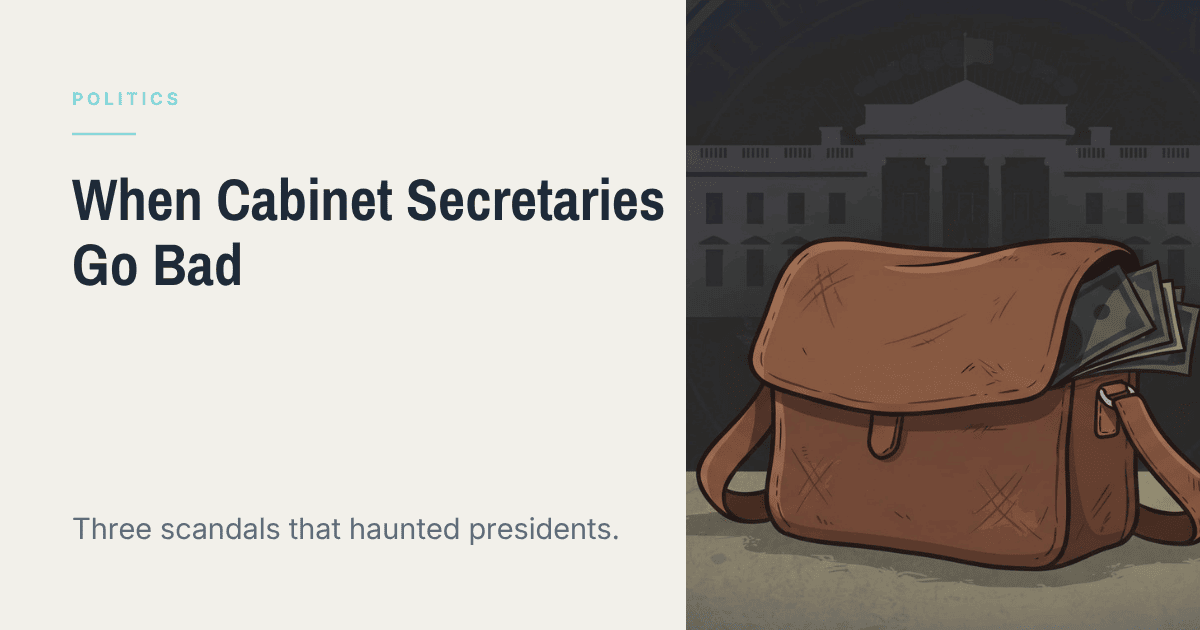
Oilman Edward Doheny had received another valuable federal oil lease from Fall. Doheny eventually testified that he had instructed his son to deliver $100,000 in cash to Fall — in a little brown satchel. Doheny called it a loan; Fall had concealed it. And $100,000 in 1921 wasn’t pocket change — the Senate estimates it was worth well over $1 million in today’s money. (U.S. Senate)
But there was more. Investigators also uncovered $269,000 in Liberty Bonds and cash from Harry Sinclair, arriving about a month after Sinclair received the Teapot Dome lease. (U.S. Senate)
Now imagine being President Harding. You put your poker buddy in charge of the Interior Department. You transfer enormously valuable government oil reserves into his control. He secretly gives drilling rights to private oilmen. Then investigators discover that those oilmen have given your Cabinet secretary enormous sums of money — one payment literally arrives in a satchel.
There is no press secretary on Earth who wants that briefing.
And Harding Had Put His Own Name on the Deal
There’s another detail that makes this worse: as questions about the leases grew, Harding didn’t initially distance himself from Fall. In 1922, Harding sent Fall’s lengthy defense of the oil policy to the Senate along with a message saying the policies had been reviewed by him and had “at all times had my entire approval.” (U.S. Senate)
Harding wasn’t convicted of taking Fall’s money, and the evidence uncovered by the Senate did not establish that he participated in Fall’s bribery. But politically, that distinction couldn’t make the scandal disappear. He had appointed Fall. He had transferred control of the reserves. And he had publicly backed the policy. Then Harding died suddenly in August 1923, before the investigation revealed the worst of what had happened. (whitehouse.gov)
The Cabinet Secretary Goes to Prison
The scandal kept unfolding after Harding’s death. The leases were eventually canceled, and Fall was convicted of accepting a bribe and sentenced to a year in prison — the first former Cabinet officer in American history to be sent there. (U.S. Senate) But Teapot Dome didn’t go to prison with him. It stayed attached to Warren Harding.
That’s why this story matters. A president doesn’t have to personally carry the bag of cash for a Cabinet scandal to become part of his presidency. Harding chose Albert Fall, trusted him with enormously valuable public resources, and Fall betrayed that trust spectacularly. Nearly a century later, we are still talking about Warren Harding’s Teapot Dome scandal. Not Albert Fall’s.
🔑 Why It Matters
Cabinet appointments can feel like Washington inside baseball: confirmation hearings, résumés, committee votes and names most Americans will forget within a few months. Teapot Dome shows why they aren’t. The person running a federal department may control public land, government contracts, law enforcement, military decisions or hundreds of billions of taxpayer dollars. Most will never become famous. But choose the wrong person, give them enough power, and someday Americans may remember your presidency because somebody showed up with a bag of cash.
And if you’re thinking surely we’ve reached peak Cabinet scandal — we haven’t. Because next we’re going to the Justice Department, where America’s top law-enforcement official ends up behind bars.
3. The Attorney General Who Became a Criminal Defendant
Teapot Dome involved the man responsible for America’s public lands. This one involved the man responsible for enforcing America’s laws.
The Attorney General is the head of the Justice Department and the federal government’s chief law-enforcement officer. (Department of Justice) So imagine this headline appearing on your phone: FORMER U.S. ATTORNEY GENERAL INDICTED IN CRIMINAL CONSPIRACY CONNECTED TO PRESIDENT’S REELECTION CAMPAIGN. That is essentially where America ended up during Watergate.
And John Mitchell wasn’t merely some Cabinet secretary Richard Nixon happened to appoint. He was Nixon’s friend and former law partner who had managed Nixon’s successful 1968 presidential campaign, whom Nixon then appointed Attorney General in 1969. In March 1972, Mitchell left the Justice Department for another enormously important job: running Nixon’s reelection campaign. (Department of Justice)
Read that sequence again: campaign manager → Attorney General → reelection campaign chairman. That relationship matters for what happened next.
First: What Was Watergate?
If you grew up hearing the word Watergate, you may know it means “Nixon scandal” without knowing what anyone actually did. Here’s the short version. During the 1972 presidential campaign, people working for Nixon’s reelection operation developed a political-intelligence program that, in a scaled-down form, led to break-ins at Democratic National Committee headquarters in Washington’s Watergate complex — including the June 1972 burglary that blew the scandal open. (Senate Select Committee on Intelligence) Yes: bugging the political opposition.
Five men were caught inside. And suddenly, a burglary that might have looked like a bizarre campaign dirty trick started producing a much bigger question: who sent them?
Follow the Burglars Up the Ladder
This is where Watergate stops being a story about five guys breaking into an office. Investigators began pulling at the threads connecting the burglars to Nixon’s reelection organization and people around the White House — and sitting near the top of that political operation was the man who, only months earlier, had been Attorney General of the United States.
Think about how extraordinary that was. This wasn’t merely someone who knew federal law. Mitchell had run the department responsible for enforcing it — and now his own conduct was part of one of the biggest federal criminal investigations of its time.
And Then America Watched It Unfold
There was another enormous difference between Watergate and our first two scandals: television. When the Senate created a special committee to investigate the 1972 presidential campaign, the hearings became a national spectacle, with Mitchell himself entering the Senate Caucus Room to testify. (U.S. Senate) This wasn’t a historian reconstructing a scandal 50 years later — it was happening in people’s living rooms. Witness after witness. Names, money, political espionage, White House officials, and eventually the revelation that Nixon had secretly recorded conversations inside the White House.
The Former Attorney General Goes on Trial
Mitchell’s legal problems eventually became much more serious than a humiliating congressional hearing. He was prosecuted alongside senior Nixon White House officials H. R. Haldeman and John Ehrlichman for their roles in the Watergate cover-up, and in January 1975, all three were convicted. The former Attorney General of the United States — the country’s former chief law-enforcement officer — was now a convicted criminal, and Mitchell ultimately served about 19 months in federal prison.
🔑 And This One Changed the Justice Department
Here’s something I don’t want to lose beneath all the popcorn. Watergate didn’t merely damage Nixon and send powerful people to prison — it changed the government. In 1975, after revelations of serious misconduct by senior Justice Department officials, Attorney General Edward Levi created the Department’s Office of Professional Responsibility, whose job was essentially to police misconduct inside the Justice Department itself. (Department of Justice) Then, in 1976, the Department created its Public Integrity Section, dedicated to prosecuting crimes involving abuses of the public trust by government officials. (Department of Justice)
Think about that. The scandal involving America’s highest-ranking law-enforcement officials became so serious that the Justice Department created new mechanisms to protect itself from misconduct inside the Justice Department. That’s bigger than one crooked Cabinet secretary — that’s a government discovering that one of the institutions responsible for enforcing the rules also needs rules for policing itself.
Why This Was Different
Belknap teaches us what can happen when public office becomes an opportunity for personal enrichment. Albert Fall teaches us what can happen when friendship, government power and private money become tangled together. John Mitchell teaches us something more unsettling: what happens when the people responsible for enforcing the law become entangled in breaking it?
The American system eventually responded. Prosecutors prosecuted, courts convicted, Congress investigated, officials went to prison, and new safeguards followed. But none of that happened automatically. People inside institutions had to investigate other powerful people — including people who had once controlled those very institutions. And Mitchell’s old department would eventually have to investigate a scandal reaching straight into the administration he had served.
That’s why the independence of the Justice Department isn’t some abstract Washington argument. Sometimes the person being investigated might be the person who used to run it.
Why This Matters Right Now
It would be easy to read these stories and think: okay, but nobody is showing up at the Interior Department with a little brown satchel anymore. Probably not. Modern government scandals usually don’t arrive looking like Teapot Dome. The warning signs can be much less cinematic: a nominee whose main qualification appears to be a close relationship with the president; an official who repeatedly brushes aside ethics concerns; an inspector general who says an agency is obstructing an investigation; or a Cabinet secretary who suddenly resigns while Congress is asking questions. None of those things, by themselves, proves corruption. But history gives us a reason to pay attention.
Belknap wasn’t dangerous because he was a Republican. Albert Fall wasn’t dangerous because he played poker with Warren Harding. John Mitchell wasn’t dangerous simply because he was Richard Nixon’s friend. The problem came when personal relationships, political loyalty and enormous government power collided — and the normal guardrails failed to stop it soon enough.
The Cabinet Is Powerful. But It Isn’t Supposed to Be Unchecked.
A president gets to choose the people who will help carry out the administration’s agenda. Elections matter, and presidents are entitled to appoint people who broadly support the policies voters elected them to pursue. But the president doesn’t get the only say. For many senior positions, the Constitution gives the Senate an “advice and consent” role: the president nominates, and the Senate decides whether to confirm — a shared appointment power that is part of the constitutional system of checks and balances.
And there’s an interesting bit of history behind it. Alexander Hamilton — who became the very first Cabinet nominee confirmed by the Senate — argued that Senate involvement could help protect against presidential favoritism and the appointment of people chosen because of family connections, personal attachment or popularity rather than fitness for the job. More than 230 years later, that’s still a pretty useful explanation for why confirmation hearings matter.
They aren’t supposed to be ceremonial job interviews. They’re one of the places where somebody gets to ask: who exactly are we giving this power to?
And Confirmation Isn’t the Last Check
Once a Cabinet secretary takes office, other guardrails remain. Congress can hold hearings and demand information. Inspectors general investigate fraud, waste, abuse and misconduct inside federal agencies — and were deliberately designed with protections for their independence, because oversight doesn’t work very well if the person you’re investigating can simply tell you what you’re allowed to find.
The courts can become involved. Journalists can uncover information the government didn’t volunteer. Whistleblowers can bring misconduct to light. And sometimes the government responds to a scandal by building a new guardrail — as the Justice Department did after Watergate.
That’s an important part of this story. The American system has never depended on finding presidents or Cabinet secretaries who are magically immune to greed, loyalty, ambition or terrible judgment. It assumes human beings are human beings. The protection comes from making it difficult for any one of them to operate without somebody else watching.
So What Should Make Your Ears Perk Up?
Not every resignation is a scandal. Not every disagreement between a president and a Cabinet secretary means democracy is collapsing. And appointing someone a president knows and trusts isn’t automatically suspicious either. Context matters. But history gives us some perfectly reasonable questions to ask when a Cabinet story starts getting weird.
When a Cabinet story starts getting weird, ask:
- Is an inspector general investigating?
- Is Congress requesting documents?
- Are career officials raising concerns?
- Did an official resign immediately after allegations surfaced?
- Is someone trying to interfere with an investigation?
- Are government decisions benefiting someone with a personal or financial relationship to the people making them?
Are the institutions that are supposed to investigate the government still able to do their jobs?
You don’t have to decide someone is corrupt because you saw a dramatic headline. You also don’t have to ignore a dramatic headline because everyone involved insists there’s nothing to see. Watch what happens next.
Join the Discussion
History makes corruption look obvious because we already know how the story ended. A bag of cash looks very different after investigators have followed the money, courts have ruled and historians have had decades to examine the evidence.
But what about while the story is still unfolding?
- When does a conflict of interest become corruption? Is the appearance of a financial conflict enough to concern you, or should there be evidence that a government decision was actually influenced?
- How should we judge foreign gifts or business relationships involving presidents and their families? What safeguards would allow the public to distinguish an ordinary business transaction from an attempt to gain influence?
- What should happen when a president believes an independent government official is doing a bad job? Where is the line between legitimate presidential oversight and using government power to pressure an official into doing what the president wants?
- Who should investigate the people at the top? If allegations involve the president, Attorney General, Cabinet officials or people close to them, which institutions do you trust to investigate — Congress, inspectors general, federal prosecutors, courts, journalists, or some combination?
- Would you apply the same standard if the president belonged to the other political party? What evidence would you want before calling an action corrupt — and would that standard stay the same regardless of who was in office?
- Which warning sign from this article matters most to you? Personal financial benefit? Favoritism toward friends or family? Interference with an investigation? Officials unwilling to challenge the president? Or institutions losing their ability to investigate independently?
One Final Question
Belknap, Fall and Mitchell look obvious to us now because we know the ending.
If another Teapot Dome were happening today, how would we know before somebody opened the bag?




No discussions yet
Be the first to join the discussion and share your thoughts with the community.