
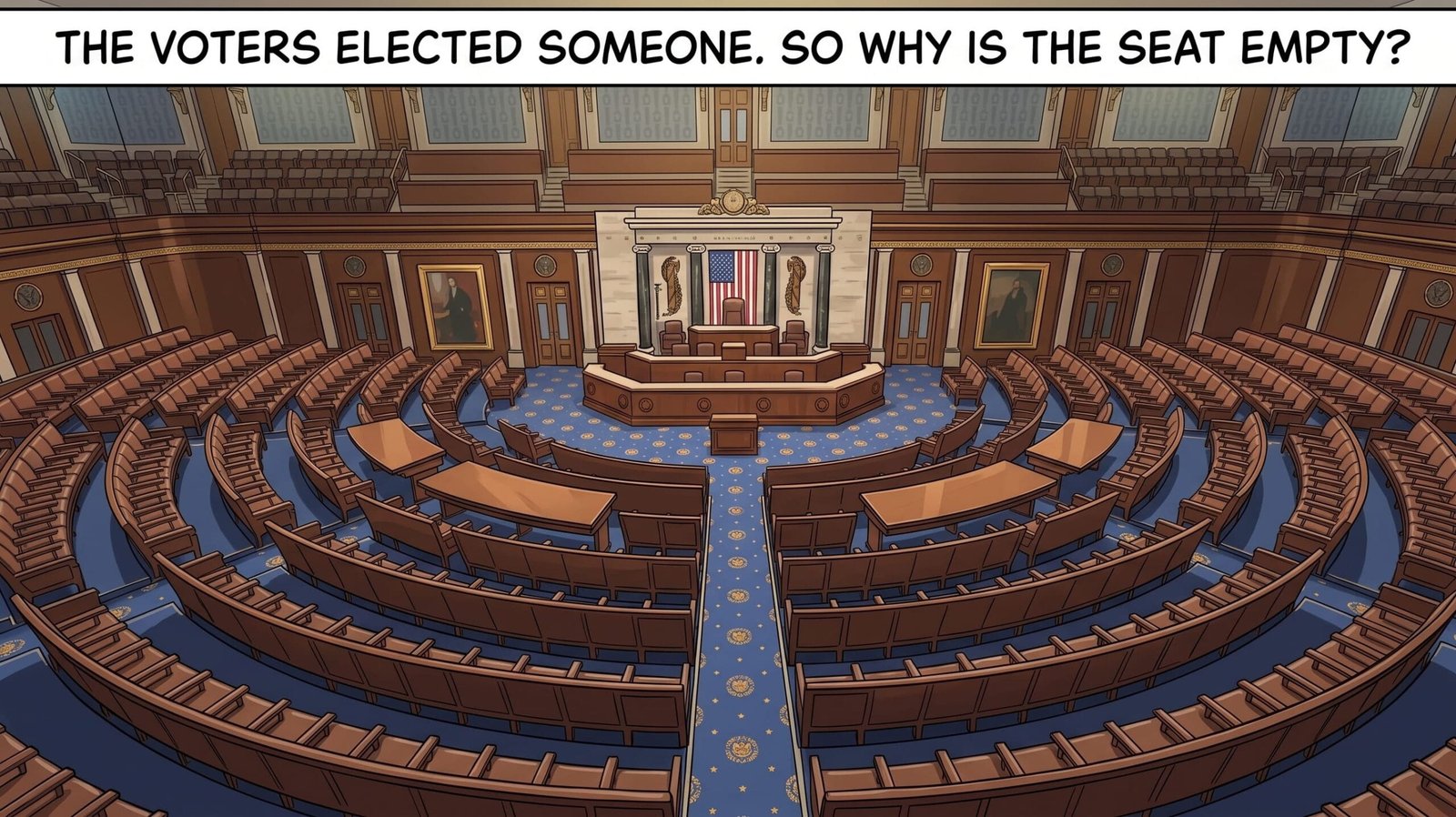
What happens after you vote — and who actually decides who takes office?
Wait, Isn’t Winning the Election Enough?
You cast your ballot, the votes are counted, and eventually the state officially certifies a winner. That person heads to Washington, D.C., takes the oath of office, and becomes your representative in Congress.
Right?
Usually, yes.
For more than two centuries, this handoff has been one of the most reliable rituals in American civic life. We vote, the outcome is verified, and the winner is seated.
But former federal appellate judge J. Michael Luttig has raised an unsettling procedural question in the New Republic: Could outgoing House leadership interfere with the process used to determine which newly elected representatives are present when a new House first organizes?
In other words, could someone win an election, receive official certification from their state — and still be stopped from taking their seat?
We don’t need an exhaustive review of every disputed congressional race since 1789. And we don’t need an impenetrable detour into constitutional arcana.
We simply need to understand what happens between winning an election and actually becoming a member of Congress.
Part I — What Actually Happens After You Elect a Representative?
To understand how the process could be challenged, we first have to understand how it is supposed to work.
Most of us assume that when a new Congress convenes on January 3, the newly elected members simply show up and get to work. But the new House must first organize itself.
The basic process looks like this:
The first two steps are familiar. Voters choose their representative, the votes are counted, and the state eventually certifies the winner.
The next step is the one that matters for this story.
Before the new Congress convenes, the Clerk of the previous House prepares the official roll of representatives-elect. Under federal law, that list is based on election credentials submitted by the states.
When the new House gathers, the Clerk uses that roll as the chamber begins organizing itself. The representatives-elect establish a quorum and elect a Speaker. The Clerk presides until a Speaker is chosen.
The new Speaker then takes the oath and administers the oath to the other representatives-elect.
The important point is that the Clerk is supposed to perform an administrative function, not decide which election winners are politically acceptable. The process is designed to carry the certified election results from the states into the new House.
Why It Matters
We rarely notice procedural rules when they work quietly in the background.
We usually notice them when someone asks:
What happens if somebody doesn’t follow them?
Part II — Wait. Didn’t Something Like This Already Happen?
If this sounds like a theoretical law-school exercise, something happened in late 2025 that shows why the gap between winning an election and actually exercising power matters.
On September 23, 2025, Adelita Grijalva won a special election in Arizona to fill the House seat previously held by her late father, Representative Raúl Grijalva. Arizona officially certified her victory on October 14.
But Grijalva wasn’t sworn in until November 12 — 50 days after the election and nearly a month after certification.
The Adelita Grijalva Timeline
Voters elect Grijalva in Arizona’s special election.
Arizona formally certifies the result.
Grijalva is sworn into office.
Speaker Mike Johnson said the delay was procedural. The House was away from regular legislative business during the government shutdown, and he said Grijalva would be sworn in when the chamber returned.
Critics questioned that explanation. Earlier in the year, two Republican special-election winners had been sworn in while the House was not conducting regular legislative business, and House procedures allowed members to be sworn in during brief pro-forma sessions.
There was also something politically important at stake.
Grijalva had pledged to become the 218th signature on a discharge petition seeking a House vote related to the Epstein records. Democrats accused Johnson of delaying her swearing-in to prevent the petition from moving forward. Johnson denied that accusation.
When Grijalva was finally sworn in on November 12, she immediately signed the petition.
Grijalva was delayed. She was not permanently denied her seat.
And her dispute occurred within an already organized House, with a Speaker and established rules already in place.
Luttig’s warning concerns something different: what could happen before a newly elected House has even organized itself.
Part III — What Is Judge Luttig Warning About?
The Grijalva dispute involved a delay inside an already functioning Congress.
Judge Luttig is warning about a different scenario altogether: what could happen while a newly elected House is still trying to organize itself.
His scenario can be understood in three steps:
The Clerk Prepares the Roll
Before the new House convenes, the Clerk prepares the list of representatives-elect based on election credentials submitted by the states.
Someone Tries to Change the List
Luttig warns that an outgoing House Speaker could attempt to replace the sitting Clerk with someone willing to leave certain certified representatives-elect off the opening roll.
The New House Organizes Without Them
If those representatives-elect were excluded from the opening proceedings, they could be prevented from participating in the initial quorum call and the vote for Speaker.
And in an extremely close House, leaving out even a few members could change who has enough votes to elect the Speaker.
That is the vulnerability Luttig is highlighting.
He is not saying this is normal procedure. He is not saying it would clearly be legal. And he is not saying it is certain to happen.
The House has to organize before it can fully function. If someone interfered with the administrative process used to organize it, what would stop them?
That brings us to the most important question:
Could they really do that?
Part IV — Could They Really Do That?
This is where we need to separate “someone could try this” from “someone has the legal authority to do this.”
They are not the same thing.
Not every election-law expert agrees that Luttig’s scenario could succeed. Some argue that because each new House is constitutionally distinct from the one before it, an outgoing Speaker or temporary Clerk could create a serious dispute but could not ultimately dictate the membership or leadership of the incoming House. Read further here: Bush-Appointed Judge Warns of Another Jan.6 After Midterms.
There are reasons Luttig believes the opening of a new House deserves attention:
| Why Luttig Says the Risk Is Real | What Stands in the Way |
|---|---|
| The Clerk’s opening roll helps determine who participates when the House first organizes. | States formally certify congressional election winners. |
| The dispute would happen before the new House has fully organized and elected a Speaker. | Federal law governs how the Clerk prepares the opening roll. |
| In a closely divided House, excluding even a few members could affect who becomes Speaker. | The Constitution gives the House itself authority to judge the elections, returns, and qualifications of its members. |
| The opening process depends on officials carrying out their assigned duties. | Courts could be asked to intervene if certified representatives-elect were excluded. |
In other words, Luttig is not pointing to a secret legal power that allows congressional leaders to erase election results.
He is pointing to a procedural vulnerability that could create a constitutional confrontation if someone were willing to disregard the rules governing the process.
And that raises a different problem entirely.
What if someone simply ignores the rules?
Part V — What If Someone Simply Ignores the Rules?
If the legal barriers are so significant, why worry about this at all?
A state can certify an election. Congress can establish procedures. A court can issue an order. But constitutional government ultimately depends on public officials following those rules and lawful orders — even when doing so means losing political power.
That doesn’t mean the rules are meaningless. It means enforcement can require other institutions and officials to act when someone refuses to follow them.
And that brings us to the larger question behind Luttig’s warning:
What happens when a political dispute is no longer about who won the election — but about whether the certified winner is permitted to exercise the power of the office?
That question matters more than trying to predict whether this particular scenario will ever be attempted.
Because the American system relies not only on laws and procedures, but on institutions willing to enforce them and officials willing to follow them.
Part VI — Panic vs. Paying Attention
Warnings like this can easily push people toward one of two extremes.
Panic
If someone identifies a vulnerability in the system, we assume the worst outcome is inevitable.
Complacency
Because something hasn’t happened before, we assume it can’t happen.
Neither helps us understand what is actually happening.
Two distinctions are worth remembering:
“This hasn’t happened yet” and “this can’t happen” are two very different statements.
And:
“Someone says this could happen” and “this is going to happen” are also two very different statements.
That matters here.
Judge Luttig is warning about what he sees as a vulnerability in the process used to organize a new House. He is not saying that this outcome is inevitable.
Hawk, a practicing trial attorney and legal podcaster who explains complex legal and political issues in plain language, approaches the issue with considerable anxiety. He has been candid about how deeply the possibility worries him. At the same time, he acknowledges that Luttig’s scenario is a warning, not a certainty, and that legal scholars disagree about whether the maneuver could ultimately succeed.
We don’t have to choose between panic and pretending there is nothing worth watching.
There is a much more useful response:
As with so much in politics, the less we understand about how something works, the easier it is to fill the gaps with either fear or false reassurance.
Curiosity gives us another option: ask questions, learn how the system actually works, and keep paying attention.
Because panic can lead to despair.
And complacency can lead to neglect.
Join the Discussion
This article started with a simple question: Could this actually happen? Now that you know more about how the process works, what do you think?
- Before reading this article, did you know there were administrative steps between winning a congressional election and actually taking office? Did anything about the process surprise you?
- How concerned should we be about weaknesses in government procedures that have rarely — or never — been tested? Is identifying a possible vulnerability enough reason to fix it before something happens?
- Where should the line be between sounding an alarm and creating unnecessary fear? What information would you want before deciding that a political warning deserves serious concern?
- Which is more dangerous to a democracy: panic or complacency? Or can both cause problems in different ways?
Supporting members can share their thoughts below. You don’t have to agree — just bring your curiosity.




No discussions yet
Be the first to join the discussion and share your thoughts with the community.