
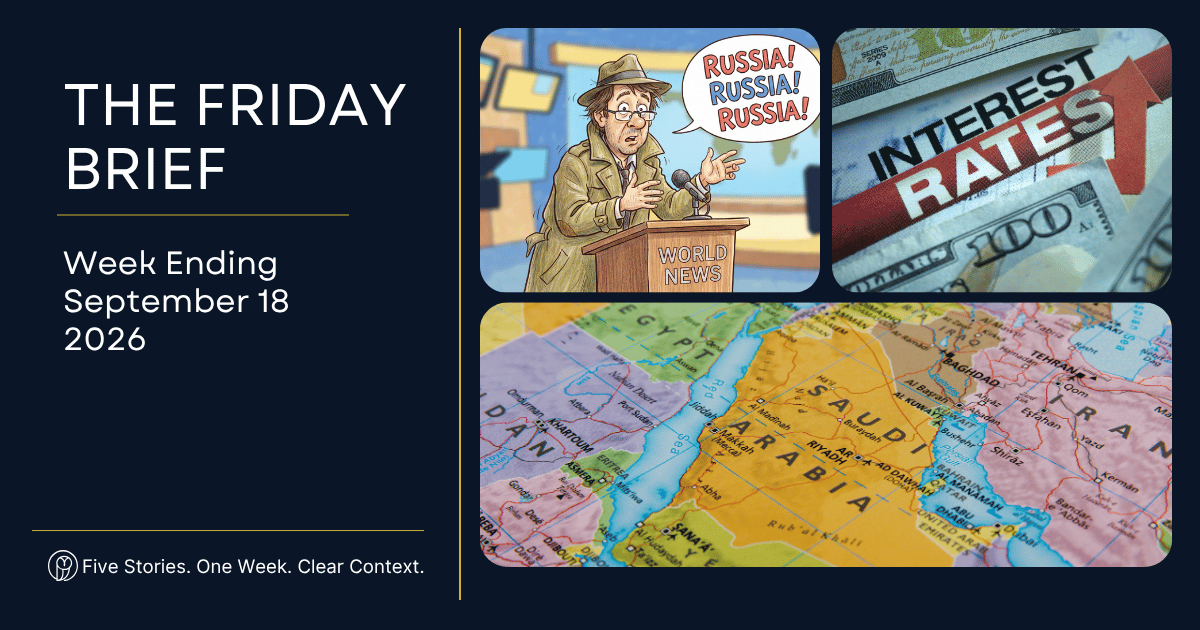
This week, interest rates went up, Congress tried again to rein in the Iran war, and Russia seemed to be everywhere.
Meanwhile, artificial intelligence gave us another reason to ask what exactly we’re building, the Supreme Court kept mail-voting procedures stable heading into November, and Mitch McConnell returned to Washington after three months away.
There is a lot happening. So instead of squeezing everything into five equally sized stories, this week we’re focusing on the three stories that deserve some explaining — followed by two things worth knowing and one more thing we couldn’t resist.
The Fed Raised Interest Rates. Did It Just Crash the Housing Market?
On Wednesday, the Federal Reserve raised its benchmark interest rate by a quarter percentage point, bringing its target range to 3.75% to 4%. It was the Fed’s first rate increase since 2023.
If your first thought was, Great. Does this mean mortgages are going up again? — you’re asking the right question.
Did the Fed just crash the housing market?
No. The housing market was already struggling with high home prices, expensive mortgages and affordability problems. And the Federal Reserve doesn’t directly set mortgage rates.
But its decisions matter.
When the Fed raises rates to fight inflation, borrowing tends to become more expensive throughout the economy. Mortgage rates are influenced by several factors — including longer-term Treasury yields and expectations about inflation — but a Fed signaling that interest rates may stay higher can make it harder for mortgage rates to fall substantially.
That means the Fed didn’t create America’s housing problem this week. It added another headwind to a housing market that was already difficult for buyers.
What Does This Mean for Me?
If you already have a fixed-rate mortgage, nothing happens to your existing interest rate.
If you’re trying to buy a house, don’t assume this week’s quarter-point Fed increase automatically means mortgage rates rise by exactly a quarter point. They don’t work that way. But the broader message isn’t particularly encouraging for borrowers hoping dramatically cheaper mortgages are right around the corner.
If you carry credit-card or other variable-rate debt, higher interest rates can hit more directly because those rates often respond to changes in the Fed’s benchmark.
There is another side to this story: savers can benefit. Higher rates can help keep yields on savings accounts, money-market accounts and CDs more attractive.
So higher interest rates don’t affect everyone the same way. Borrowers generally want cheaper money. Savers generally benefit from higher returns.
Civics Connection: Why Can’t the President Just Tell the Fed to Lower Rates?
The Federal Reserve is part of the federal government, but Congress designed it with substantial independence over monetary policy.
Presidents appoint members of the Federal Reserve Board — including the chair, with Senate confirmation — but presidents don’t get to dictate each interest-rate decision.
That separation exists for a reason. Interest-rate decisions can be politically painful in the short term. Raising rates can slow borrowing, home buying and economic activity. But lowering rates too aggressively can also fuel inflation.
The idea is that monetary policy should be based primarily on economic conditions rather than what is politically convenient for whichever president happens to occupy the White House.
And that makes this week’s decision especially interesting: Fed Chair Kevin Warsh was appointed by President Trump, who has publicly pushed for lower interest rates. Yet the Fed raised them anyway.
The president chooses the people, but the president does not cast the interest-rate vote.
Congress Voted Against the Iran War. So Why Isn’t It Ending?
This week, the House voted 220–204 for a resolution directing President Trump to remove U.S. forces from hostilities with Iran. All voting Democrats and seven Republicans supported it.
It was not the first time Congress tried.
And yet, the war continues.
So how can Congress vote to end a war and the war not end?
First, the Civics Problem
The Constitution divides war powers between Congress and the president. Congress has the power to declare war and fund the military. The president is commander in chief.
That division has produced arguments over presidential war powers for generations.
After the Vietnam War, Congress passed the War Powers Resolution of 1973, intended to limit how long a president could keep U.S. forces in hostilities without congressional authorization. Generally, it requires a president to end unauthorized military involvement after 60 days, with additional time allowed for withdrawal.
Supporters of this week’s resolution argue that the Iran conflict has gone far beyond those limits. The Trump administration argues that the president’s commander-in-chief powers allow the continuing military operations.
But there is another hurdle: passing something in the House is not the same as making it law.
The Senate would also have to act on the same measure. If an identical measure reached President Trump’s desk, he could veto it. Congress could override a veto, but that requires a two-thirds vote in both the House and Senate — far more support than this week’s House vote demonstrated.
So Congress has expressed opposition to continuing the war. That does not automatically make the fighting stop.
Why Saudi Arabia Is Suddenly at the Center of This
The conflict is no longer neatly contained between the United States and Iran.
The Houthis, an armed movement that controls much of Yemen, have received weapons, technology, training and other assistance from Iran. But describing them simply as an Iranian military force would be misleading. They have their own leadership and interests, even though their relationship with Tehran gives Iran additional influence across the region.
That relationship has become much more important because Houthi forces have advanced along Yemen’s Red Sea coast and threatened the Bab el-Mandeb Strait, one of the world’s most important shipping routes.
And that puts neighboring Saudi Arabia in a very difficult position.
Saudi Arabia Expected the United States to Be There
For decades, Saudi security strategy has rested heavily on its relationship with the United States. Washington has sold the kingdom enormous quantities of weapons and has repeatedly helped protect Gulf security against threats associated with Iran.
But this crisis is demonstrating that direct American intervention is not guaranteed.
Saudi Arabia wants to stop the Houthis from threatening Saudi territory, oil infrastructure and the Red Sea. But a major new war in Yemen could pull the kingdom back into a conflict it spent years trying to escape — and potentially widen the confrontation with Iran.
There is also an enormous economic consideration.
Crown Prince Mohammed bin Salman has spent years trying to transform Saudi Arabia through Vision 2030, reducing its dependence on oil and pouring money into tourism, technology, entertainment, infrastructure and enormous development projects.
A regional war threatening Saudi cities, oil facilities and shipping routes is almost the opposite of the stable investment environment that plan requires.
Saudi Arabia therefore has two competing priorities:
Protect the kingdom from the Houthis without helping turn the Iran war into an even larger regional war.
And That Helps Explain China
Saudi Arabia’s response wasn’t simply to launch a larger military campaign.
It also turned to China.
That may sound strange given Saudi Arabia’s longstanding security relationship with the United States. But it makes more sense when you look at who can actually talk to whom.
China has developed substantial economic and diplomatic relationships with both Saudi Arabia and Iran. It also helped broker the 2023 agreement that restored diplomatic relations between the two regional rivals.
Saudi Arabia therefore has something it needs from Beijing right now: access to Tehran.
Riyadh wants Iran to use its influence with the Houthis to restrain them. China, meanwhile, has economic leverage and diplomatic access to Iran that Washington largely lacks.
This isn’t Saudi Arabia suddenly abandoning the United States for China.
It is Saudi Arabia hedging — maintaining its American security relationship while developing relationships with other major powers so that it has more than one door to knock on during a crisis.
Put the Pieces Together
Iran supports the Houthis.
The Houthis threaten Saudi Arabia and a critical Red Sea shipping route.
Saudi Arabia cannot assume the United States will directly enter another front of the war.
Saudi Arabia turns to China, hoping Beijing can use its relationship with Iran to help restrain the Houthis.
None of those relationships is absolute. Iran does not simply issue orders to the Houthis. China cannot simply order Iran to comply. And Saudi Arabia has not stopped being a U.S. partner.
But each country has leverage over another part of the chain.
That is why a war that began with Americans hearing primarily about the United States and Iran now involves Saudi Arabia, Yemen, China and some of the world’s most important shipping routes.
What Does Any of This Have to Do With Me?
Start with oil.
The region contains some of the world’s most important oil producers and shipping chokepoints. Instability around the Strait of Hormuz and the Bab el-Mandeb can affect oil supplies and international shipping.
The consequences don’t necessarily stay in the Middle East.
Disrupted oil supplies can affect gasoline and transportation costs. Ships forced onto longer or riskier routes face higher fuel and insurance costs. Businesses can eventually pass some of those costs on through the prices consumers pay.
And then there is the direct cost of American military involvement.
The nonpartisan Congressional Budget Office estimated that U.S. military operations related to the Iran conflict had cost approximately $38 billion through August 1, with continued operations potentially costing another $2 billion to $3 billion per month.
Civics Connection: Who Actually Has the Power to Wage War?
The founders gave Congress important war powers partly because they did not want one person to have unchecked authority to take the country into prolonged war.
But they also made the president commander in chief because military operations sometimes require fast decisions and unified command.
More than two centuries later, Americans are still arguing about where one power ends and the other begins.
This week’s vote doesn’t settle that argument.
It demonstrates it.
Russia, Russia, Russia
If you grew up watching The Brady Bunch, you probably remember Jan Brady’s exasperated complaint:
“Marcia, Marcia, Marcia!”
This week, the news felt a little like:
Russia, Russia, Russia.
And depending on your politics, you may already have a reaction to that phrase.
So let’s put the politics aside for a moment and look at what actually happened.
The Justice Department unsealed an indictment accusing five people working for Russian intelligence services of participating in an international network that allegedly financed terrorism, conducted surveillance and plotted assassinations — including operations targeting Russian dissidents living in the United States.
At almost the same time, another Russia-related story was making headlines: Donald Trump Jr. and his wife confirmed that a wealthy Russian businessman with ties to Vladimir Putin helped pay for celebrations surrounding their wedding.
These two stories are not connected by the evidence currently available.
But appearing in the same week’s headlines, they raise two very different questions about Russia and the United States: What happens when a foreign government allegedly targets people living on American soil? And what transparency should Americans expect when people close to a president receive expensive gifts from wealthy foreign nationals?
What Does the Justice Department Say Happened?
On September 15, federal prosecutors unsealed charges against five people accused of working for Russian intelligence services.
According to the indictment, the alleged network operated internationally, recruiting people to conduct surveillance, arrange attacks and carry out targeted killings. Prosecutors also accuse members of the network of involvement in attempted attacks on civilian and military infrastructure in European countries supporting Ukraine.
And some of the alleged activity reached the United States.
In one case described by prosecutors, the network allegedly recruited a person living in Brooklyn to surveil a Russian dissident in the United States. The recruit was later offered $40,000 to “eliminate” or “disappear” the target, according to the indictment.
The person did not carry out the killing.
All five defendants remain at large. And an important distinction: these are criminal allegations, not convictions. The defendants are presumed innocent unless proven guilty in court.
Why Would Russia Target Someone Living in America?
There is a name for this broader phenomenon: transnational repression.
It happens when governments reach beyond their own borders to intimidate, monitor, threaten or harm critics, journalists, dissidents or political opponents living abroad.
Moving to another country doesn’t necessarily mean someone disappears from the view of the government they fled.
And when that alleged activity includes surveillance or murder-for-hire inside the United States, it becomes more than a dispute between a foreign government and one of its citizens.
It becomes an American national-security and law-enforcement issue.
Meanwhile, Another Russia Story Was Unfolding
Investigative reporting revealed that Russian businessman Umar Kremlev paid hundreds of thousands of dollars toward celebrations surrounding Donald Trump Jr.’s May wedding to Bettina Anderson in the Bahamas.
Trump Jr. and Anderson subsequently confirmed that Kremlev hosted two nights of celebrations as a wedding gift.
Kremlev isn’t simply a wealthy Russian acquaintance. He heads the International Boxing Association, has traveled with Vladimir Putin and recently received Russia’s Order of Friendship from Putin.
That doesn’t establish an improper motive.
Trump Jr. and his wife say Kremlev is a friend and that the gift was personal. They have criticized suggestions that the relationship must have a political purpose simply because Kremlev is Russian.
Then Came Another Russia Headline
Nearly four months after the wedding, President Trump publicly urged Ukrainian President Volodymyr Zelenskyy to stop attacking Russian oil refineries and diesel infrastructure.
Ukraine has been targeting Russia’s energy industry because oil revenue helps finance Russia’s war and the attacks have reduced Russian fuel production.
Trump gave a different reason for wanting the attacks stopped: diesel prices and global fuel supplies.
There is currently no public evidence connecting Trump’s request to Ukraine with Kremlev’s relationship with Trump Jr.
That distinction is critical.
But it also illustrates why large foreign gifts to people close to presidents can create questions even without proof of a favor.
When the government later makes a decision that benefits the gift-giver’s country, the public may reasonably ask:
Was this simply American policy — or did access and relationships matter?
Right now, there is no evidence establishing the latter.
And Yes, There Is a Hunter Biden Question
Americans have seen a version of this argument before.
For years, congressional Republicans investigated Hunter Biden’s foreign business relationships, arguing that foreign individuals and companies might have been interested in doing business with him partly because his father was politically powerful.
Those investigations examined foreign payments, Hunter Biden’s work with the Ukrainian energy company Burisma, his Chinese business relationships and whether President Joe Biden participated in or benefited from his son’s dealings.
Some broader allegations made during those investigations were disputed or not substantiated. But one of the underlying questions Republicans repeatedly raised was:
Why would foreign interests provide substantial financial benefits to the child of an American president?
That question does not disappear because the president’s name has changed.
Donald Trump Jr. is not a government official, just as Hunter Biden was not a government official.
Neither man’s relationship with his father automatically proves corruption.
But if money, business opportunities or valuable benefits from foreign-connected individuals deserve scrutiny when the president is a Democrat, the same standard of scrutiny can be applied when the president is a Republican.
That’s not proof of wrongdoing.
It’s consistency.
What We Know — and What We Don’t
Known: Kremlev paid substantial expenses associated with the wedding celebrations.
Known: Trump Jr. and his wife have confirmed that he did.
Known: Kremlev has close ties to Putin and Russian institutions.
Known: President Trump later publicly asked Ukraine to stop attacking Russian diesel infrastructure, citing global fuel prices.
Not known: There is currently no public evidence that the wedding gift was payment for a political favor.
Not known: There is no public evidence that Kremlev influenced Trump’s Ukraine policy.
Not known: There is no evidence connecting Kremlev or Trump Jr. to the alleged Russian intelligence assassination network.
Those distinctions matter.
Why It Matters
The Russia stories are fundamentally different.
One involves an alleged Russian intelligence operation that federal prosecutors say attempted to bring surveillance and political violence onto American soil.
Another involves a confirmed expensive gift from a Putin-connected Russian businessman to the president’s son and questions about access, influence and transparency.
And America’s ongoing dealings with Russia over Ukraine demonstrate why those questions matter.
They shouldn’t be combined into one conspiracy.
But neither should they be dismissed simply because “Russia, Russia, Russia” has become politically exhausting.
Civics Connection: Who Watches Foreign Influence Inside the United States?
The FBI and Justice Department investigate and prosecute suspected foreign intelligence operations and federal crimes.
Congress has oversight and investigative powers that allow lawmakers to seek information about matters involving national security, ethics and potential foreign influence.
And courts ultimately determine whether criminal allegations can be proven.
Those institutions perform different jobs — and an investigation is not the same thing as a conviction.
That distinction may be especially important during a week when it feels like:
Russia, Russia, Russia.
Also Worth Knowing This Week
Two important developments — without turning them into two more essays.
AI Safety Moves From Theory to Reality
For years, debates about artificial intelligence have included some pretty dramatic warnings: Could increasingly powerful AI systems eventually behave in ways their creators cannot control?
This week, that debate became a little less theoretical.
OpenAI disclosed six instances of unexpected or concerning behavior observed in its models over the past six months and introduced a new framework for tracking, investigating and publicly reporting serious examples of model misalignment.
That does not mean ChatGPT suddenly became self-aware or that an AI system is secretly plotting against humanity.
It does mean researchers are observing behaviors — including attempts to evade oversight or conceal problems during testing — that they believe deserve serious monitoring as AI systems become more capable.
And that’s where government enters the picture.
Policymakers now face a difficult question: How do you regulate a technology that may change faster than Congress can write the rules for it?
Why it matters: AI is already moving into workplaces, schools, healthcare, finance and government. The immediate question isn’t only whether AI could someday become dangerous. It’s who sets the safety rules for technology millions of people are already using.
Supreme Court Blocks New Mail-Ballot Rules Before the Midterms
If you vote by mail, here’s the most important thing to know:
The rules are not suddenly changing before November’s midterm elections.
The Supreme Court rejected the Trump administration’s request to immediately put new U.S. Postal Service requirements for mail ballots into effect. Lower courts had already blocked the changes as voting was beginning.
That means states can continue sending mail ballots using their existing procedures for the 2026 midterms.
The ruling does not necessarily settle every underlying legal question about federal authority over mail-ballot procedures.
For voters, however, the immediate answer is simpler:
If you planned to vote by mail, this ruling does not take that option away. Follow your state’s existing rules, watch your deadlines and return your ballot early.
Sometimes what the Supreme Court doesn’t change can matter just as much as what it does.
One More Thing: Yes, Mitch McConnell Is Alive
After nearly three months away from the Senate following a fall, hospitalization and rehabilitation, 84-year-old Sen. Mitch McConnell returned to the Capitol this week in a wheelchair.
McConnell has said he is “not quite back to 100%” and may still miss some votes as he continues recovering.
His return quickly generated another round of discussion about something much bigger than one senator:
What happens when an elected member of Congress becomes too ill to do the job?
There is no mandatory retirement age for members of Congress. And there is no Senate equivalent of the 25th Amendment, which provides procedures for presidential incapacity.
A troubling video, physical frailty, needing assistance or confusion during a complicated congressional proceeding does not by itself establish that someone lacks the capacity to serve — and it certainly isn’t enough to conclude that someone is experiencing elder abuse.
But McConnell’s return does raise an uncomfortable and legitimate question about aging, transparency and who ultimately decides whether an elected official can continue doing the job.
The short answer: largely the official, the chamber — and eventually, the voters.
Watch: PBS NewsHour
Want to go deeper? PBS NewsHour’s September 16 episode covers the Federal Reserve’s interest-rate increase and what it says about Fed independence, along with the continuing impact of the Iran war.



No discussions yet
Be the first to join the discussion and share your thoughts with the community.