
Power, Diplomacy and Who Still Has a Seat at the Table
This week: America’s standing abroad, a White House press fight, the strangest diplomatic soundtrack imaginable, California preparing before disaster strikes, and a changing war in Ukraine.
Some weeks, the biggest stories have very little in common. This wasn’t one of them.
Again and again this week, the news came back to power: how much the United States can accomplish on its own, what happens when other countries stop cooperating, what limits exist on presidential authority, and what government can do before a crisis arrives.
Here are five stories worth understanding — plus one we’re watching.
Jump to a Story
1. At the UN, America Projected Power — But the Empty Seats Told Another Story
President Trump went to the United Nations this week with a forceful message: the United States remains powerful, intends to use that power, and expects other countries to take notice.
Much of his speech focused on Iran. Trump defended his decision to begin the war, warned Iran about what could happen if negotiations fail, but also left the door open to diplomacy — he told reporters that American officials had held a “very productive” three-hour meeting with the Iranian delegation on the sidelines. Iran’s delegation walked out during Trump’s criticism of its government. (AP News)
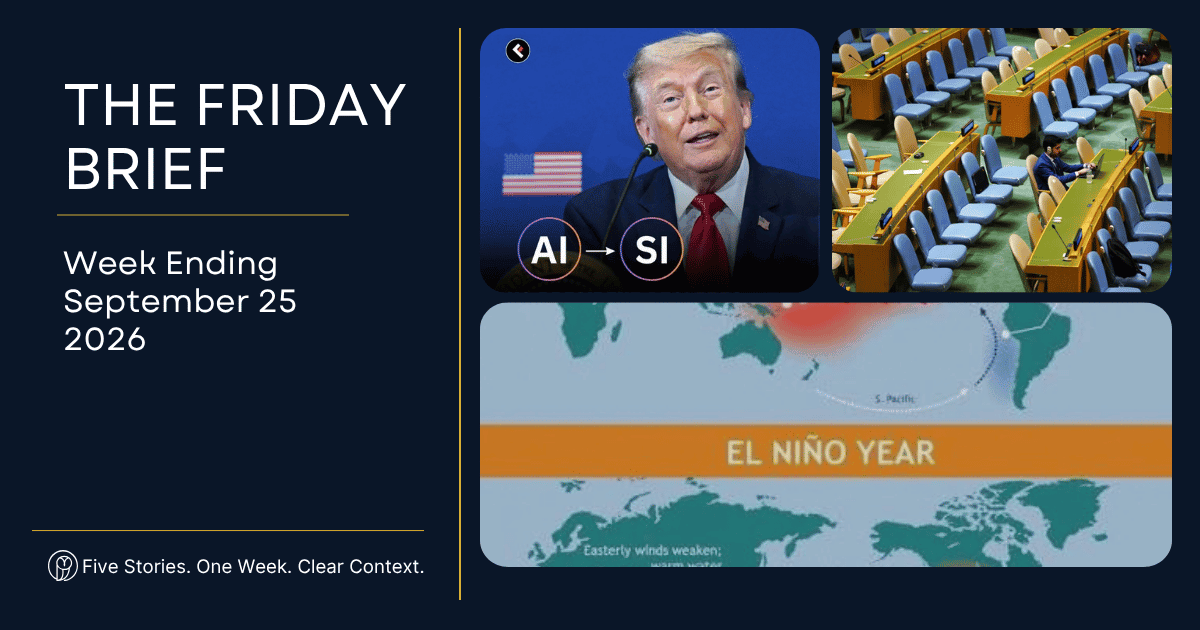
Trump also talked about Russia and Ukraine, celebrated a new security agreement with Denmark and Greenland, criticized international institutions, and introduced a new name for artificial intelligence: “super intelligence,” or SI. Trump said the word artificial makes the technology sound fake — “it’s not fake, it’s actually amazing” — and said federal documents would begin using his preferred term.
But some of the most revealing moments at the UN weren’t happening at the microphone.
Two days later, Israeli Prime Minister Benjamin Netanyahu took the same stage. More than 100 delegates walked out before he began. Others stayed and cheered. Netanyahu responded by denouncing the departing delegates as “moral cowards” — inviting anyone else who felt that way to leave too — defended Israel’s conduct in Gaza and Iran, and rejected genocide allegations as “the biggest lie of the century.” (Reuters)
And then, shortly after Netanyahu stepped away from the podium, Trump told reporters: “I think we have a deal on Gaza.”
The walkout doesn’t mean every country has abandoned Israel. It doesn’t mean America’s alliances have disappeared. But it was a very public display of how strained some international relationships have become — and that matters far beyond the UN auditorium.
Why It Matters: Foreign Opinion Isn’t Just a Popularity Contest
It is easy to dismiss international opinion with a reasonable argument: Americans elect an American president, and Europeans don’t get a vote.
That’s true. But the United States doesn’t operate alone.
The United States asks other countries to share intelligence, enforce sanctions, host American troops, participate in military coalitions, negotiate trade agreements, cooperate against terrorism and organized crime, and support American diplomatic initiatives.
Those relationships can sound abstract until something goes wrong.
Intelligence shared by another government can help identify a terrorist threat before it reaches American soil. Trade relationships affect prices, jobs and supply chains. Military alliances can determine whether American troops respond to a crisis alone or alongside forces from other countries. Sanctions work much better when other countries agree to enforce them.
A president doesn’t have to be popular overseas to accomplish any of this — governments routinely work together even when their leaders dislike one another. But trust is a form of power, too.
That’s why this week’s empty seats are worth noticing. They don’t prove that the United States or Israel has “lost the world.” They don’t tell us whether Trump or Netanyahu’s policies are right or wrong. They do tell us that disagreements once handled primarily through diplomatic statements and closed-door meetings are increasingly visible — and increasingly hard for governments to control.
Something Else Is Changing: How Americans See Israel
For generations, strong support for Israel was a familiar feature of American foreign policy and American public opinion. That doesn’t mean Americans always agreed with the Israeli government. But historically, when Americans were asked which side they sympathized with more in the Israeli-Palestinian conflict, Israel held a substantial advantage.
That gap has not just narrowed. For the first time in 25 years of Gallup’s tracking, Israelis no longer hold the advantage.
Gallup’s February 2026 poll found 41% of Americans sympathized more with Palestinians and 36% with Israelis. Because of the poll’s margin of error of plus or minus 4 points, Gallup said neither side held a statistically significant advantage. That’s notable because from 2001 through 2025, Israelis had consistently held the advantage in Gallup’s measure — as recently as 2023, it was 54% to 31% in Israel’s favor.
Why has opinion changed? There probably isn’t one explanation. The war in Gaza, Israeli government policies, partisan polarization, generational differences and changing attitudes toward Palestinians all matter. Younger Americans moved first — for the first time, a majority of adults under 35 sympathize more with Palestinians — but this year Gallup found the shift has spread to independents and even middle-aged Americans.
But there is another enormous difference between today’s conflict and the ones many Americans grew up watching: the phone in your hand.
Americans no longer experience a distant war primarily through an evening newscast or newspaper. Videos from Gaza, Israel and the West Bank can reach millions of people before a television network has verified or even seen them.
That can expose Americans to people and perspectives they might never have encountered before. It also creates a serious problem: authentic footage can appear alongside old videos, edited clips, propaganda and completely false claims. Seeing more does not necessarily mean understanding more — but it does mean that governments have much less control over what the public sees.
This changing debate is showing up far beyond politics. Arguments over Israel and Gaza have reached college campuses, entertainment, music and social media. And now, at the United Nations, more than 100 representatives physically got out of their seats and walked away as Israel’s prime minister began speaking.
The Bigger Picture
There is a strange contradiction in American foreign policy right now. The United States remains extraordinarily powerful, with enormous military capabilities, economic influence, intelligence networks and alliances around the world. But military power and diplomatic influence aren’t exactly the same thing.
You can make another country pay attention to you because you are powerful. Getting that country to trust you, cooperate with you or follow you is something different. One you can compel. The other you have to earn — and can spend.
That may be the more important story underneath all the speeches at the United Nations this week. America can project enormous military and economic power. Israel remains one of its closest allies. But power can make other countries pay attention; it cannot always make them agree, cooperate or stay in the room.
And yes, apparently, we are now supposed to call artificial intelligence Super Intelligence.
We’ll see if that one survives the trip home from New York. 😏
(PBS NewsHour)2. A President Banned Three News Outlets. A Judge Said: Not Like That.
President Trump announced last Friday that CNN, MS NOW and Politico were banned from the White House, accusing the organizations of spreading “fake news” and later describing their reporting as a national-security threat. The following morning, reporters arriving for work were turned away and some had their White House press passes confiscated.
The three news organizations sued.
Early Thursday morning, U.S. District Judge Timothy Kelly — a judge Trump himself appointed during his first term — issued a temporary restraining order requiring the administration to restore their credentials for 14 days. Kelly found that the outlets were likely to succeed on at least one part of their case: that taking away established press access without adequate notice and an opportunity to challenge the decision violated the Fifth Amendment’s guarantee of due process.
There’s an important distinction here.
The judge did not rule that every journalist has a constitutional right to walk into the White House. Nor did he decide the larger First Amendment question of whether Trump retaliated against these organizations because he disliked their reporting.
For now, the ruling is narrower:
If the government gives someone an established benefit or access protected by due-process rules, it cannot necessarily take it away instantly without a fair procedure.
And the story got stranger Thursday morning.
Despite the court order, some CNN and Politico journalists who tried to enter the White House were initially turned away again. The organizations sought an emergency hearing. By later Thursday morning, their credentials had been restored and reporters were again entering the White House complex.
Why It Matters: This Isn’t Really About Whether You Like CNN
People can dislike CNN. They can dislike Fox News, MS NOW, The New York Times, Politico — or all of them.
That’s not the constitutional question.
The more important question is whether a president can use government-controlled access to reward news organizations whose coverage he likes and punish organizations whose coverage he doesn’t.
The White House argues that access to its grounds is a privilege and that the president has broad authority over who is allowed inside. The news organizations argue that once the government establishes a system for press access, it cannot selectively exclude journalists because officials dislike what they report. Their lawsuit raises both First Amendment and Fifth Amendment claims.
And something unusual happened after the ban.
Other news organizations that had not been banned began withholding some coverage in solidarity. Major television networks suspended pooled video coverage after CNN was removed from a scheduled pool assignment. The New York Times and The Washington Post also withheld presidential photographs for a period.
That matters because the White House press pool isn’t just a group of reporters standing around hoping the president says something interesting.
Physical space around a president is limited. A small rotating group of journalists therefore travels with and closely covers the president, then shares its reporting, photographs and video with the wider press. That system allows Americans to see presidential events even when hundreds of reporters cannot physically fit in the room.
So when access breaks down, the public can lose access too. You don’t have to trust every reporter, nor do you have to agree with every newspaper. You don’t even have to like the press.
But in a democracy, someone needs to be in the room asking questions the government might rather not answer.
And this week, another branch of government stepped in and said that, at least for now, the White House couldn’t decide who gets to be in that room without following the rules.
(Reuters)3. Diplomacy, Greenland and… “Send in the Clowns”?
International diplomacy is usually choreographed down to the smallest detail. Flags are positioned correctly. Seating arrangements are negotiated. Music is chosen carefully.
Which makes what happened in Denmark this week particularly memorable.
As U.S. officials, including Secretary of State Marco Rubio, arrived for the signing of a new security agreement involving the United States, Denmark and Greenland, “Send in the Clowns” began playing over the speakers.
Yes. That “Send in the Clowns.”
The timing immediately attracted attention because relations between the United States, Denmark and Greenland have been strained by President Trump’s repeated interest in greater American control over Greenland.
Social media quickly assumed Denmark had chosen the song as a not-so-subtle diplomatic jab.
Apparently not.
Denmark’s Foreign Ministry said it had nothing to do with the music. The United Nations said it didn’t choose it either. Fact-checkers confirmed that the song really was playing as the officials entered — but couldn’t establish who actually selected the playlist.
So perhaps the strangest part of the story is that nobody appears willing to take credit for one of the most perfectly timed songs in diplomatic history.
But in diplomacy, perception can matter almost as much as intention.
Why It Matters: “America First” Still Requires Other Countries
Greenland may seem remote from everyday American life, but its location has made it strategically important for decades. It sits between North America and Europe, near increasingly important Arctic routes, and the United States already operates the Pituffik Space Base there.
(Reuters)That helps explain why the Trump administration has placed so much attention on Greenland. But getting access to strategically important places usually requires something besides military or economic power: relationships.
And this is where foreign opinion can affect Americans at home.
The United States asks other countries to share intelligence, enforce sanctions, host American troops, participate in military coalitions, negotiate trade agreements, cooperate against terrorism and organized crime, and support American diplomatic initiatives.
You can believe strongly in an “America First” foreign policy and still recognize that America doesn’t operate in isolation. Intelligence from an ally can help stop a threat before it reaches the United States. Trade agreements affect American businesses, workers and prices. Foreign military bases allow American forces to operate in places where the United States doesn’t own the land. Sanctions against another country become much less effective if other nations refuse to participate.
That doesn’t mean American presidents should make decisions based on whether they are popular in Europe. Sometimes countries will strongly disagree, even when they remain allies.
But how America is perceived overseas can have consequences at home.
Denmark is a NATO ally. Greenland is a self-governing territory within the Kingdom of Denmark, and Greenlanders themselves have a say in their future. If the United States wants cooperation from both, the relationship matters.
That’s why seemingly silly diplomatic moments can become revealing. A song doesn’t change an alliance. An eye roll doesn’t cancel a treaty. A sarcastic joke doesn’t determine foreign policy.
But diplomacy is built partly on relationships, and relationships accumulate memories.
The United States can have enormous military and economic power while simultaneously having disagreements with countries whose cooperation it needs. Power can get you into the room. It doesn’t necessarily make everyone in the room want to work with you.
And sometimes international tension doesn’t arrive through a declaration from a podium.
Sometimes the speakers start playing “Send in the Clowns.”
(Lead Stories Fact Check)4. California Declared an Emergency Before the Emergency
Usually, a governor declares a state of emergency after something goes wrong: a wildfire erupts, a hurricane hits or flooding begins.
California is trying something different.
Governor Gavin Newsom declared a statewide emergency this week in preparation for what forecasters say could be an unusually strong El Niño. The declaration allows state agencies to move faster on preparations, including reinforcing levees, clearing waterways, positioning emergency equipment and cutting through some permitting requirements before potentially dangerous storms arrive.
(California Governor’s Office)California has good reason to take the threat seriously. El Niño occurs when unusually warm water in the tropical Pacific changes weather patterns around the world. It doesn’t guarantee that California will experience catastrophic flooding, and forecasters cannot predict exactly where individual storms will hit months in advance.
But a strong El Niño can increase the chances of powerful storms and heavy precipitation in parts of California.
Why It Matters: Government Doesn’t Have to Wait for Disaster
A state of emergency sounds dramatic, especially when there isn’t currently an emergency.
But that’s partly the point.
Emergency declarations give governments powers they don’t normally use. Rules can be temporarily waived, contracts and supplies can move faster, workers and equipment can be positioned ahead of time, and agencies can prepare for problems before communities are underwater.
There is a tradeoff. Emergency powers are intentionally broad, which is why they deserve public scrutiny. And preparations based on forecasts may turn out to have been unnecessary.
But waiting has a cost too.
A levee that needs reinforcement is considerably easier to repair before the river rises. Emergency supplies are more useful sitting near the community that needs them than sitting in a warehouse hundreds of miles away. Evacuation plans work better when someone has figured out the routes before roads begin flooding.
Think of it less as declaring that a disaster has happened and more as giving government permission to start preparing as though one might happen.
Whether California ultimately needs all those preparations will depend on weather that hasn’t arrived yet.
And perhaps the best possible outcome is also the least exciting headline: California prepares for a disaster that never becomes one.
5. Ukraine Is Getting More U.S. Air Defense — But This Isn’t Just Another Aid Package
After more than four years of war, another multibillion-dollar Ukraine announcement can easily become background noise.
This one is worth a closer look.
The U.S. State Department has approved a possible $2.68 billion sale of air-defense equipment and support to Ukraine. It comes as Russia is changing the way it attacks Ukrainian cities, including increased use of faster jet-powered drones that are more difficult for some Ukrainian defenses to intercept. Reuters reported this week that Ukraine’s interception rate against those drones is about 60%, compared with roughly 90% for the slower propeller-driven versions.
Ukraine is also running short of some of its most important defenses. Reuters reported last week that Ukrainian forces had nearly exhausted their supply of U.S.-made Patriot interceptors as Russia intensified ballistic-missile attacks.
So this isn’t simply about giving Ukraine “more weapons.”
It’s about an arms race within the war itself: Russia changes how it attacks. Ukraine has to change how it defends.
Why It Matters: Wars Don’t Stay Where They Start
For Americans, Ukraine can feel very far away — especially after more than four years of headlines about weapons, sanctions and military aid.
But the consequences don’t necessarily stay in Ukraine.
The war has affected European security, energy markets, food and grain exports, defense spending and relationships between Russia and NATO countries. This week Poland joined a coalition with Ukraine and other countries working to develop less expensive defenses against ballistic missiles, while Denmark accelerated another Ukrainian aid package after a confrontation between a Russian warship and a Danish military helicopter.
(Reuters)There is also an important distinction in the phrase “the United States approved $2.68 billion.”
That doesn’t necessarily mean the president simply wrote Ukraine a $2.68 billion check.
Foreign military sales involve multiple parts of the U.S. government. The executive branch reviews and approves proposed sales, Congress receives formal notification and has oversight authority, and the actual equipment can involve American defense companies, production schedules and contracts.
That makes Ukraine another example of something we’ve seen throughout this week’s Brief: American foreign policy rarely belongs entirely to one person or even one branch of government.
And while Washington debates how much support Ukraine should receive, the technology of the war keeps changing.
The drones get faster. The defenses have to catch up.
What to Watch: Parents, Schools and Transgender Students
A federal lawsuit in Kansas could become an important test of where parental rights end and student privacy begins.
(KCUR)The Justice Department is suing Kansas City, Kansas, Public Schools over guidelines for transgender students. The dispute involves situations in which a student asks school staff to use a different name or pronouns but does not want that information shared with a parent.
The district says those requests are considered case by case, taking into account factors including the student’s age, grade and welfare. DOJ argues that the practice violates federal laws protecting parents’ access to their children’s educational records. The district says it complies with federal law.
One distinction is important because the language surrounding this case can make it sound like something else is happening:
This lawsuit is not about schools secretly providing children with medical treatment.
The dispute centers on school practices involving things such as names, pronouns, gender identity and what information must be disclosed to parents. DOJ characterizes those practices as facilitating a “social transition”; the district disputes the government’s allegations and says it follows federal law.
There are competing concerns here. Parents argue they have a right to know significant information about their children and to inspect school records.
But student-privacy advocates point to a harder question: What happens when telling the parent could put the child at risk?
For some LGBTQ+ students, disclosure can carry the risk of being kicked out, threatened or abused, or being subjected to efforts intended to change their sexual orientation or gender identity. That is why advocates argue that automatically notifying parents isn’t always as simple as “parents have a right to know.”
The courts may now have to sort out where parental rights, student privacy and a school’s responsibility to protect children intersect.
Why we’re watching: DOJ calls this case the first of its kind, and federal officials have indicated that other school districts could face similar enforcement actions. That means a dispute beginning in one Kansas school district could eventually help determine what schools across the country are required to tell parents — and what students may keep private.


No discussions yet
Be the first to join the discussion and share your thoughts with the community.