
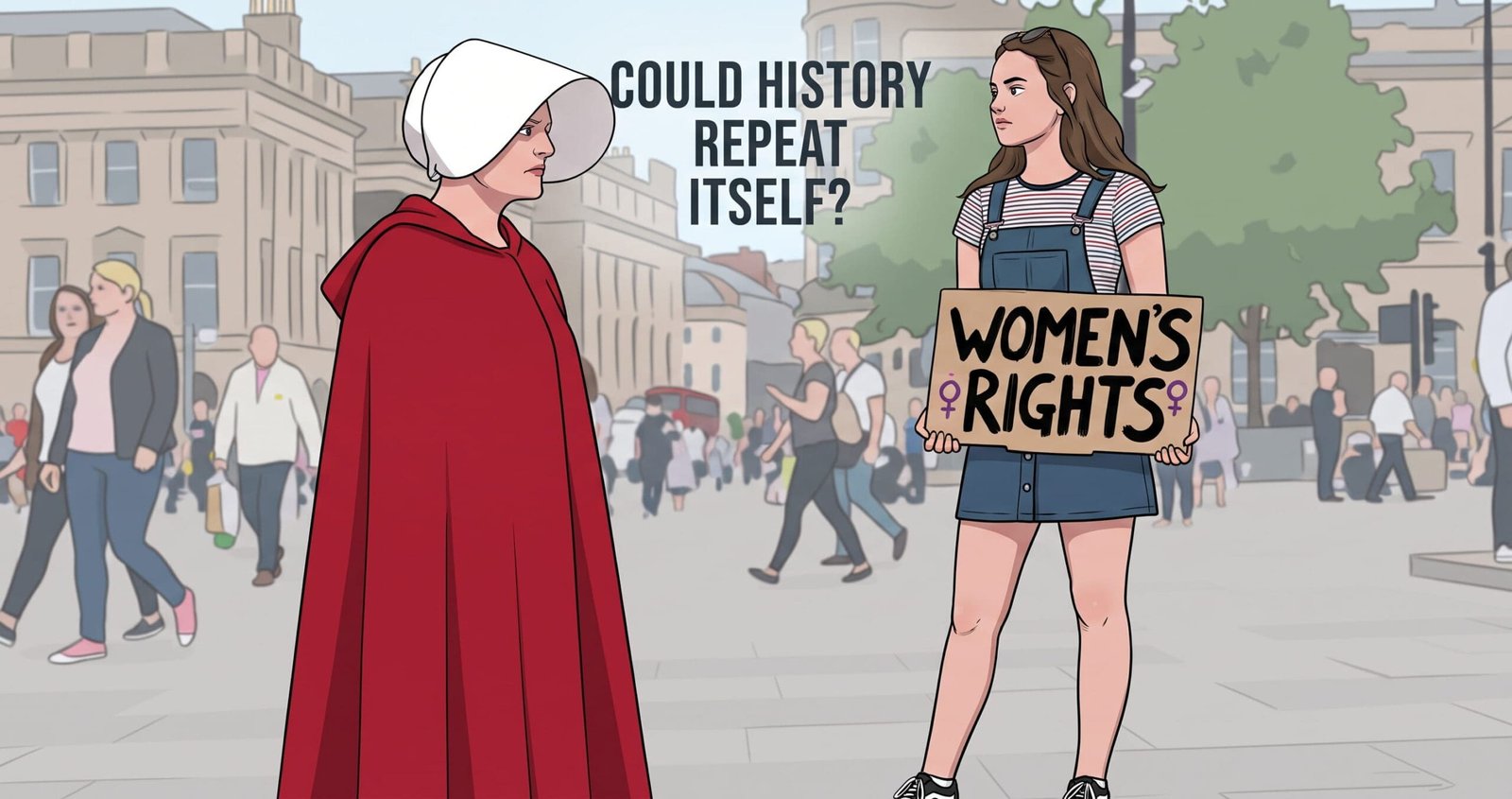
Rights and legal protections rarely change through one simple mechanism. Use the links below to jump to a section or come back to where you left off.
Opening — Nothing Here Hasn’t Happened Before
When Margaret Atwood wrote The Handmaid’s Tale, she followed one rule: nothing would go into Gilead that human beings hadn’t already done somewhere, at some point in history. Forced childbearing, women stripped of property rights, literacy forbidden — every piece had a real-world precedent, and as she later noted, most of them came not from distant cultures but from Western history itself.
Atwood assembled a fictional country out of documented parts. That’s the distinction this article turns on: The Handmaid’s Tale is not a prediction that the United States will become Gilead. But some of Gilead’s building blocks came from real practices — including practices with roots in American and Western history. The more useful question isn’t whether the novel will come true exactly as written. It’s what has actually happened before, and how.
Here’s what should unsettle us more than any novel: in the first two years after Roe v. Wade was overturned, the advocacy group Pregnancy Justice documented at least 412 people facing criminal charges related to their pregnancies. Nearly all involved allegations of substance use during pregnancy, while only nine included allegations related to abortion. Many were prosecuted under child-abuse, neglect, or endangerment laws.
But before we get there, we need to understand something more basic: how does a right people assumed was permanent actually change? Americans tend to picture revolutions — Gilead arriving by coup. The real mechanisms are quieter: repeal, judicial reversal, old laws revived, political movements that outlast decades of failure.
Roe proved it — a 49-year-old constitutional right, reversed in one ruling in June 2022.
Part I — We Don’t All Live Under Exactly the Same Rules
When Americans talk about our rights, we tend to use the word our as though there is one rulebook.
There is a Constitution. There are federal laws that apply across the country. But underneath that national framework sits 50 states, thousands of counties and municipalities, school districts, courts and agencies making decisions of their own. States regulate everything from education and marriage to healthcare and elections, while constitutional protections such as religious freedom and parental rights can sometimes collide with other interests the government is trying to protect.
Education offers a surprisingly close-to-home example. New York requires children in nonpublic schools to receive an education that is “substantially equivalent” to instruction in public schools. Yet the state has spent years wrestling with allegations that some ultra-Orthodox yeshivas provided boys with very limited general education.
Former students and advocates have described schools where boys received only rudimentary English and math instruction through eighth grade — and no instruction in non-religious subjects after that. Some former students say they entered adulthood struggling with English writing, higher-level math, history and science.
The dispute isn’t simply about whether education matters. It involves competing rights and responsibilities. Parents have significant authority over how they raise their children. Religious communities have constitutional protections against government interference. The state also has an interest in making sure children receive an education that prepares them for adult life.
And then there is the person whose interests are easiest to overlook: the child who will eventually become an adult. Who decides how much education that future adult needs?
From Amish education and Wisconsin v. Yoder to New York’s yeshiva battles, we’ll look at what happens when religious freedom, parental rights and a child’s future independence collide.
For now, the example matters for another reason. It shows why talking about rights as though every American experiences them identically can be misleading.
Sometimes a national constitutional right establishes the rule. Sometimes states have room to make very different policies. Sometimes local governments add another layer. Sometimes two constitutional protections collide and courts have to decide where one ends and another begins.
And sometimes something Americans have treated as a national right stops being one.
That’s what happened with abortion in 2022. When the Supreme Court overturned Roe v. Wade, abortion did not simply become illegal throughout the United States. Instead, a constitutional protection that had limited what states could do disappeared, giving states much greater authority to make their own abortion laws.
Which brings us to the real question behind this article:
How does something Americans understand as a right become narrower, different depending on where they live, or disappear altogether?
There isn’t one answer. There are several mechanisms — and only one looks anything like Gilead.
Part II — Iran, 1979: When the Entire Rulebook Changes
If Americans picture women’s rights disappearing, Iran is probably closer to the image they have in mind: a revolution, a government overthrown, and a new political and legal order taking its place.
But the story is often told too simply.
Iranian women did not go from having no rights to having even fewer. Before the 1979 Islamic Revolution, women had spent years gaining legal protections, particularly in marriage, divorce and family law.
Iran’s Family Protection Laws of 1967 and 1975 restricted a husband’s ability to divorce his wife unilaterally, placed limits on polygamy, expanded women’s ability to seek divorce and custody, and raised the minimum marriage age for girls to 18. Women were also serving as judges and participating in universities and professional life.
Then the government changed.
Soon after the revolution, a directive from Ayatollah Ruhollah Khomeini’s office declared the Family Protection Law incompatible with Islamic law and suspended it. Protections limiting a husband’s ability to divorce unilaterally or take additional wives were rolled back, women’s custody and divorce rights were reduced, and women were removed from judgeships.
According to Encyclopaedia Iranica, women did not begin returning to even limited judicial roles until 1992, when they were permitted to serve as advisory judges — roughly 13 years after the revolution. They were not simply restored to the judicial authority women had held before 1979; they returned in a more limited role within a judicial system whose senior leadership and appointment authority remained male-controlled.
Some family-law protections would also be modified or partially restored over time, but the direction immediately after the revolution was unmistakable: protections women had already gained were being taken back.
Clothing changed too, although not overnight in quite the way popular retellings sometimes suggest. In March 1979, Khomeini called for women working in government offices to follow Islamic dress requirements. Thousands of women protested. Mandatory covering was imposed progressively, with broader enforcement developing over the following years.
What Changed?
| Before the Revolution | After the Revolution |
|---|---|
| Family law restricted a husband’s ability to divorce his wife unilaterally. | Protections limiting unilateral divorce were rolled back. |
| Under the Family Protection Laws, a husband could not simply decide to take another wife under the older rules. A man seeking another marriage generally needed court permission, and the law established conditions he had to meet. Taking another wife without complying with the legal requirements could also give the first wife grounds to seek divorce. | Those protections were rolled back. Islamic family law again allowed men to have up to four permanent wives, while women lost many of the protections the Family Protection Laws had provided in divorce, custody and marriage. |
| The minimum marriage age for girls had been raised to 18. | It was lowered to 13 after the revolution. By 1982, the law tied marriage eligibility to puberty, legally defined as 9 lunar years for girls. |
| Women could serve as judges. | Women were removed from judgeships and did not begin returning even in limited advisory roles until 1992. |
| Women could appear in public without legally mandated Islamic dress. | Mandatory Islamic dress was gradually imposed. |
This is why Iran belongs in this article — but also why we need to be careful about what lesson we take from it.
Iran did not slowly lose these protections because one ordinary bill passed a state legislature or because one court revisited an old precedent. The country went through a revolution. The political system itself changed.
That is fundamentally different from what happened in the United States with Dobbs, and it is different from a state legislature debating divorce law.
But Iran demonstrates something that is easy to forget once a right becomes part of ordinary life: people can live under a legal protection long enough for it to feel normal — and still live to see the government take it away.
The women protesting in Tehran in March 1979 weren’t protesting for rights that existed only in some distant future. In important respects, they were protesting because they could see protections they had already gained beginning to disappear.
And that brings us back to the United States. America doesn’t need to experience a revolution for a longstanding protection to change. Our own system contains mechanisms for doing that.
We saw one of them in 2022.
Part III — Roe and Dobbs: When the Court Changes the Rule
Iran changed its legal system through a revolution.
The United States did not need one.
For nearly half a century, Roe v. Wade and later Planned Parenthood v. Casey limited how far states could go in banning abortion. States still passed abortion regulations, sometimes aggressively, and Americans remained deeply divided over the issue. But there was a constitutional boundary states could not cross.
That boundary lasted through Democratic presidents and Republican presidents, liberal courts and conservative courts, recessions, wars, elections and enormous cultural change.
Roe Was Never Politically Settled
This is important, because Dobbs can look very different if we begin the story in 2022.
Opposition to Roe did not suddenly appear when Mississippi passed the law that eventually reached the Supreme Court. For decades, abortion opponents organized politically, supported candidates who opposed Roe, challenged abortion laws in court, pushed states to enact restrictions and advocated for judges who might reconsider the constitutional right to abortion.
They also lost. Repeatedly. In 1992, many abortion opponents thought the Supreme Court might overturn Roe in Planned Parenthood v. Casey. Instead, the Court reaffirmed what it called Roe’s “essential holding,” while allowing states greater room to regulate abortion. Roe survived — for another 30 years.
That’s an important part of this story, because political movements don’t necessarily disappear when they lose an election, a court case or a legislative fight. They can change strategy, build organizations, elect different lawmakers, bring different lawsuits and wait for the political or judicial environment to change.
Then Mississippi Passed a 15-Week Ban
In 2018, Mississippi enacted a law generally prohibiting abortions after 15 weeks of pregnancy — earlier than the viability line protected under Roe and Casey. The law was challenged, and the case eventually reached the Supreme Court as Dobbs v. Jackson Women’s Health Organization.
By the time it arrived, Mississippi wasn’t simply asking the justices to allow a slightly earlier abortion restriction. It asked them to reconsider Roe and Casey themselves — and twenty-six states urged the Court to do exactly that.
On June 24, 2022, five justices voted to overrule Roe and Casey. The Court held that the Constitution does not confer a right to abortion, overruled Roe and Casey, and returned authority over abortion policy largely to elected governments.
Chief Justice John Roberts agreed Mississippi’s 15-week law could stand but argued that the Court did not need to go as far as completely overruling the precedents.
Wait — Doesn’t Precedent Protect Old Decisions?
Usually, it helps. Courts follow a principle called stare decisis — roughly, respect for earlier decisions. The idea is important: laws would become unpredictable if courts treated every settled case as a blank sheet of paper whenever the membership of the Court changed.
But precedent is not permanent. The Supreme Court has overturned its own decisions before, sometimes for reasons now widely celebrated. Brown v. Board of Education, for example, rejected the constitutional framework that had allowed government-mandated racial segregation under Plessy v. Ferguson.
That is why the real debate in Dobbs wasn’t simply whether the Court could overturn precedent. Everyone knew it could. The fight was over whether Roe and Casey should be overturned.
The majority concluded that they should, arguing that the Constitution does not protect a right to abortion and that Roe had been wrongly decided. The dissent argued that the Court was abandoning precedent on which generations of women had relied and warned about the consequences for women’s liberty and equality.
No revolution is required. No constitutional amendment is required. Congress does not have to repeal anything. The Court can reconsider its own precedent.
In his Dobbs concurrence, Justice Clarence Thomas explicitly urged the Court to revisit other long-recognized rights as well, naming the decisions protecting contraception, same-sex intimacy and same-sex marriage.
The majority opinion, however, explicitly said that its decision should not be understood to cast doubt on precedents that do not involve abortion.
That concurrence matters here not because of where any reader stands on those issues, but because of what it shows about the mechanism: judicial reversal is not a tool that applies to one topic. It is not a mechanism unique to abortion. It is a general-purpose one.
Why Dobbs Matters Beyond the Abortion Debate
You can believe Roe was correctly decided or terribly decided. You can believe Dobbs corrected a constitutional mistake or took away a fundamental right. That argument matters — but it isn’t the only lesson here.
For this article, Dobbs demonstrates something narrower. For 49 years, Americans lived in a country where the Constitution, as interpreted by the Supreme Court, protected a right to abortion. Political movements spent decades trying to change that interpretation. They experienced major defeats along the way. Eventually, they succeeded.
That does not mean every movement seeking to reverse an existing protection will eventually succeed. Most political goals don’t. But it does mean we should be careful with one particular argument:
History doesn’t support the word never.
And that brings us to something being debated right now — in more areas than one.
Part IV — When a Proposal Is a Warning, Not a Law
One of the hardest things about following political debates is knowing how seriously to take a proposal that hasn’t passed.
We covered one example in depth in our article on no-fault divorce: lawmakers in several states have proposed restricting or eliminating it. So far, those efforts have stalled or failed, and no state has eliminated no-fault divorce. That’s a fact — and the full story of why the proposals keep returning is in the earlier piece.
Here, only one lesson matters: Roe taught us that a movement whose proposals keep failing isn’t the same thing as a movement that is failing.
That lesson isn’t limited to divorce. Consider contraception.
Birth control remains legal throughout the United States. There is no nationwide ban on the pill, emergency contraception or IUDs.
But the legal debate around reproductive rights has begun reaching questions that extend beyond abortion. In the first half of 2026, lawmakers in at least 17 states introduced dozens of bills containing some form of embryo or fetal “personhood” language. None had become law by early June.
Personhood proposals differ, but many start with the same basic idea: an embryo should have legal rights beginning at fertilization. If that definition becomes law, lawmakers and courts may eventually have to decide how it applies to other areas of reproductive care.
That is where contraception enters the debate. Some abortion opponents believe that if a contraceptive method could prevent a fertilized egg from implanting in the uterus, it should be restricted because they believe legal protection should begin at fertilization.
Medical organizations draw the line differently. Pregnancy is medically defined as beginning after implantation, and emergency contraception and IUDs are classified as contraception, not abortion. They remain legal in the United States.
So the disagreement is not simply about whether “birth control is abortion.” It is partly about where the law should draw the starting line — at fertilization or at pregnancy — and what other laws might be affected if that line changes.
But the political disagreement has created enough uncertainty that lawmakers in other states are doing something revealing:
As of June 2026, lawmakers in 29 states had introduced more than 120 bills designed to protect contraceptive access, and several had already become law — including an explicit legal right to contraception in Virginia.
So we now have two things happening at once. Some lawmakers are proposing legal definitions that could raise new questions about reproductive care. Other lawmakers are writing contraception protections into state law precisely because they don’t want those questions left unanswered.
Neither development means birth control is about to disappear. But neither is meaningless, either.
Here is where Roe gives us a useful lesson without giving us a crystal ball. A bill that fails today may disappear forever. It may come back next year. It may return in a different form, or become part of a political platform.
Courts may eventually be asked to interpret language lawmakers never anticipated affecting something else. Or voters may reject the entire idea.
That distinction allows us to do something surprisingly difficult in modern politics: take a proposal seriously without pretending its outcome is inevitable.
No-fault divorce remains legal. Contraception remains legal. The personhood bills tracked in the first half of 2026 had not become law. Those are facts. So is the fact that people are debating them. And Dobbs taught us why both pieces of information belong in the same sentence.
Part V — The Comstock Act: When an Old Law Comes Back to Life
Sometimes changing the law doesn’t require passing a new law at all. Sometimes the law is already there.
In 1873 — when Ulysses S. Grant was president and women were still almost 50 years away from gaining the constitutional right to vote — Congress passed what became known as the Comstock Act. The federal law restricted the mailing of materials considered obscene and included provisions involving abortion. Parts of those provisions remain in federal law today.
Over the decades, Congress amended the law and courts interpreted it in ways that narrowed its reach. For decades, the remaining abortion provisions seemed increasingly irrelevant to modern abortion access.
The Fight Is Over What the Old Law Means Today
The current dispute isn’t over whether the words still exist. It’s over what they mean.
In 2022, the Justice Department concluded that the Comstock Act does not prohibit mailing abortion pills merely because the recipient lives in a state restricting abortion. Others have argued for a much broader interpretation of the law — one that could sharply restrict the mailing of abortion drugs and other abortion-related materials.
Those interpretations could produce dramatically different results. And because Comstock is a federal law, the argument isn’t limited to one state.
For now, there is no nationwide Comstock ban on abortion pills. But the statute remains on the books. A Justice Department could adopt a different interpretation, courts could be asked to decide what the law permits, or Congress could amend or repeal it.
Comstock wasn’t literally dead. It sat largely dormant while the legal world around it made the statute seem increasingly irrelevant.
Sometimes legal protections don’t change because a new law passes.
No revolution occurred. No new law was passed. The landscape shifted — and a law written more than 150 years ago mattered again.
Part VI — Why People See the Risk So Differently
Put all of these examples together and two people can look at exactly the same facts and walk away with completely different conclusions.
One person sees:
Failed bills to restrict no-fault divorce, contraception that remains legal, personhood proposals that haven’t passed, and a 150-year-old statute that hasn’t produced a nationwide abortion-pill ban.
“We’re nowhere near The Handmaid’s Tale. Stop scaring people.”
Another person sees:
Roe surviving for 49 years before being overturned, a movement that survived decades of political and legal defeats, states moving rapidly in different directions after Dobbs, and an 1873 abortion-related law becoming part of a serious modern legal debate.
“We’ve heard ‘that will never happen’ before. Why would we stop paying attention now?”
The Case Against Panic
There are good reasons not to assume every proposal is the beginning of a national rollback of rights.
Most bills introduced in state legislatures never become law. Courts strike down laws. Voters reject candidates and ballot measures. Advocacy organizations challenge government actions. States can respond to federal changes by creating protections of their own. Elections change who controls legislatures, governors’ offices and the federal government.
The United States has not undergone the kind of revolutionary replacement of its political and constitutional order that Iran experienced in 1979. Its existing constitutional system continues to provide multiple places where political change can be challenged — through elections, courts, Congress, state governments, a free press and civil society.
And importantly, political organizing works in both directions. While some states have considered fetal-personhood measures, others have passed protections for contraception. When one government changes policy, opponents don’t simply disappear. They organize too.
That isn’t evidence that the system is failing. Much of the time, that’s the system working exactly as designed.
The Case Against Complacency
But democratic institutions don’t make political change impossible. They’re often the means through which political change happens.
Dobbs wasn’t a coup. The justices weren’t installed by a revolutionary government. Presidents nominated them. The Senate confirmed them. States passed abortion restrictions. Lawyers brought cases. Advocacy organizations spent decades building legal strategies. Eventually, a case reached a Supreme Court willing to reconsider Roe.
That distinction matters. When people warn about proposals affecting divorce, contraception, reproductive rights or other personal freedoms, the useful response isn’t automatically “That’s impossible.” But it also isn’t “This proves Gilead is coming.”
Better Questions to Ask
- Has a bill actually been introduced?
- Does it have meaningful political support?
- Has it passed a committee or legislative chamber?
- Are similar bills appearing in multiple states?
- Are courts accepting the legal theory behind it?
- Did the proposal fail once — or does it keep returning?
- Is an old law suddenly being interpreted differently?
Those questions tell us much more than the comparison to a television show ever could.
Atwood’s Warning Wasn’t Really About Costumes
This brings us back to where we started.
The disturbing thing about The Handmaid’s Tale isn’t that Americans might someday wake up and discover women wearing red dresses while armed guards patrol the grocery store. That’s fiction.
What Atwood understood was that societies don’t invent every form of control from scratch. They reuse ideas, laws, religious arguments, political structures and social expectations that already exist somewhere in human history.
Sometimes those ideas disappear. Sometimes they remain on the margins. Sometimes voters reject them. And occasionally, circumstances change enough that an idea once considered politically impossible becomes law. We cannot know in advance which category a proposal will fall into.
Part VII — What You Can Actually Watch
You don’t need to monitor every political rumor or treat every introduced bill as an emergency.
Start with the boring stuff.
When someone says a state is “banning birth control”:
Find the bill. Does it actually ban contraception? Does it define personhood at fertilization? How far has it actually gotten? Who supports it?
When someone says politicians are “ending no-fault divorce”:
Check the state legislature. Was a bill introduced? Did it receive a hearing? Did it die in committee? Has it returned?
We did that homework in our no-fault divorce article: proposals have surfaced, but no state has eliminated no-fault divorce.
When someone says an old federal law could suddenly prohibit something:
Ask who is making that legal argument — and whether a court has agreed.
Those distinctions matter. They are the difference between a proposal, a movement, a law, an enforcement policy and a court ruling.
Final Thought — The Ending Isn’t Written
Every protection we’ve discussed in this series came from somewhere. Women gained access to credit in their own names because laws changed. Pregnancy discrimination became illegal because Congress changed the law. No-fault divorce spread because state legislatures changed theirs.
Roe recognized a constitutional protection because the Supreme Court interpreted the Constitution one way — and Dobbs later interpreted it differently.
That doesn’t mean every right is fragile or every political proposal is a threat. It means laws are made by people, interpreted by people, challenged by people and sometimes changed by people.
Margaret Atwood didn’t build Gilead entirely from imagination. She assembled it from pieces of history.
What Happens After a Right Disappears?
Dobbs didn’t create one new abortion policy for the United States. It did almost the opposite. Once Roe was overturned, states gained much greater authority to make their own abortion laws — and what happened next raises a different set of questions.
Why have hundreds of people faced pregnancy-related prosecutions when very few cases actually involved abortion? What does fetal personhood have to do with substance use during pregnancy? What happens when one state’s laws collide with medical care that is legal in another? And what happens when exercising a right requires enough money to cross a state line?
Join Discussion
- Is there a right or legal protection you assumed was permanent before reading this article?
- When should a political proposal be taken seriously — when it is introduced, when it gains broader support, when it begins passing legislatures, or only when it becomes law?
- Does the fact that a proposal has repeatedly failed make you less concerned about it — or does a movement’s willingness to keep trying matter?
- Where should the balance fall between respecting legal precedent and allowing courts to correct decisions they believe were wrongly decided?
- Which concerns you more: panicking too early about a possible loss of rights, or paying attention too late?


No discussions yet
Be the first to join the discussion and share your thoughts with the community.