
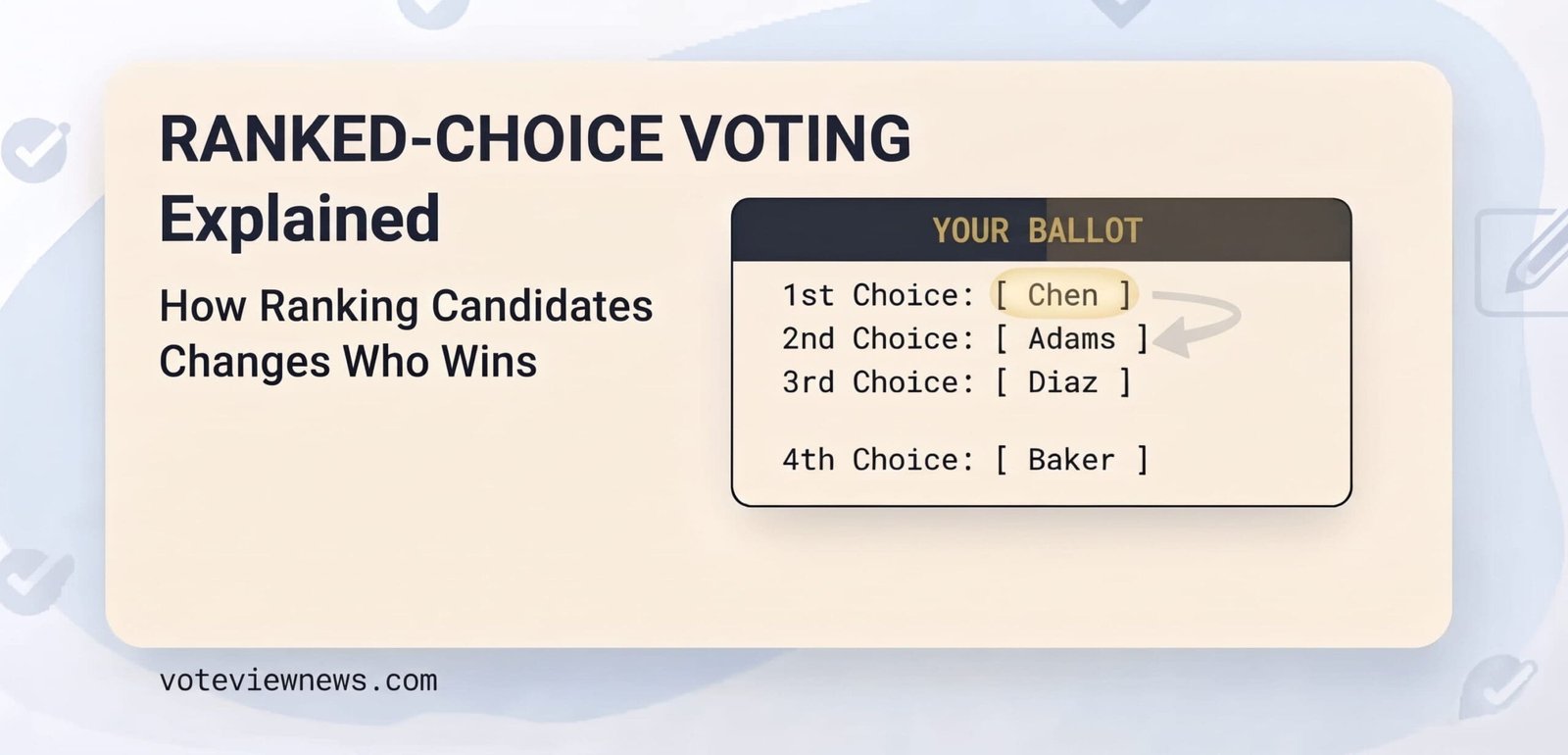
How Ranking Candidates Changes Who Wins
Opening
Picture yourself standing in a voting booth, staring at a list of candidates. Maybe you genuinely prefer a minor-party or independent candidate, but you’re worried that voting for that person could “waste” your vote — or worse, help elect the candidate you like least.
Do you vote for the person you actually want? Or the person you think has the best chance of beating the candidate you don’t want?
That tension — between voting for someone and voting against someone — is one reason some voters, cities, and states have turned to ranked-choice voting (RCV).
Ranked-choice voting lets you rank multiple candidates in order of preference instead of choosing just one.
But that raises an obvious question:
If voters can rank several candidates, how do election officials figure out who actually won?
The short answer: Think of ranked-choice voting as a built-in backup plan.
You rank candidates in order of preference — 1st choice, 2nd choice, 3rd choice, and so on:
- First count: Everyone’s first-choice votes are counted. If a candidate wins the required majority, the election is over.
- If no one reaches the threshold: The candidate with the fewest votes is eliminated.
- Your backup kicks in: If your first choice is eliminated, your vote can transfer to your next-ranked candidate who is still in the race.
- Repeat: The process continues until a candidate meets the winning threshold.
It’s like ordering food. If your favorite dish is sold out, the restaurant gives you your second favorite instead of sending you home hungry.
One thing to keep straight from the start: your choices are not all counted at the same time. Your vote still counts as one vote for one candidate at any given moment in the tally.
Quick Answers: People Are Asking
“Does ranked-choice voting let people vote multiple times?” No. Every voter gets exactly one vote per round. Your backups only activate if your top pick is eliminated. (Courts have upheld this — more below.)
“Can I rank my favorite candidate first, second, and third to boost them?” No. Your ballot counts for one candidate at a time. Extra rankings of the same person do nothing.
“Is it legal?” Yes, ranked-choice voting has survived federal constitutional challenges, although whether and how it can be used also depends on state law. We’ll look at the legal debate, and the states that have restricted or banned it, later in the article.
“Do I have to rank everyone?” Usually, no. Rank as many or as few as you like — but if all your ranked candidates get eliminated, your ballot is set aside for the rest of the count.
Ranked-choice voting sounds complicated until you see how the pieces fit together. Read straight through for the full explanation, or use the section links below to jump to the question you want answered.
Part 1 — What Is Ranked-Choice Voting?
Let’s start simple.
Imagine four candidates — Adams, Baker, Chen, and Diaz — running for mayor of a small town.
In a traditional “pick-one” election, your ballot might look like this:
☑ Chen
You choose one candidate. That’s it.
In a ranked-choice election, you can instead put the candidates in order of preference:
| Ranking | Candidate |
| 1st Choice | Chen |
| 2nd Choice | Adams |
| 3rd Choice | Diaz |
| 4th Choice | Baker |
But here’s the important part:
Those rankings do not give four candidates four votes.
When counting begins, your vote counts for Chen, your first choice. Adams gets nothing from your ballot at that point. Neither do Diaz or Baker.
Your other choices are backups.
If Chen remains in the race, your vote stays with Chen. If Chen is eliminated, your ballot can move to the next candidate you ranked who is still in the race.
Your ballot never counts for Chen and Adams at the same time. It counts for one continuing candidate at a time.
Part 2 — How Are Ranked-Choice Votes Counted?
Let’s watch an election from beginning to end.
Imagine a small town with 100 voters and four candidates: Adams, Baker, Chen, and Diaz.
For this example, a candidate needs 51 votes to win.
Round One — Count Everyone’s First Choice
First, election officials count only the candidate each voter ranked first.
| Candidate | First-Choice Votes |
| Adams | 38 |
| Baker | 32 |
| Chen | 20 |
| Diaz | 10 |
Adams is ahead with 38 votes, but Adams hasn’t won.
No candidate has reached 51.
This is an important difference from a traditional plurality election. In a pick-one election where the candidate with the most votes wins, Adams could win with 38% even though 62% of voters chose someone else.
Under the ranked-choice system in our example, the counting continues.
Round Two — Eliminate the Last-Place Candidate
Diaz has the fewest votes, so Diaz is eliminated.
Now election officials look at the 10 ballots currently counting for Diaz and find each voter’s next-ranked candidate who is still in the race.
Those ballots break down like this:
- 6 voters ranked Chen next
- 3 ranked Baker next
- 1 ranked Adams next
So those 10 votes transfer:
| Candidate | Round 1 | Transfers | Round 2 |
| Adams | 38 | +1 | 39 |
| Baker | 32 | +3 | 35 |
| Chen | 20 | +6 | 26 |
| Diaz | 10 | −10 | Eliminated |
Still nobody has 51 votes.
So we go another round.
Round Three — Another Candidate Is Eliminated
Chen now has the fewest votes and is eliminated.
This time, election officials look at the 26 ballots currently counting for Chen and find the next-ranked candidate on each ballot who is still in the race.
In our example:
20 transfer to Baker.
6 transfer to Adams.
And here’s the interesting part:
Baker didn’t lead in Round One. Adams did.
But Adams’s 38 first-choice votes weren’t enough to win under this system. Once voters’ backup preferences were considered, Baker ended up with the winning majority.
The Takeaway: Baker didn’t have the most first-choice votes. But after lower-finishing candidates were eliminated and those ballots transferred according to voters’ rankings, Baker ended with support from 55 of the 100 ballots in the final round.
That’s one of the central ideas behind ranked-choice voting: the candidate who starts in first place isn’t necessarily the candidate who finishes there.
Part 3 — What If You Don’t Rank Every Candidate?
One of the most common questions about ranked-choice voting is:
Do I have to rank everyone?
Generally, no. Ranked-choice voting gives you the option to rank candidates in order of preference. You don’t have to rank a candidate you don’t want to support.
Imagine you rank only Adams:
1st Choice — Adams
2nd Choice — blank
3rd Choice — blank
4th Choice — blank
Your vote counts for Adams as long as Adams remains in the race.
But if Adams is eliminated, there’s no next choice on your ballot to receive your vote.
That’s when your ballot can become exhausted.
What Is an Exhausted Ballot?
Despite the name, your ballot isn’t tired. 😄
An exhausted ballot simply means there are no remaining candidates on your ballot to whom your vote can transfer.
Maybe you ranked only one candidate and that person was eliminated. Or perhaps you ranked several candidates and eventually all of them were eliminated.
Your ballot was still counted in the rounds when one of your ranked candidates remained in the race. It simply stops participating once there is no remaining ranked choice to receive it. RCV systems recognize this situation as a ballot reaching the point where no further continuing candidate is ranked.
Does That Mean You Should Rank Everyone?
Not necessarily.
Ranking another candidate means:
“If the candidates I ranked above this person are eliminated, I would prefer this candidate over the other candidates still remaining.”
So don’t rank someone merely because there’s an empty space on the ballot.
But there is a tradeoff:
The fewer candidates you rank, the greater the possibility that your ballot will have no remaining choice in a later round.
Good to Know: Can I Rank My Favorite Candidate More Than Once?
This one is easy:
No extra votes.
Ranking Adams first, second, and third doesn’t give Adams three votes.
Remember our rule from Part 1:
Your ballot counts for one continuing candidate at a time.
Writing the same candidate multiple times doesn’t turn one ballot into several votes.
What If I Make a Mistake?
Ranked-choice ballots can have specific rules about skipped rankings, duplicate rankings, or ranking more than one candidate in the same position. Because those rules and ballot designs can vary, follow the instructions printed on your ballot.
If you’re voting in person and think you’ve made a mistake, ask an election worker what options are available before casting your ballot.
The Takeaway
You don’t get more votes by ranking more candidates. You get more backup choices.
Part 4 — Ranked-Choice Voting Isn’t One Single System
So far, we’ve been using ranked-choice voting to elect one person to one office.
But that’s not the only way ranked ballots can be used.
The mechanics can change depending on how many people are being elected and how the election itself is structured.
Single-Winner Ranked-Choice Voting
This is the version we’ve been using throughout the article.
One office is being filled — perhaps mayor or another elected position — and voters rank the candidates.
If no candidate reaches the required majority in the first round, the lowest-finishing candidate is eliminated and ballots transfer to voters’ next remaining choices.
The process continues until there is a winner.
This system is also commonly called instant-runoff voting because the additional rounds happen through the ranked ballot rather than through a separate runoff election.
Multi-Winner Ranked-Choice Voting
Ranked ballots can also be used when several seats are being filled at the same time, such as multiple seats on a city council.
This works differently from the system we’ve been demonstrating.
Instead of eliminating candidates until one person has a majority, multi-winner systems use a winning threshold based partly on the number of seats available. Candidates who reach that threshold can win seats, and votes may be transferred as the count continues.
The goal is to fill several seats rather than produce one majority winner. You may also hear this called proportional ranked-choice voting or the single transferable vote (STV) — the terminology and exact counting rules can vary.
Good to Know: RCV Can Be Combined With Other Rules
Alaska’s system, for example, uses a nonpartisan primary where the top four advance to a ranked-choice general election. That’s not a new type of RCV — it’s RCV as one piece of a larger election structure.
So, when someone says they support or oppose “ranked-choice voting,” ask: Which version — and for what office? The details matter.
Part 5 — Why Do Some People Support Ranked-Choice Voting?
Supporters of ranked-choice voting aren’t usually arguing that ranking candidates is inherently better than choosing one.
They’re arguing that it can solve — or at least reduce — some problems created by traditional plurality elections.
Here are the major arguments.
1. Voters Can Express Backup Preferences
In a traditional pick-one election, voters sometimes feel pressured to choose between the candidate they prefer and a candidate they believe has a better chance of winning.
Ranked-choice voting allows voters to rank a preferred candidate first while still naming backup choices.
Supporters argue this can reduce the familiar “spoiler effect.” We’ll look more closely at that claim in Part 7.
2. Winners Must Build Support Beyond Their First-Choice Voters
In our imaginary election, Adams had the most first-choice votes.
But that wasn’t enough to win.
Because no candidate initially had a majority, voters’ later preferences mattered.
Supporters see that as an advantage. They argue that a candidate should have to build support beyond a narrow first-choice plurality rather than win a crowded race with, say, 35% or 40% of the vote. The EAC identifies broader majority support as one of the principal arguments proponents make for alternative voting systems.
There is an important qualification:
The final winner may have a majority of ballots still active in the final round, not necessarily a majority of everyone who originally cast a ballot.
That’s because some ballots can become exhausted.
3. Candidates May Have a Reason to Appeal Beyond Their Base
Ranked-choice voting can also change the incentives of a campaign.
A candidate may still want your first-choice vote. But if they can’t get it, your second-choice ranking could matter too.
That gives candidates another reason to appeal to people who support their opponents:
“If I’m not your first choice, would you consider ranking me second?”
Supporters argue that this incentive could encourage broader outreach and discourage scorched-earth campaigning.
4. It Can Replace a Separate Runoff Election
Some jurisdictions hold a second election if nobody wins the required majority in the first.
Single-winner RCV can essentially build that runoff process into the original ranked ballot. The lowest-finishing candidates are eliminated through successive counting rounds rather than requiring voters to return for another election.
That’s why you’ll sometimes hear it called:
instant-runoff voting.
Supporters argue this can avoid the cost and logistical burden of holding a separate runoff election.
The Bigger Argument
Put all of these arguments together, and the case supporters make for ranked-choice voting is fairly simple:
Let voters express more than one preference, require candidates to compete for broader support, and resolve a runoff through the original ballot rather than another trip to the polls.
But every one of those changes introduces tradeoffs.
And that’s where critics come in.
Part 6 — Why Do Some People Oppose Ranked-Choice Voting?
Critics of ranked-choice voting aren’t necessarily arguing that voters shouldn’t have more choices.
Their concern is that giving voters more choices also makes the ballot — and the counting process — more complicated.
Here are the major arguments.
1. It Is More Complicated Than “Pick One”
There’s no getting around this one.
Choosing:
☑ Candidate A
is simpler than:
1st — Candidate A
2nd — Candidate C
3rd — Candidate B
With ranked-choice voting, voters have to understand what the rankings mean, how to mark the ballot correctly, and what happens if one of their choices is eliminated.
Critics worry that added complexity can lead to mistakes or discourage voters who aren’t familiar with the system.
But there’s an important distinction:
More complicated doesn’t automatically mean too complicated.
Ballot errors happen under traditional voting systems too, and research hasn’t established that RCV simply produces dramatically higher error rates across the board. Some research has found similar overall error rates while identifying differences among groups of voters, which makes ballot design and voter education especially important.
That’s why jurisdictions adopting RCV often put significant effort into voter education. The EAC specifically identifies voter education as an important part of implementation.
2. The Winner May Not Be Known on Election Night
Ranked-choice voting can also take longer to tabulate than a simple plurality contest.
Election officials first have to determine the complete pool of ballots that will be included in the count. Then, if no candidate wins in the first round, additional rounds of elimination and transfer must be calculated.
Slower doesn’t necessarily mean something went wrong.
Election-night results are unofficial in American elections generally. Mail ballots, provisional ballots, canvassing, and other procedures can mean final results take days or sometimes weeks even in elections that don’t use ranked-choice voting. With RCV, the additional rounds can add another step before the final winner is known.
3. Some Ballots Can Become Exhausted
As we explained in Part 3, a ballot becomes exhausted when none of that voter’s ranked candidates remain.
That matters when we talk about a “majority winner.”
Suppose 100 people vote, but only 90 ballots remain active in the final round. A candidate could win with 46 votes — a majority of the 90 active ballots, but not a majority of the original 100.
Critics argue that distinction complicates claims that RCV always produces a majority winner. Supporters respond that exhausted ballots still counted in earlier rounds.
The real question is what we mean when we say “majority.”
4. Changing an Election System Costs Money and Takes Work
Switching to ranked-choice voting isn’t as simple as printing numbers next to candidate names.
Depending on the jurisdiction, implementation can involve:
- voting-system software or equipment changes
- testing and certification
- redesigned ballots
- election-worker training
- new tabulation procedures
- voter-education campaigns
The EAC specifically warns jurisdictions to anticipate additional costs, training, procurement, legal requirements, and potentially new or updated voting systems when adopting alternative voting methods.
That creates a legitimate policy question:
Does the problem RCV is trying to solve justify the cost and complexity of changing the system?
Different communities can reasonably answer that question differently.
The Bigger Argument
Ranked-choice voting isn’t simply a choice between a “more democratic” system and a “less democratic” one.
It’s a tradeoff.
RCV gives voters more ways to express their preferences, but it also asks voters and election administrators to navigate a more complicated system.
Whether that tradeoff is worthwhile depends partly on what problem a community is trying to solve.
Supporters Point To
- More ways for voters to express their preferences
- Less pressure to abandon a preferred candidate
- Incentives to seek support beyond a candidate’s base
- A runoff process built into the original ballot
Critics Point To
- A more complicated ballot and counting process
- Results that may take longer to determine
- Ballots that can become exhausted
- Implementation, training, and voter-education costs
Part 7 — Does Ranked-Choice Voting Eliminate the “Spoiler Effect”?
One of the biggest arguments for ranked-choice voting is that it can reduce the spoiler effect.
Here’s the basic problem.
Imagine a traditional pick-one election:
Candidate A — 45%
Candidate B — 42%
Candidate C — 13%
Candidate A wins because A received the most votes.
But suppose most of Candidate C’s voters actually preferred Candidate B over Candidate A.
Now the result gets interesting.
If Candidate C hadn’t been in the race, many of those voters might have chosen B instead — potentially changing the winner.
That’s what people mean when they talk about a candidate “splitting the vote” or acting as a “spoiler.”
What Changes Under Ranked-Choice Voting?
Now give those same voters a ranked ballot.
A voter who really prefers Candidate C could rank:
1st — Candidate C
2nd — Candidate B
They don’t have to abandon their favorite candidate because they’re worried C can’t win.
If C is eliminated, that ballot can transfer to B.
So instead of forcing the voter to choose between:
“Who do I really want?”
and
“Who has the best chance of beating the candidate I don’t want?”
the ranked ballot can capture both preferences.
That’s why supporters argue RCV can reduce the familiar spoiler problem created when similar candidates divide first-choice votes.
But Does RCV Eliminate the Spoiler Effect Completely?
No.
Reality Check: RCV Doesn’t Solve Every Mathematical Problem
Ranked-choice voting can reduce ordinary vote-splitting, but no voting system produces a perfect result in every possible election.
Because candidates are eliminated round by round, unusual outcomes are possible. For example, a candidate who could beat every opponent in separate one-on-one contests — known as a Condorcet winner — can theoretically be eliminated before reaching the final RCV round.
That’s uncommon, but it illustrates an important point:
Different voting systems measure voter preferences in different ways.
Plurality voting asks who received the most first-choice votes. Ranked-choice voting considers voters’ later preferences through elimination rounds. Neither system eliminates every possible mathematical quirk.
The Takeaway: RCV can reduce the traditional spoiler problem. It doesn’t make every complicated election mathematically simple.
Part 8 — Is Ranked-Choice Voting Constitutional?
Whenever ranked-choice voting makes headlines, one question comes up quickly:
Is this actually legal?
At the federal level, courts have upheld ranked-choice voting against constitutional challenges.
In the 2011 case Dudum v. Arntz, for example, voters challenged San Francisco’s ranked-choice system, arguing in part that it allowed some voters to cast more votes than others.
The Ninth Circuit rejected that argument.
The reason goes back to something we’ve emphasized throughout this article:
Ranking several candidates does not mean casting several votes at once.
A ballot counts for only one continuing candidate at each stage of the count. The court described the rankings as preferences counted sequentially, not simultaneously.
But States Can Still Restrict It
Something can be constitutionally permissible without every state being required to use it.
States establish many of the rules governing how their elections operate, subject to federal constitutional and statutory requirements. That means state law can determine whether ranked-choice voting is permitted, required, restricted, or prohibited.
And states have gone in very different directions. We’ll look at that landscape in Part 9.
The Takeaway:
“Constitutional” doesn’t mean “required.”
Ranked-choice voting can survive a federal constitutional challenge while a state still chooses not to use it.
Part 9 — Where Is Ranked-Choice Voting Used Today?
Ranked-choice voting is unusual because the country is moving in two directions at once.
Some states and cities are adopting or expanding it. Others are banning or restricting it.
Where It’s Used
Maine and Alaska use ranked-choice voting in statewide elections, although the exact offices and election procedures differ.
RCV is also used in a variety of local elections. New York City uses it in certain primary and special elections, while other cities use different versions for local offices.
Several other states explicitly permit or require ranked-choice voting in at least some elections.
Where It’s Restricted
At the same time, opposition has grown rapidly.
As of 2026, 19 states prohibit ranked-choice voting in all or some elections, while eight states plus Washington, D.C., permit or require it in certain elections. Elsewhere, the legal picture varies.
Indiana and Ohio joined the restriction side in 2026. Ohio’s law has an unusual twist: rather than simply prohibiting municipalities from adopting RCV in every circumstance, it makes a municipality that approves RCV ineligible for certain Local Government Fund distributions from the state. (cleveland.com)
So two seemingly contradictory headlines can both be true:
“Ranked-choice voting is expanding.”
and
“More states are banning ranked-choice voting.”
It depends on where you look.
Ashtabula, Ohio becomes the first U.S. city to use a multi-winner Single Transferable Vote system.
Malta begins using the Single Transferable Vote system.
Maine voters approve ranked-choice voting for statewide elections.
Maine first uses ranked-choice voting in statewide primaries.
Australia, Ireland, Malta, and U.S. jurisdictions use different forms of ranked or preferential voting.
Beyond the United States
Ranked voting isn’t uniquely American. Australia uses preferential voting in federal elections, while Ireland and Malta use versions of the Single Transferable Vote, in which voters rank candidates and preferences can transfer during the count.
The systems aren’t identical to every form of ranked-choice voting used in the United States, but the underlying idea — rank candidates in order of preference and allow later choices to matter — is well established internationally.
Why the Map Matters
Ranked-choice voting isn’t simply spreading across America — and it isn’t simply being rejected.
It’s being tested.
Different states and cities are making different choices about whether its benefits outweigh its complexity.
That gives Americans something unusually valuable: real-world elections to study instead of arguing only about theory.
Part 10 — Navigating the News
Ranked-choice voting can produce headlines that sound alarming — especially if you don’t know which round of counting a headline is describing.
Here are two claims worth looking at carefully.
Claim: “Candidate X Was Winning — Then Ranked-Choice Voting Made Them Lose”
The first question to ask is:
Winning when?
A candidate can lead after first-choice votes are counted without having met the threshold required to win.
If additional rounds are required, those rounds aren’t overturning an earlier victory. They’re completing the counting process under the rules of that election.
Think back to our example: Adams led 38–32 after the first round.
But Adams hadn’t won yet.
After the remaining ballots transferred according to voters’ rankings, Baker won 55–45.
Leading is not the same thing as winning.
That’s true in RCV for the same basic reason an early election-night lead in a traditional election isn’t necessarily a final result: the count isn’t finished yet.
Claim: “RCV Lets Some People Vote More Than Once”
This sounds plausible because a ballot may appear in several rounds—but it’s only counted once. If your first choice is eliminated, the ballot moves to your next choice; if not, it stays put. Federal courts have held this is one vote, counted sequentially across rounds (see Dudum v. Arntz in Part 8).
One Question Cuts Through Most RCV Arguments
When you encounter a dramatic claim about ranked-choice voting, ask:
What would have happened under a different voting system?
A candidate winning with 38% might look strange under RCV.
A candidate losing after leading with 38% might look strange under RCV.
Neither number tells you by itself which system is better.
That’s a question for voters and lawmakers — not for election-night arithmetic.
Final Thoughts
Ranked-choice voting can sound complicated when it’s explained through rounds, transfers, exhausted ballots, thresholds, and election law.
But the basic idea is much simpler:
You still have one vote. Ranking candidates gives that vote instructions about where to go if your earlier choices are eliminated.
Whether that’s a better way to run an election is a different question.
Supporters see ranked-choice voting as a way to give voters more choices, reduce vote-splitting, and require candidates to compete for support beyond their strongest base.
Critics see added complexity, implementation costs, the possibility of exhausted ballots, and a counting process that can be harder for voters to follow.
Both are describing real features of the system.
Ranked-choice voting doesn’t eliminate every problem with elections. Neither does the traditional pick-one system.
Ultimately, the debate isn’t simply about whether ranked-choice voting is good or bad.
It’s about something more useful:
What do we want our voting system to measure, what problems are we trying to solve, and what tradeoffs are we willing to accept?
Understanding how the system actually works is the first step toward answering those questions.
Further Reading: Who Runs Elections




No discussions yet
Be the first to join the discussion and share your thoughts with the community.