
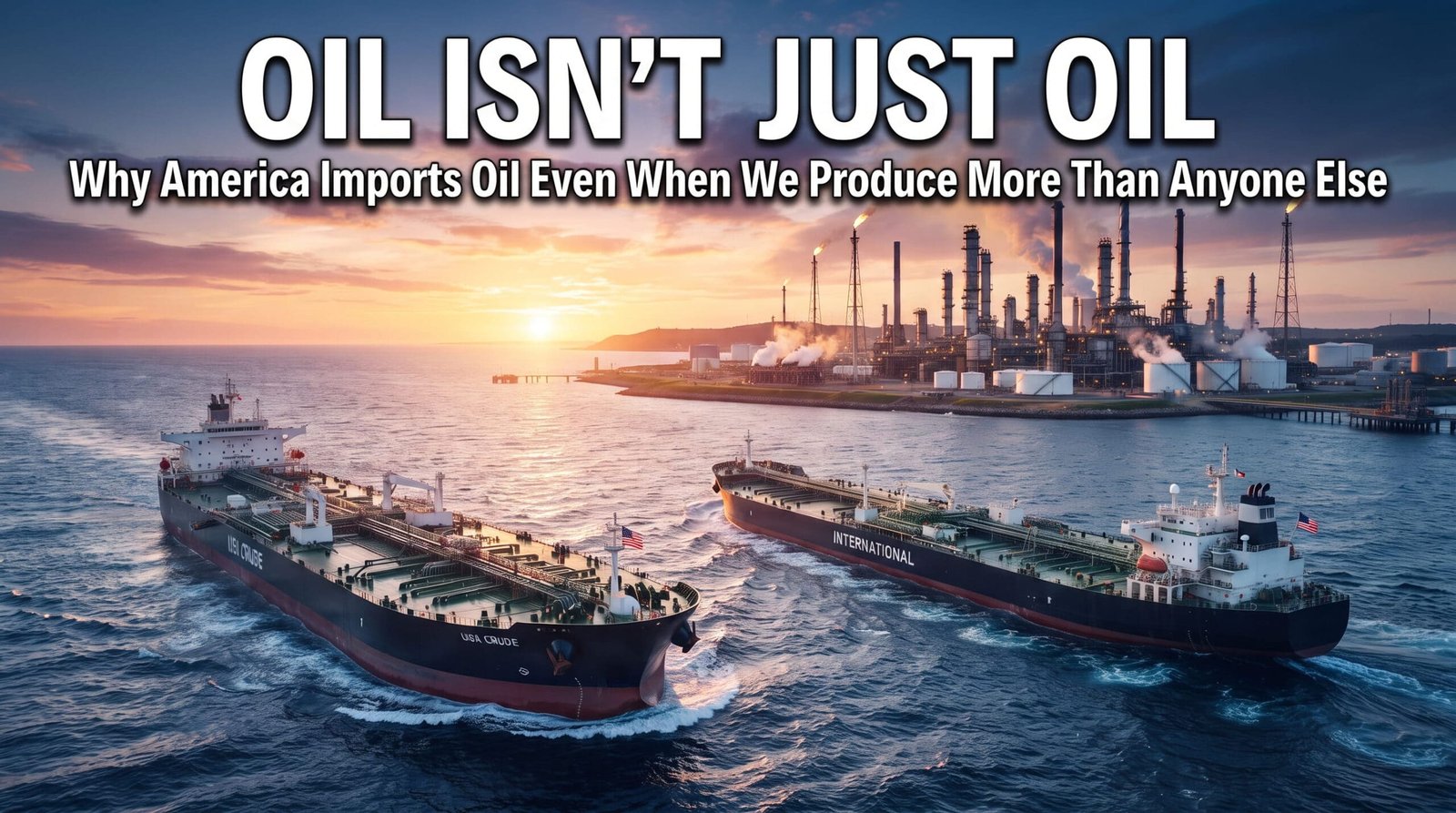
The United States pumps more crude oil out of the ground than any other country on Earth.
In 2025, American production averaged a record 13.6 million barrels per day — more than Russia or Saudi Arabia. The United States has held the title of world’s largest crude oil producer since 2018. And yet, in that same year, the United States imported about 6.2 million barrels of crude oil every day while exporting about 4 million barrels per day of its own crude.
At first glance, that makes very little sense. If America produces more oil than anyone else, why are tankers bringing foreign oil into American ports while other tankers carry American oil out? Why not just keep ours?
The answer starts with something that gets lost in almost every political argument about oil: crude oil is not one interchangeable product. Different types of crude have different physical properties, American refineries were built to process different mixtures of those crudes, and the petroleum system we use today developed over decades — long before the shale boom transformed what kind of oil the United States produces. Once you understand that mismatch, the strange sight of oil traveling in both directions starts making considerably more sense.
Source: The US Produced More Crude Oil Than Any Other Country in 2025
Because it isn’t only a question of whether America has enough crude. It also matters what kind of crude we produce and what kind American refineries are designed to process.
No. American crude production set another record in 2025. Imports continue because of refinery design, geography, transportation costs, crude quality, and economics.
If “energy independence” means producing more total energy than we consume or exporting more energy than we import, the United States has already reached versions of it. In 2025, the United States exported substantially more energy than it imported — while still importing enormous quantities of petroleum. If independence means America can stop relying on international energy markets entirely, that is a very different claim — and not how the modern economy works.
Because many American refineries were specifically designed to process heavier crude that domestic wells do not produce in the same abundance. Restricting those supplies would force refiners to find substitutes, change their crude mixtures, invest in different equipment, or reduce output — and those costs can ultimately reach consumers. There is no switch labeled FOREIGN OIL that turns off the imports while everything else stays the same.
A country does not have to make everything itself to be secure. It needs enough domestic capacity, diverse suppliers, infrastructure, emergency reserves, and alternatives — so that losing one source does not cripple the system. That is the difference between isolation and resilience.
Oil Isn’t Just Oil
When most of us hear “a barrel of oil,” it sounds like a standard unit of an identical product — one barrel interchangeable with another. It isn’t. Crude oil varies depending on where and how it formed, and two characteristics are particularly important.
Light Crude
Flows relatively easily and generally produces a larger share of valuable products such as gasoline and diesel with less intensive processing.
Heavy Crude
Thicker and more difficult to process. Some extra-heavy crude may be blended with lighter hydrocarbons to make it easier to transport through pipelines and process.
Sweet Crude
Contains relatively little sulfur and generally requires less sulfur removal during refining.
Sour Crude
Contains more sulfur, requiring additional equipment and processing to meet fuel and environmental specifications.
That might sound like a chemistry lesson until we get to the part that explains American imports — because refineries aren’t interchangeable either.
A Refinery Has a Diet
A refinery is not simply a giant machine where any barrel of crude goes in one end and gasoline comes out the other. It is closer to an enormous chemistry plant combining distillation towers, crackers, cokers, desulfurization equipment, and other processing units. Those configurations determine which types of crude a refinery can process most efficiently, and changing them can require enormous investment.
Over decades, many American refineries — particularly the huge complexes along the Gulf Coast — invested heavily in equipment capable of processing medium and heavy, sour crude. Those grades were readily available from countries including Canada, Mexico, and Venezuela, and heavier crude has often sold at a discount because it is more difficult to refine. A sophisticated refinery capable of handling it can turn that cheaper raw material into valuable gasoline, diesel, jet fuel, and other products.
Then American oil production changed. Beginning in the late 2000s, horizontal drilling and hydraulic fracturing unlocked enormous quantities of shale oil — much of it relatively light and sweet. By 2025, the Permian Basin of Texas and New Mexico alone accounted for approximately 48% of all U.S. crude production.
America suddenly had enormous quantities of one kind of oil flowing into a refining system in which many facilities had spent decades investing in the ability to process something different. The oil coming out of American wells changed faster than America’s refining system did.
Source: U.S. crude oil production increases; imports remain strong to support refinery operations
The Mismatch
Large quantities of relatively light, sweet crude
Mixtures that include medium and heavy, sour crude
The United States can export some domestically produced light crude while importing heavier grades that fit particular American refineries.
So imagine two oil tankers passing each other. One is leaving an American port carrying light American crude to a refinery overseas that values it highly. The other is arriving with heavier foreign crude destined for a Gulf Coast refinery equipped to process it efficiently. Neither ship represents a failure of American energy policy; both trips can make economic sense at the same time.
Why Don’t We Just Rebuild the Refineries?
If America now produces enormous quantities of light crude, why not redesign our refineries around the oil we produce?
To some extent, refiners have adjusted. But these are among the most complicated and expensive industrial facilities in the economy, and companies make investment decisions based on crude prices, transportation costs, expected demand, and how long an investment is likely to remain profitable. The EIA has found that Gulf Coast refineries capable of processing imported heavy, sour crude can have a genuine economic incentive to keep doing so even as American production expands — because discounted heavy crude, processed by equipment built for it, can be more profitable than light crude those refineries were never optimized for.
In other words, these refineries are not outdated machines waiting for someone to fix them. Many were deliberately built to do something difficult — and potentially profitable.
The Global Filling Station
Refinery design explains why oil travels in seemingly strange directions. But there is another reason record American production cannot completely insulate American consumers from events overseas: oil is traded in a global market. Prices respond to supply and demand, wars, sanctions, production decisions, economic growth, transportation disruptions, and expectations about what may happen next.
Consider the Strait of Hormuz, the narrow waterway connecting the Persian Gulf with the Arabian Sea and one of the world’s most important petroleum transit routes. A serious disruption there can affect prices thousands of miles away, including in the United States — which is why a president cannot simply set the price of gasoline by ordering more drilling, and why record domestic production cannot guarantee that wars, hurricanes, sanctions, or supply disruptions elsewhere never reach American consumers. Domestic production matters. So do refineries, pipelines, ports, inventories, emergency reserves, and reliable trading partners. The system works together.
America Imports Oil — And Exports It
Once you understand the refinery mismatch and the global market, the numbers stop looking like a contradiction. American producers sell crude where it is valuable. American refiners buy crude grades that work efficiently in their facilities, then sell finished products both at home and abroad — about 2.4 million barrels per day of gasoline, diesel, and jet fuel went to other countries in 2025, alongside the crude exports above.
The United States is not an isolated oil tank. It is one of the world’s largest producers, refiners, consumers, and traders of petroleum. Ships travel in both directions because the products, refineries, markets, and locations are different.
We Don’t Just Put Oil in Cars
When Americans talk about petroleum, the conversation usually ends up at the gas pump. But gasoline is only part of the story.
In 2025, petroleum products supplied about 89% of the energy used by the U.S. transportation sector. Gasoline accounted for the largest share, followed by diesel and jet fuel. Biofuels, natural gas, and electricity supplied much smaller portions.
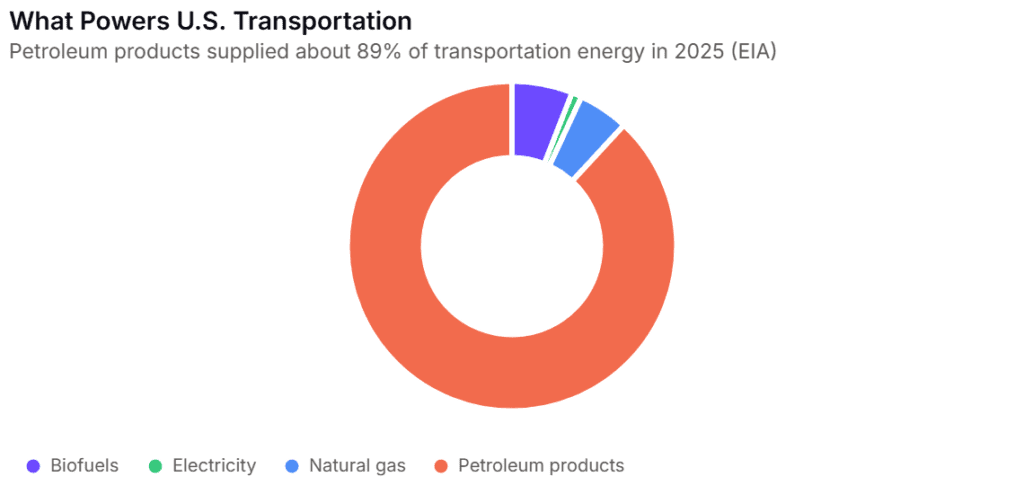
That means petroleum still powers most of the system moving people and goods around the country — cars, trucks, airplanes, ships, tractors, and delivery vehicles. And petroleum’s role reaches beyond transportation: petroleum and other hydrocarbon feedstocks are used throughout modern industry in plastics and synthetic materials, lubricants, asphalt, solvents, waxes, and many other products.
This is where comparing today’s economy with the nineteenth century becomes useful. In 1880, a disruption in international petroleum trade could not disrupt commercial aviation, interstate trucking, or a modern petrochemical supply chain — because those systems did not exist. Today’s economy is built around highly specialized networks connecting wells, pipelines, refineries, chemical plants, ports, railroads, highways, and international shipping. Having natural resources underground is only one part of energy security; you also have to be able to turn them into something people can use and get that product where it needs to go.
Venezuela itself is a rather spectacular example of what happens when those two things are confused.
Source: Short-Term Energy Outlook
What Would True Independence Actually Look Like?
“Energy independence” sounds simple as a slogan. So let’s make it concrete. Imagine independence meant the United States should avoid relying on other countries whenever possible — not merely for crude oil, but for the materials, technology, and supply chains that allow a modern economy to function.
Start with your car. Modern vehicles depend on complicated supply chains extending across North America, Asia, and Europe. America could certainly manufacture more vehicle components domestically — and there are good economic and national-security reasons to do so. But making more things here is different from making everything here.
Suppose instead we simplified. Could you live with a Model T? It topped out at roughly 40–45 miles per hour, with no air conditioning, airbags, GPS, touchscreen, modern crash protection, or computer-managed brakes. Now imagine driving it on the highway — next to all the other Model Ts, none of which are going 70 either. You’d want to leave considerably earlier for work.
And it wouldn’t just be your car. Buses, trains, trucks, airplanes, and delivery systems all depend on fuels, materials, electronics, and parts that cross borders. The grocery store needs trucks. The pharmacy needs deliveries. Farmers need machinery, fertilizer, fuel, and replacement parts. A modern economy is a web: pulling out one international connection does not necessarily break it, but trying to remove all of them would change the economy itself.
None of this means America should simply accept every dependence it has. The real distinction is between saying “we should be able to function if a supplier cuts us off” — a goal the United States can genuinely pursue through domestic capacity, diversified suppliers, and emergency reserves — and saying “we should never need another country,” which would require rebuilding the modern economy at a cost no politician who promises it ever itemizes.
Before we promise the second, there is a practical question worth asking: what are we willing to give up — or pay more for — to get there?
What This Means for You
The next time you hear an argument about American energy, you don’t need to memorize refinery engineering or international petroleum statistics. A few simple questions tell you quite a lot.
“America produces plenty of oil.”
AskWhat kind of oil?
“We’re still importing foreign oil.”
AskFrom where, and why?
“We’re going to achieve energy independence.”
AskWhat exactly does independence mean?
“This policy will determine gasoline prices.”
AskWhat else is happening with global supply, demand, refining, transportation, and geopolitical disruptions?
The point isn’t to make energy policy complicated for the sake of complexity. It is to recognize when a complicated system is being sold as something much simpler than it really is.
Why This Matters for the Venezuela Deal
And that brings us back to those 65 billion barrels. The potential value of Venezuelan petroleum to the United States isn’t simply that Venezuela has an enormous amount of oil underground — it is also the kind of oil Venezuela has. Much of Venezuela’s crude is heavy, while enormous amounts of recent American shale production are light, and sophisticated Gulf Coast refineries already have equipment capable of processing heavier grades. That makes additional Venezuelan production potentially useful to American refiners and potentially valuable to U.S. energy security.
But the lesson from the first article still applies. Venezuela possessing oil does not mean that oil is immediately available — production requires wells, infrastructure, workers, investment, and time. And access to another source of crude cannot separate American consumers from a global petroleum market.
The strange part isn’t that the world’s largest oil producer still imports oil. Once you understand how the system works, it would be stranger if we didn’t.
America doesn’t need to produce everything itself to be more secure. It needs domestic capacity, reliable alternatives, diversified suppliers, and the ability to keep functioning when one source disappears.
Join the Discussion
- Before reading this article, did it seem contradictory that the United States could be the world’s largest oil producer and still import millions of barrels of crude every day? Does the refinery mismatch change how you think about that?
- Where should the United States draw the line between normal international trade and dangerous dependence on another country?
- Does the Model T thought experiment change how you think about the difference between producing more in America and trying to produce everything in America?
- When politicians promise “energy independence,” what would you now want them to explain before deciding whether their proposal could actually deliver it?
Continue the Series
The 65-Billion-Barrel Promise
What the Venezuela Oil Deal Really Means for American Energy and why 65 billion barrels underground does not mean 65 billion barrels of American oil — and what the United States actually received.
How Venezuela Got Here
Why Hugo Chávez once attracted enormous support, what happened to Venezuela’s oil wealth, how the petroleum industry deteriorated, and how the country eventually reached the 2026 U.S. intervention.
Coming Soon
Who Benefits This Time?
Who is receiving opportunities in Venezuela’s new oil economy, what the United States receives, what Venezuelans receive, and how to distinguish legitimate questions about political connections from claims the evidence does not prove.
Coming Soon




No discussions yet
Be the first to join the discussion and share your thoughts with the community.