
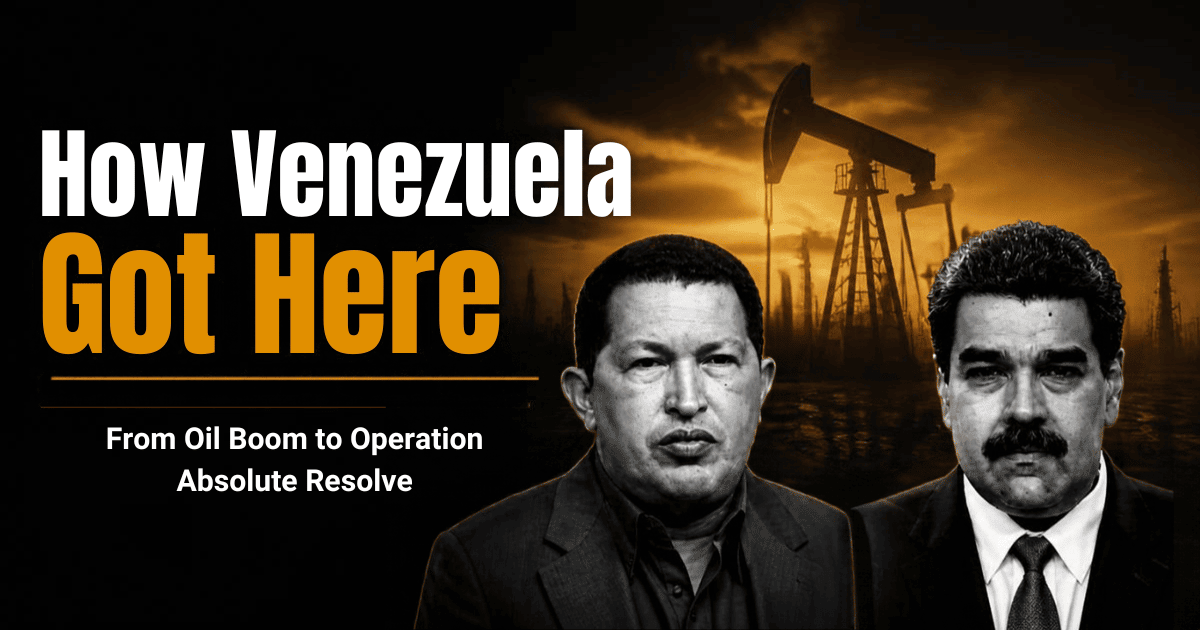
In 1950, Venezuela was one of the richest countries per person in the Western Hemisphere.
In 1998, it produced roughly 3.4 million barrels of oil per day.
By 2020, production had fallen below 400,000 barrels a day, and millions of Venezuelans had left the country.
And in January 2026, American forces entered Caracas and captured Nicolás Maduro.
Any one of those facts would make for a remarkable national story. Together, they describe one of the most dramatic political and economic transformations in modern Latin America. How does that happen?
The answer is not one election, one ideology, one president, one foreign government, or one disastrous decision. Venezuela got here through a sequence of choices — some understandable, some popular, some successful for a time, and some devastating in hindsight. That distinction matters, because the shorthand version of this story is usually one of two sentences:
“Socialism destroyed Venezuela.”
Or:
“The United States destroyed Venezuela.”
Neither sentence explains what actually happened. To understand Venezuela, we have to start with something much harder: why millions of Venezuelans enthusiastically supported Hugo Chávez in the first place — and why many continued supporting him even as the system around him began to change.
Running underneath that history is a question much larger than Venezuela: what happens when a leader who believes he has a mandate to fix a broken system begins to believe that protecting his mission requires removing the institutions that can restrain him? Venezuela gives us an extraordinary case study because the transformation did not happen overnight. Chávez won elections. He remained enormously popular. His government delivered tangible benefits to millions of people who believed the old political system had ignored them. And then, step by step, the boundaries began to move.
Estimated reading time: 12–14 minutes
People Are Asking
Did socialism destroy Venezuela? Not by itself. Venezuela’s economy collapsed under governments that described their political project as socialist, but that sentence leaves out decades of dependence on oil, the deterioration of the state oil company, borrowing, currency and price controls, an oil-price collapse, corruption, political concentration, monetary policy, declining investment, and eventually increasingly severe international sanctions. Those pieces did not arrive at the same time, and the sequence matters.
Did Chávez actually help poor Venezuelans? Yes. His government expanded healthcare, literacy programs, subsidized food, housing, and other services through programs known as misiones. Poverty fell substantially during the oil-boom years, and many Venezuelans who had felt excluded from the country’s political and economic system became active participants in it. That history matters because Chávez’s popularity cannot be understood simply as propaganda or personality: for many Venezuelans, life really did improve. The harder question was whether the system paying for those improvements could survive when the oil money stopped pouring in.
Was Chávez a dictator from the beginning? No. Chávez won the presidency in 1998 with about 57% of the vote after campaigning against corruption, poverty, and Venezuela’s deeply unpopular political establishment. He won another election under the new constitution in 2000 and remained electorally popular for years. The concentration of political power came gradually — which is precisely why the story is worth understanding.
Did the United States cause Venezuela’s collapse? U.S. policy eventually contributed significantly to Venezuela’s economic isolation, particularly through sanctions that became much broader during the Maduro years. But Venezuela’s major structural problems — including declining oil production, PDVSA’s loss of expertise, excessive dependence on petroleum revenue, borrowing, and economic distortions — were developing before the broadest oil sanctions arrived. Washington matters in this story. So do decisions made in Caracas.
Part I — The Country That Oil Built
Venezuela’s modern history begins underground. Commercial oil development accelerated around Lake Maracaibo in the early twentieth century, and by the 1920s Venezuela had become one of the world’s great petroleum exporters.
Oil transformed the country. It financed highways, universities, public services, and a growing urban middle class. By the middle of the twentieth century, Venezuela had one of the highest per-capita incomes in Latin America. But oil created a contradiction that would follow Venezuela for generations: the country could be extraordinarily rich while many of its citizens still felt poor. Foreign companies played a dominant role in extracting and selling Venezuelan petroleum. The Venezuelan government collected royalties and taxes, but many citizens believed too much of the country’s wealth was flowing outward — or upward to a small, politically connected class.
In 1976, Venezuela nationalized its petroleum industry and created the state oil company PDVSA. This was not Hugo Chávez’s revolution: it happened twenty-two years before he became president, and nationalization enjoyed broad political support. Venezuelans across the political spectrum believed the country should exercise greater control over the resource beneath its own soil. For a while, the system appeared remarkably successful.
Venezuela was also unusual in another way. After 1958, while military governments ruled much of Latin America, Venezuela maintained civilian democratic government and peaceful transfers of power, dominated by two major parties. Eventually, that stability became part of the problem.
Part II — When the Old System Stopped Working
Oil revenue can hide an extraordinary number of problems when prices are high. When prices fall, it becomes much harder. During the 1980s, declining petroleum prices battered Venezuela’s economy. Debt grew. Inflation rose. Living standards deteriorated, and corruption scandals damaged confidence in political leaders who had spent decades promising that oil wealth would guarantee prosperity.
Then came February 1989. President Carlos Andrés Pérez adopted an economic adjustment program that included higher fuel and transportation costs. Protests and riots erupted in Caracas and spread elsewhere. The government sent in the military, and hundreds of people were killed in what became known as the Caracazo. The exact death toll remains disputed, but the political consequence is much easier to see: for many Venezuelans, the old system had lost its legitimacy. They lived in one of the most oil-rich countries on Earth, yet their government was telling them there wasn’t enough money. Then, when people took to the streets, the government sent soldiers.
Three years later, a 37-year-old army lieutenant colonel attempted to overthrow that government. His name was Hugo Chávez. The February 1992 coup failed, but something unexpected happened afterward. Chávez appeared on television and told the soldiers supporting the rebellion to surrender. He accepted responsibility and said their objectives had failed — “por ahora.”
For now.
He went to prison, and his political career had begun.
Part III — Why Venezuelans Chose Chávez
Chávez was pardoned in 1994 and eventually traded his military rebellion for electoral politics. By 1998, Venezuela’s traditional political establishment was deeply unpopular after repeated recessions, corruption scandals, and growing distrust of the two parties that had dominated national politics for decades.
Chávez offered something different. He promised to fight corruption, rewrite the constitution, and challenge a political elite that many Venezuelans believed had squandered the country’s oil wealth. And most importantly, he asked an extraordinarily powerful question: How can a country this rich have so many people who feel left behind?
That question had a factual basis. Venezuelans did not vote for hunger, hyperinflation, or authoritarianism in 1998. They voted for a political outsider promising to repair a system many of them already believed was broken. Chávez won with roughly 56% of the vote, and his support did not disappear after the election: voters approved a new constitution in 1999, and Chávez won another presidential election in 2000. His movement increasingly brought working-class Venezuelans into politics, and during the years that followed, government programs reached communities where many residents felt the state had previously been absent.
Understanding that popularity is essential. Otherwise, the rest of the story makes no sense.
Part IV — When the Revolution Was Working
Beginning in the early 2000s, Chávez’s government expanded a collection of social programs known as the Bolivarian Missions, or misiones. They offered community healthcare, literacy programs, subsidized food, housing, and other assistance. Millions of Venezuelans benefited: poverty declined substantially during the oil-boom years, and previously marginalized communities gained services and a stronger political voice. Chávez wasn’t simply telling supporters that his revolution was helping them — many could see changes in their own neighborhoods.
Then Venezuela received an extraordinary piece of luck. Oil prices soared. Petroleum that had sold for around $10 a barrel in the late 1990s eventually approached above $130 during the 2008 global price spike. Money flooded into an economy built around oil, and that revenue allowed Chávez to expand government programs, subsidies, and public spending while strengthening the political coalition supporting him. For a while, the model looked remarkably successful.
But there was a vulnerability hiding inside that success: nearly all of it ran on oil revenue the government did not control and could not count on. When the price fell, so would everything the promises were built on.
Part V — The Coup That Changed the Political Climate
Then came April 2002.
Opposition to Chávez had grown sharply, including a bitter conflict over his attempts to exert greater control over PDVSA. Mass demonstrations ended in violence on April 11. Military officers detained Chávez, and Pedro Carmona, the head of Venezuela’s largest business federation, declared himself interim president.
Then Carmona went much further. His government dissolved the National Assembly, suspended key democratic institutions, and discarded the constitutional order Chávez’s opponents had claimed they were defending. The new government lasted roughly two days: military units changed sides, Chávez supporters filled the streets, and Chávez returned to the presidential palace.
The episode profoundly changed Venezuelan politics. It also created a question that remains controversial decades later: what did Washington know? The Bush administration denied planning or encouraging Chávez’s removal, and a later State Department Inspector General review reported finding no evidence that the State Department or U.S. Embassy had planned, participated in, or encouraged the overthrow. But American officials had contacts with opposition figures, and the initial U.S. response to Chávez’s removal generated lasting suspicion in Venezuela. Those facts should not be stretched beyond the evidence — but neither should the political effect be ignored.
Chávez had now experienced something most elected presidents never do: his opponents had actually removed him from office. For his supporters, the coup reinforced the belief that powerful Venezuelan interests — and perhaps foreign ones — would never accept their political project. For his opponents, Chávez’s return intensified fears that the president would use the attempted coup to justify greater control. Both fears would shape what happened next.
Part VI — The Battle Over PDVSA
The conflict soon moved to the institution Venezuela could least afford to destabilize: its oil company.
From December 2002 into early 2003, Chávez’s opponents launched a general strike aimed at forcing him from office. The confrontation centered heavily on PDVSA, where managers and employees participated in a shutdown that devastated petroleum production and the wider economy. The strike failed to remove Chávez — and his response fundamentally changed PDVSA. Approximately 18,000 – 19,000 employees were dismissed, including large numbers of managers, engineers, technicians, and other experienced workers.
From Chávez’s perspective, the problem was obvious: employees controlling the country’s most important economic institution had just used that institution as a political weapon against an elected government. But the solution carried an enormous cost. Political loyalty increasingly replaced institutional expertise. The government gained greater control over PDVSA, and PDVSA lost thousands of people who knew how to operate one of the most technically complicated industries in the world. Expertise, once dispersed, is remarkably difficult to reassemble.
This is where Venezuela’s political and economic stories begin to merge. The opposition had attempted to use the oil company to remove Chávez. Chávez responded by ensuring the oil company could never be used against him that way again. Each side had reasons for what it did — and each decision made the next confrontation easier to justify.
Part VII — The Oil Boom Hides the Bill
Normally, losing thousands of experienced employees from the company responsible for financing much of your government would create an immediate crisis. Venezuela got lucky: oil prices soared, and the windfall allowed Chávez’s government to continue expanding social programs and subsidies even as deeper weaknesses accumulated underneath them.
PDVSA increasingly served two purposes at once. It had to remain an enormous petroleum company requiring continual investment, maintenance, and technical expertise — and it had become a major financing arm of Chávez’s social and political project. Those goals could coexist while money was abundant. The problem was what happened when they competed. Venezuela borrowed against future petroleum income. Government dependence on oil deepened. PDVSA resources that might otherwise have been available for reinvestment were increasingly directed toward current government priorities. Meanwhile, Chávez expanded state control over other parts of the economy and accumulated greater power within the presidency and the institutions surrounding it. Some of those decisions were defended as necessary to protect a political project that voters had repeatedly supported.
That brings us back to the question running through this story: what happens when a leader who believes he has a mandate to fix a broken system begins to believe that protecting his mission requires removing the institutions that can restrain him?
The danger does not necessarily begin when a leader announces an intention to destroy democracy.
When opposition becomes obstruction.
When independent institutions become enemies of the mission.
When expertise becomes disloyalty.
When admitting that a policy is failing becomes indistinguishable from admitting that the movement itself is failing.
High oil prices gave Venezuela an unusual ability to postpone that reckoning — as long as the money kept arriving, the weaknesses were easier to hide.
Then the money stopped arriving.
Part VIII — Maduro Inherits the Bill
Hugo Chávez died of cancer in March 2013. Nicolás Maduro inherited the presidency — and an economic system extraordinarily dependent on something no Venezuelan president controlled: the global price of oil.
Beginning in 2014, petroleum prices collapsed. For Venezuela, this was more than an ordinary recession. The government had expanded commitments during the boom years. PDVSA was already struggling with declining investment and lost expertise. Debt had accumulated, and domestic production outside the petroleum sector had weakened. Now the revenue holding much of that system together was disappearing.
The Maduro government responded with policies that made many of the problems worse. Money creation accelerated. Currency distortions deepened. Shortages became severe, and oil infrastructure continued deteriorating. Inflation eventually became hyperinflation. Food and medicine became difficult to obtain, and electricity and water systems failed repeatedly. Millions of Venezuelans left.
As the economic crisis intensified, Venezuela’s political system became increasingly repressive. Opposition figures were jailed or barred from office. The government bypassed an opposition-controlled legislature, elections became increasingly contested internationally, and Maduro consolidated control over state institutions. His government continued Chávez’s socialist political project, but socialism and authoritarianism describe two different things: one concerns economic and social organization; the other concerns how political power is exercised. By the Maduro years, authoritarianism had become a defining feature of Venezuela’s political system. Calling Maduro simply “communist” misses that distinction — and obscures what actually happened to Venezuelan democracy.
Then another layer was added: U.S. sanctions. Washington had imposed targeted sanctions earlier, but restrictions became substantially broader during the Maduro years, eventually striking Venezuela’s oil industry — the source of most of the country’s foreign revenue. There is still legitimate debate over exactly how much of Venezuela’s later economic suffering should be attributed to sanctions. But the chronology matters: Venezuela was already in severe economic trouble before the broadest petroleum sanctions arrived. The sanctions did not create all of Venezuela’s problems. They also did not make those problems easier to solve.
The scale of what followed is easiest to see in the industry at the center of it all:
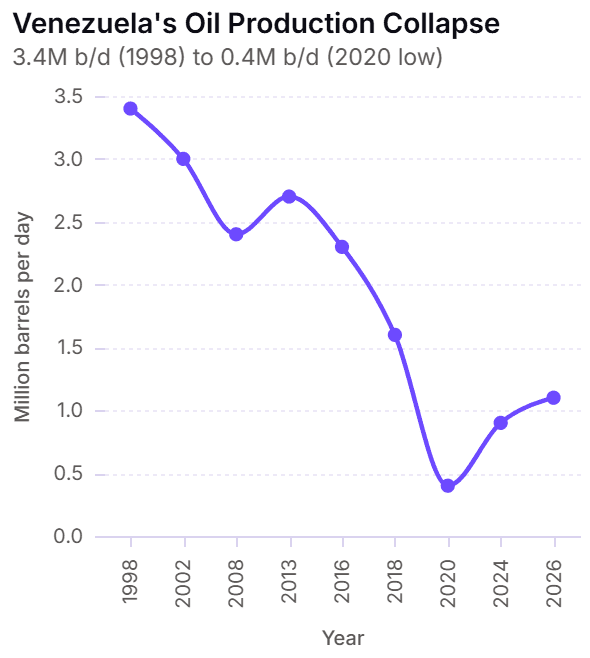
(Approximate EIA and OPEC secondary-source estimates; the 2020 point reflects the mid-2020 low of roughly 340,000–400,000 b/d. See sources below.)
Part IX — January 2026
By the middle of the 2020s, the contrast was extraordinary. Venezuela still possessed some of the largest proven petroleum reserves on Earth, yet its oil industry produced only a fraction of what it had produced when Chávez was first elected. Millions of Venezuelans lived outside their country. Maduro remained in power despite years of international pressure and domestic opposition.
Then, on January 3, 2026, the United States crossed a line that dramatically changed the story. American military and law-enforcement forces entered Venezuela and captured Nicolás Maduro. The operation marked an extraordinary escalation in U.S. involvement: after years of sanctions and diplomatic pressure, the United States had now used military force inside Venezuela to remove its leader.
For this series, however, what happened next brings us almost exactly back to where Venezuela’s modern oil story began. Foreign companies returned. American investment returned. Venezuela needed capital, equipment, and technical expertise — and once again, enormous amounts of money were potentially sitting beneath Venezuelan soil.
The Trump administration also revived an older dispute over Venezuela’s nationalization of foreign oil investments, arguing that Venezuela had taken American property and oil. What was actually taken — and who owned what — becomes important to what happened next.
The Question Venezuela Never Answered
In 1976, Venezuela nationalized its petroleum industry because Venezuelans believed too much of their country’s extraordinary oil wealth benefited foreign interests. In 1998, Hugo Chávez rose to power asking a related question: how could Venezuela possess so much oil while so many Venezuelans felt excluded from its prosperity? He promised to change that — and for a time, millions of Venezuelans believed he had. His government expanded services, reduced poverty, and gave previously marginalized communities a stronger political voice. But the system also became increasingly dependent on oil revenue and increasingly concentrated around a political movement that weakened the institutions capable of restraining it. When oil prices fell, the weaknesses that enormous petroleum revenue had helped conceal became much harder to hide. Maduro inherited those weaknesses and compounded many of them. Sanctions added another burden. Eventually, an oil-rich country could no longer reliably produce the resource on which almost everything depended.
There is a temptation to turn that history into a slogan — socialism, capitalism, Chávez, Maduro, America, corruption. Any one of those words can become an answer if we stop the story early enough.
A popular leader can identify real problems. A government program can produce real benefits. An economic model can still be unsustainable. An opposition can legitimately resist a government and still make destructive choices. A foreign government can worsen a crisis it did not originally create. And institutions that occasionally frustrate a leader can also be the institutions that tell a country when it is heading in the wrong direction.
Nearly three decades after Hugo Chávez promised to redirect Venezuela’s oil wealth toward ordinary Venezuelans, the underlying question has survived Chávez, Maduro, economic collapse, sanctions, and American military intervention.
Venezuela still possesses extraordinary oil wealth.
Who will benefit from it this time?
That is the question we examine in Part 4.
What This Means for You
Venezuela is often used as a shortcut in American political arguments. Someone proposes a social program, and someone says, “Venezuela.” Someone criticizes U.S. sanctions, and someone answers that Venezuela destroyed itself. Neither response requires much understanding of Venezuela. The more useful lesson is to watch the sequence.
When a government introduces a popular program, ask how it will be financed when economic conditions change. When a political leader says an institution is preventing necessary change, ask whether that institution is merely obstructing the government — or performing the uncomfortable job it was created to perform. When experts are replaced by loyalists, ask what knowledge leaves with them. And when politicians promise that one person or movement can finally fix a broken system, pay attention not only to what they want to change — but to what they believe should still be allowed to tell them no.
That lesson does not belong to the political left or the political right. It belongs to anyone living under a government run by human beings.
Join the Discussion
- Chávez entered office with genuine democratic support and addressed problems many Venezuelans believed the old political system had ignored. Does knowing that change how you understand what happened later?
- Chávez’s social programs produced real benefits during years of high oil revenue. What responsibility does a government have to prepare popular programs for the possibility that the money funding them may disappear?
- After opponents briefly removed Chávez from office in 2002 and later used a PDVSA strike to try to force him out, greater government control may have seemed reasonable to many supporters. Where should a government draw the line between protecting itself and weakening institutions that can restrain it?
- PDVSA lost thousands of experienced workers after the 2002–03 strike. What does Venezuela’s experience suggest about the tension between political loyalty and institutional expertise?
- Venezuela’s collapse is frequently explained with a single word — socialism, corruption, sanctions, authoritarianism, or oil. After following the sequence, which parts of the story do you think are most often missing from the way Venezuela is discussed?
Continue the Series
Part 1 — The 65-Billion-Barrel Promise What the new U.S.–Venezuela oil agreement actually provides — and what 65 billion barrels really means.
Part 2 — Oil Isn’t Just Oil Why America produces, imports, and exports petroleum at the same time — and what “energy independence” really means.
Part 3 — How Venezuela Got Here You are here.
Part 4 — Who Benefits This Time? — Coming Soon Venezuela still has the oil. Now we’ll follow the money, the companies, the political relationships, and the promises — and ask who actually stands to benefit from rebuilding the industry.
Sources
U.S. Energy Information Administration — Venezuela Country Analysis
This is probably our most important technical source. EIA documents Venezuela’s long oil-production decline and identifies the combination of underinvestment, deteriorating infrastructure, PDVSA’s financial problems, workforce losses, power failures, sanctions, and other constraints affecting production. Its historical production series also supports the dramatic decline shown in the article.
U.S. Energy Information Administration: Venezuela Country Analysis
U.S. Energy Information Administration — Venezuela’s Oil Production Decline
EIA’s historical reporting is especially useful for the PDVSA story. It documents the disruption caused by the 2002–03 strike and the later deterioration associated with lower investment, loss of experienced workers and managers, unpaid oil-service companies, and other operational problems.
EIA: Venezuela’s Crude Oil Production Declines
Congressional Research Service — Venezuela: Political Crisis and U.S. Policy
CRS provides background on Chávez, Maduro, Venezuela’s economic and humanitarian crisis, political repression, contested elections, and U.S. policy toward Venezuela. The April 2025 report describes increasing authoritarianism under Maduro and the disputed 2018 and 2024 elections.
Congressional Research Service: Venezuela — Political Crisis and U.S. Policy
U.S. Department of State, Office of Inspector General — Review of U.S. Policy During the 2002 Coup
This is the source I particularly wanted us to fix. The State Department inspector general reviewed allegations about U.S. involvement in Chávez’s brief removal in April 2002. The review found no evidence that the State Department or U.S. Embassy planned, participated in, or encouraged Chávez’s overthrow. That supports the careful wording we used rather than claiming either that Washington orchestrated the coup or that the U.S. role surrounding the episode was politically irrelevant.
State Department OIG findings on Venezuela and the 2002 coup
United Nations High Commissioner for Refugees — Venezuela Situation
UNHCR reports that nearly 7.9 million Venezuelan refugees and migrants were living outside Venezuela worldwide, based on government figures, as of December 2025. More than 6.9 million were hosted in Latin America and the Caribbean.
UNHCR: Venezuela Situation
The White House — Operation Absolute Resolve, January 3, 2026
The White House’s official record documents the January 2026 U.S. military operation in Venezuela and Maduro’s capture. Because this is an administration source, I would use it specifically for what the U.S. government says it did—not as an independent assessment of the operation or its legality.
White House: Operation Absolute Resolve


No discussions yet
Be the first to join the discussion and share your thoughts with the community.