
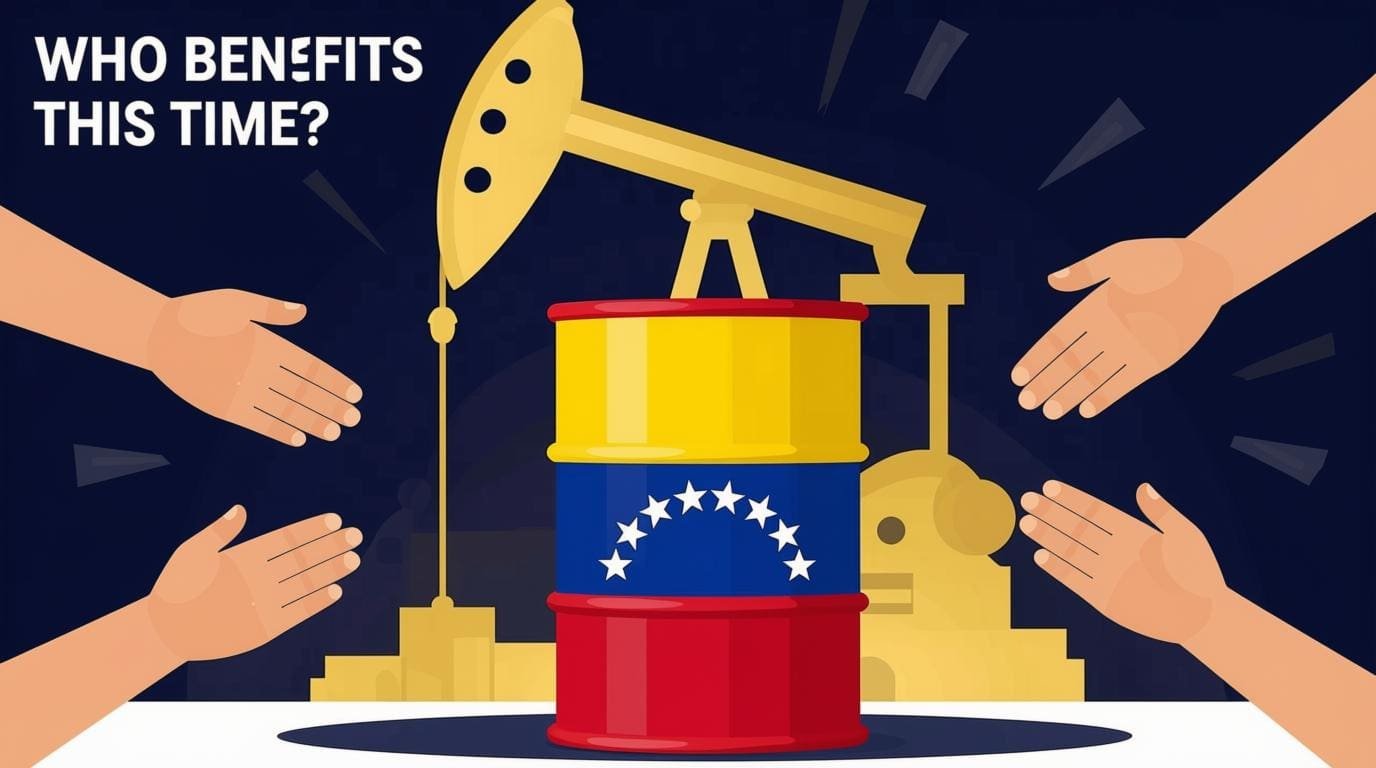
Venezuela still has the oil.
That fact has survived nationalization, revolution, an oil boom, economic collapse, mass emigration, an American military operation, and, now, an enormous new oil agreement. Through every era, the question has remained remarkably similar: Who benefits from the oil beneath Venezuela?
In 1976, nationalization was supposed to put more of that wealth under Venezuelan control. Hugo Chávez later promised to direct it toward ordinary Venezuelans. Corruption and mismanagement eventually diverted enormous sums while Petróleos de Venezuela, S.A. (PDVSA) deteriorated.
Now the answer is changing again.
The new oil economy includes familiar global energy companies, a private company controlled by Venezuelan businessman Alejandro Betancourt, the U.S. government itself, and companies connected to politically influential Americans. That combination deserves scrutiny and makes transparency about how companies were selected considerably more important.
A political relationship can be real. A financial benefit can be real. A sequence of events can look remarkable when placed on a timeline. And none of those things automatically proves that one caused the other. So rather than asking readers to choose between “historic opportunity” and “criminal looting,” we’re going to do something less exciting and considerably more useful: follow the money, separate what we know from what we don’t, and ask what evidence would turn a legitimate question into a factual conclusion.
First, the Players
Before we follow the money, we need to know who’s at the table.
At the center is North American Blue Energy Partners (NABEP), the private company that received development rights covering seventeen Venezuelan oil fields with roughly 65 billion barrels of proven reserves. The Pentagon’s Office of Strategic Capital received rights to a 35% equity stake in NABEP’s corporate parent, while the U.S. received guaranteed access to 20% of production and first refusal on the remainder.
NABEP is controlled by Venezuelan businessman Alejandro Betancourt. We’ll come back to him.
But NABEP isn’t alone.
Chevron is expanding its long-standing Venezuelan operations. Continental Resources, controlled by billionaire Harold Hamm, signed a preliminary agreement involving another enormous section of the Orinoco Belt. TotalEnergies, Eni and GE Vernova have also announced agreements or projects connected to Venezuela’s energy rebuilding.
Some of these arrangements are preliminary. Announced investment is not the same as money actually spent, and oil underground is not the same as oil produced. But after years in which Venezuela struggled to attract the capital and expertise its oil industry needed, companies are moving in quickly.
The question isn’t whether Venezuela needs outside investment. It does. The question is how these opportunities are being distributed, on what terms, and who ultimately benefits.
Sources:
Reuters — Trump’s Venezuela oil deal and the NABEP agreement
“Venezuela Stole Our Oil”: The Rhetoric and the Record
President Trump has repeatedly described Venezuela’s actions in unusually simple terms: they stole from us. Speaking to oil executives in January 2026, Trump said American expertise and investment had helped build Venezuela’s oil industry before its assets were taken. He then went further: “We’re taking back what was taken from us.” He added: “They took our oil industry.”
There is a real grievance underneath those statements. In 2007, Hugo Chávez’s government required foreign operators in major Orinoco Belt projects to accept minority positions under PDVSA control. Companies that refused, including ExxonMobil and ConocoPhillips, lost investments and assets. International tribunals later ruled that Venezuela had unlawfully taken some company investments and owed compensation. International arbitration later found Venezuela liable for unlawful expropriation in major cases, and substantial compensation was awarded to ConocoPhillips.
But losing oil investments is not the same thing as Venezuela stealing America’s oil. American companies owned investments, infrastructure, and contractual rights associated with producing Venezuelan petroleum. The petroleum beneath Venezuelan territory belonged to Venezuela. Those are different property claims. That distinction doesn’t erase the expropriations or Venezuela’s compensation obligations. It means the accurate grievance is narrower than the political slogan.
GovInfo — President Trump’s January 9 meeting with oil executives
ConocoPhillips — Venezuela expropriation arbitration decision
The Fifty-Year Echo
There is an irony here worth noticing. In 1976, Venezuela nationalized its oil industry amid a broader belief that too much of the country’s petroleum wealth was benefiting foreign interests. Fifty years later, Americans are being told that Venezuela took America’s oil wealth.
The grievances aren’t identical. Venezuela’s nationalization concerned a natural resource beneath Venezuelan territory; later disputes involved foreign investments, contracts, and infrastructure associated with producing that resource. But the political story has a familiar shape: Someone else took what belonged to us. That is precisely why the details matter.
“To the Victor Belong the Spoils”
President Trump has also described the arrangement in terms that go beyond recovering property once owned by American companies. Speaking about Venezuela at the U.N. General Assembly in September 2026, Trump said the United States and Venezuela control “more than 60%” of the world’s oil. Then he invoked an old political phrase: “To the victor belong the spoils.” Those are the President’s words, not an interpretation placed on them by his critics.
That phrase carries historical baggage. For much of human history, victorious rulers conquered territory and claimed its wealth as part of winning. Modern international law was built in significant part to move away from that world. Military victory does not, by itself, transfer ownership of another country’s territory or natural resources to the victor. That is what makes the President’s choice of words so striking: “To the victor belong the spoils” invokes an older idea of power — we won; therefore, we are entitled to benefit from what the defeated side possesses.
Whether Trump intended the phrase literally, rhetorically, or somewhere in between, we don’t have to guess. What we can examine is what happened next: who received access to Venezuela’s oil, how they were selected, on what terms, and what Venezuela received in return.
And that brings us to one of the most unusual figures in this story.
Sources:
Roll Call Factbase — President Trump’s September 22, 2026 U.N. General Assembly address
International Committee of the Red Cross — Occupation and international humanitarian law
The Man in the Middle: Alejandro Betancourt
At the center of an agreement promoted as a major victory for American energy is an unusual partner: Alejandro Betancourt, a Venezuelan billionaire whose rise began during Hugo Chávez’s government.
Betancourt became prominent during Venezuela’s electricity crisis through Derwick Associates, one of several companies run by young businessmen who prospered during the Chávez era. Venezuelans dubbed some of them the bolichicos — the “Bolivarian boys.”
Today, Betancourt controls NABEP, the private company at the center of the new U.S.–Venezuela oil agreement. His history helps explain why the selection process deserves closer examination.
Betancourt has faced money-laundering scrutiny in several countries involving funds allegedly diverted from Venezuela’s state oil company, PDVSA. He has not been charged with a crime in connection with those investigations and denies wrongdoing.
But the investigations have not simply disappeared. A Spanish judge closed one investigation in March 2026. Anticorruption prosecutors appealed, and in June Spain’s National Court ordered the case reopened, concluding that additional investigation was warranted. A related Swiss investigation has also remained active.
Meanwhile, Betancourt’s relationship with the United States changed dramatically. Reuters reported that he provided information to U.S. authorities before Maduro’s removal and helped American efforts involving sanctioned Venezuelan oil shipments. The Washington Post separately reported that senior U.S. officials pressed Swiss authorities to resolve their investigation without criminal penalties and allow Betancourt to travel.
Now the U.S. government is becoming a financial partner in the company he controls. Secretary of State Marco Rubio has defended the arrangement, saying Betancourt had no open investigation within the U.S. system when the deal was made.
And here is where our rule matters: Betancourt’s history does not prove that this deal is corrupt. It does make transparency about the deal considerably more important. We should know how NABEP was selected, what due diligence was performed, what conflicts were reviewed, and what protections exist for public money. Those aren’t accusations. They’re the questions a deal like this should be able to answer.
Sources:
Reuters — Alejandro Betancourt, U.S. investigations and the NABEP deal
The Washington Post — U.S. intervention in the Swiss investigation of Betancourt
El País — Spanish court orders the Betancourt investigation reopened
Another Name: Harold Hamm
Another beneficiary of Venezuela’s reopening has a much more familiar American political connection.
Harold Hamm is the billionaire founder of Continental Resources, a major Trump financial backer, fundraiser, and longtime ally who has also served as an informal energy adviser to the President. Reuters reports that Hamm gave more than $2 million to Trump-aligned campaign committees during the 2024 election cycle.
On September 16, Continental signed a preliminary agreement with Venezuela’s state oil company, PDVSA, to explore and potentially develop Ayacucho 2, a massive block in the Orinoco Belt estimated to contain roughly 30 billion barrels of oil in place. Continental says it plans to retain the full working interest if the project moves forward.
Again, put the facts in order.
What We Know
Hamm has been a major Trump donor, fundraiser, ally, and informal energy adviser.
In January 2026, U.S. forces removed Nicolás Maduro.
The Trump administration made private energy investment central to its plans for rebuilding Venezuela’s oil industry.
Continental then received the opportunity to pursue one of Venezuela’s enormous undeveloped oil blocks.
Those facts are documented.
What We Don’t Know
We do not have evidence that Hamm’s relationship with Trump caused Continental to receive this opportunity.
We do not have evidence that Hamm was promised Ayacucho 2 before Maduro’s removal.
And we do not have evidence that access to Venezuelan oil for Continental was a reason for the U.S. military operation.
What we know is that the relationship is real, the opportunity is real, and the timing raises reasonable questions. What we do not have is evidence showing that Hamm’s relationship with Trump caused Continental to receive the opportunity.
That doesn’t mean nobody should ask the question. It means the question is where the investigation begins, not where the conclusion ends.
Sources:
Reuters — Continental Resources signs Venezuela agreement for Ayacucho 2
A political or personal connection is documented.
A government benefit or opportunity is documented.
The relationship caused the benefit.
Sometimes that conclusion eventually turns out to be supported by evidence. Sometimes it doesn’t. The problem is that A + B does not automatically equal C.
We’ve Seen This Before: Cheney and Halliburton
Consider one of the most famous examples. Dick Cheney served as CEO of Halliburton, the giant oil-services company, until August 2000. He then became vice president under George W. Bush. After the United States invaded Iraq in 2003, Halliburton subsidiary Kellogg Brown & Root received major government work connected to Iraq, including a contract involving oil-field fires and petroleum infrastructure. The relationship generated congressional investigations, audits, and years of accusations that Cheney’s former company had benefited from his position in government.
Put the basic facts together:
A: Cheney had run Halliburton.
B: Cheney became vice president.
C: Halliburton later received enormous government contracts connected to Iraq.
All three statements can be true without establishing a fourth: Cheney caused Halliburton to receive those contracts because of his relationship with the company. That requires additional evidence.
And the contracting story itself was more complicated than the political shorthand suggested. Some early Iraq work was awarded without full competition and became controversial, while much subsequent Iraq reconstruction contracting was competitively awarded. GAO later found that about 91% of the Iraq reconstruction obligations it could evaluate from October 2003 through March 2006 involved competitively awarded contracts.
That doesn’t mean questions about Halliburton were unreasonable. It means the questions and the conclusions were two different things.
Sources:
U.S. Government Accountability Office — Competition for Iraq reconstruction contracts
The Same Rule Applies Here
Now return to Venezuela. Hamm’s relationship with Trump is documented. Continental’s opportunity is documented. The sequence is documented. Those facts justify asking whether the relationship influenced the opportunity, but they do not answer the question. To know when we’ve moved from a suspicious-looking sequence to evidence of causation, we need to look for what’s missing.
Six Questions for Any Political-Benefit Story
Apply It to Venezuela
Now run the test.
We have enough evidence to justify the questions. We do not yet have enough evidence to answer all of them.
That isn’t fence-sitting. It’s where the evidence currently stops.
The Others at the Table
Betancourt and Hamm are important to examine, but they are not the whole story.
Venezuela is attracting a much broader group of energy companies. Chevron, which maintained operations in Venezuela through years of political turmoil and sanctions, has been negotiating an expansion. Italy’s Eni, India’s ONGC, Colombia’s GeoPark, and U.S.-based GE Vernova have also pursued agreements or projects as Venezuela restructures its energy sector.
Oil is not the only Venezuelan resource attracting American interest. A New York Times investigation published in September reported that 10 Venezuelan gold bars were brought to the White House in March. The Times reported that on the same day, the Trump administration issued a new policy allowing certain Venezuelan gold to be imported into the United States, including gold involving the state-owned mining company Minerven. Treasury records independently confirm that the gold authorization was issued March 6.
The timing is striking. It does not, by itself, tell us why the policy was issued. But it expands the question at the center of this article beyond oil: as Venezuela’s resources reopen to foreign investment, who receives access, under what terms, and what ultimately reaches Venezuelans?
More recently, Halliburton — yes, the same company from our Cheney example — signed preliminary agreements to pursue Venezuelan oil and gas projects with Brazilian energy company Eneva and Venezuela-based WESCA.
That matters because it complicates the simplest political explanation. If every major opportunity were going only to Trump donors, friends, or politically connected insiders, that would be one pattern. That isn’t what the evidence currently shows. Companies with very different histories and relationships are positioning themselves for Venezuela’s reopening. Some have operated there for decades. Others are trying to enter or return as the country’s investment rules change.
That doesn’t make the questions surrounding NABEP or Continental disappear. It tells us something equally important: don’t build a theory from only the examples that fit it.
Sources:
Reuters — Chevron, ONGC, Eni, GeoPark and GE Vernova pursue Venezuela projects
Halliburton — Venezuela agreements with Eneva and WESCA
The New York Times — Trump Brought Venezuelan Gold to the U.S., but Refiners Won’t Touch It
U.S. Treasury — Authorization involving Venezuelan-origin gold
What Do Venezuelans Get?
After all the discussion of American energy security, private investment, billionaires, and 65 billion barrels of oil, there is another beneficiary we haven’t talked about enough: Venezuela.
That may sound obvious. It isn’t.
In 1976, Venezuela nationalized its oil industry partly around a powerful argument: a country sitting on extraordinary petroleum wealth should have greater control over that wealth. Hugo Chávez later made an even more direct promise. Oil wealth would no longer primarily enrich foreign companies and Venezuela’s elite. It would be used to improve the lives of ordinary Venezuelans.
As we saw in Part 3, that promise produced real social spending during the oil boom — and then collided with corruption, mismanagement, falling production, and economic collapse.
Nearly fifty years after nationalization, Venezuela is once again making a promise about what its oil can do for its people. Interim President Delcy Rodríguez says the new U.S.–Venezuela agreement could generate about $209 billion in revenue for Venezuela over 25 years, based on oil at $65 per barrel. Her government says roughly $19 from each barrel would go directly to Venezuela and insists the country retains ownership of its natural resources.
Those are significant promises. But they are still promises. Reuters reported that important details of the broader arrangement remain unclear, including the precise structure of NABEP’s operating partnership in Venezuela. The agreement was negotiated without competitive bidding, and questions remain about approvals and how some of its terms will operate in practice.
The United States will also have an unusually direct role in the money. Energy Secretary Chris Wright says the U.S. will closely oversee the flow of funds from the NABEP agreement to provide financial confidence and ensure proper business practices.
Congress has begun asking questions too. In February, legislation was introduced calling for a GAO audit of the broader U.S.–Venezuela oil arrangement, including the handling of proceeds placed in U.S.-controlled accounts.
And that brings us back to where Venezuela’s modern oil story began. For decades, Venezuelans have been told that the country’s extraordinary oil wealth would eventually translate into prosperity for ordinary people. Different governments blamed different villains: foreign corporations, domestic elites, imperialism, socialism, sanctions, corruption, and mismanagement.
The villains changed. The question didn’t. Venezuela still possesses extraordinary oil wealth. Who will benefit from it this time?
Sources:
Reuters — Venezuela’s 25-year energy agreement and projected revenues
Reuters — Energy Secretary Chris Wright on controls over NABEP funds
GovInfo — Venezuela Oil Proceeds Transparency Act (S. 3838)
Could Venezuela Be Repeating the Beginning?
Venezuela has been here before — not at the end of the story, but at the beginning.
In the decades before Hugo Chávez came to power, enormous oil wealth existed alongside corruption, economic frustration and a growing belief that ordinary Venezuelans were being left behind. Chávez rose promising to change that.
Today, Venezuela is entering another oil boom with foreign companies returning, politically connected businessmen receiving major opportunities, and enormous sums of money potentially at stake.
History doesn’t have to repeat itself. But the conditions that eventually produce demands for dramatic political change can begin long before the next political figure appears.
Conclusion: Follow the Money
We began this series with an extraordinary number: 65 billion barrels. But barrels underground are only potential. Turning them into wealth requires investment, technology, functioning institutions, years of work — and decisions about where the money ultimately goes.
Venezuela has made those decisions before. Nationalization promised that Venezuelans would control their oil wealth. Chávez promised that oil would finally serve ordinary people. Later, corruption and economic collapse showed how enormous national wealth can coexist with extraordinary hardship. Now another oil era is beginning.
American companies are returning. New investors are arriving. The U.S. government has taken an unprecedented financial role. Politically connected businessmen are among those positioned to benefit. And Venezuela’s government says the arrangement could produce hundreds of billions of dollars for the country.
Some of that could help rebuild an oil industry that desperately needs investment and eventually improve life for Venezuelans. But after everything we’ve learned in this series, promises aren’t enough. We know enough to ask better questions.
Who gets the contracts?
Who controls the money?
What does Venezuela receive?
What reaches ordinary Venezuelans?
And when political relationships and financial opportunities overlap, what evidence connects them — or doesn’t?
Those questions don’t require assuming corruption. They require transparency. Venezuela has spent half a century promising that one of the world’s greatest natural-resource endowments would eventually deliver prosperity to its people. Now it has another chance to prove it.
The claim is significant. The possibilities are real. Now show us what happens.
Join the Discussion
- When should a political relationship trigger additional scrutiny of a government deal? What evidence would you need before concluding that the relationship influenced the decision?
- Does the phrase “to the victor belong the spoils” change how you view the U.S.–Venezuela oil arrangement? Why or why not?
- What information about NABEP, Continental, and the other agreements should governments make public so citizens can evaluate them fairly?
- What should we measure five or ten years from now to determine whether Venezuela’s new oil era actually benefited ordinary Venezuelans?
Read the Full Venezuela Series
Who Benefits This Time? Following the Money in Venezuela’s New Oil Economy



No discussions yet
Be the first to join the discussion and share your thoughts with the community.