
A Civics 101 guide to voter-roll maintenance, database errors, and the safeguards that stand between a glitchy flag and your canceled registration
People Are Asking
Can I be removed from the voter rolls just because I didn’t vote?
No — not solely. But under federal law, not voting can become part of a multi-year process used to determine whether you’ve moved.
What does “voter purge” mean?
It isn’t a precise legal term. It’s commonly used to describe large-scale removals from voter-registration lists. Some are routine maintenance; others become controversial because of how voters were identified for removal or what safeguards were used.
Is SAVE a list of U.S. citizens?
No. SAVE is a federal system originally built to help government agencies verify immigration status for benefits and licensing. It is increasingly being used in voter-roll reviews, but it is not a master list of every U.S. citizen.
What if I show up at the polls and my name isn’t on the list?
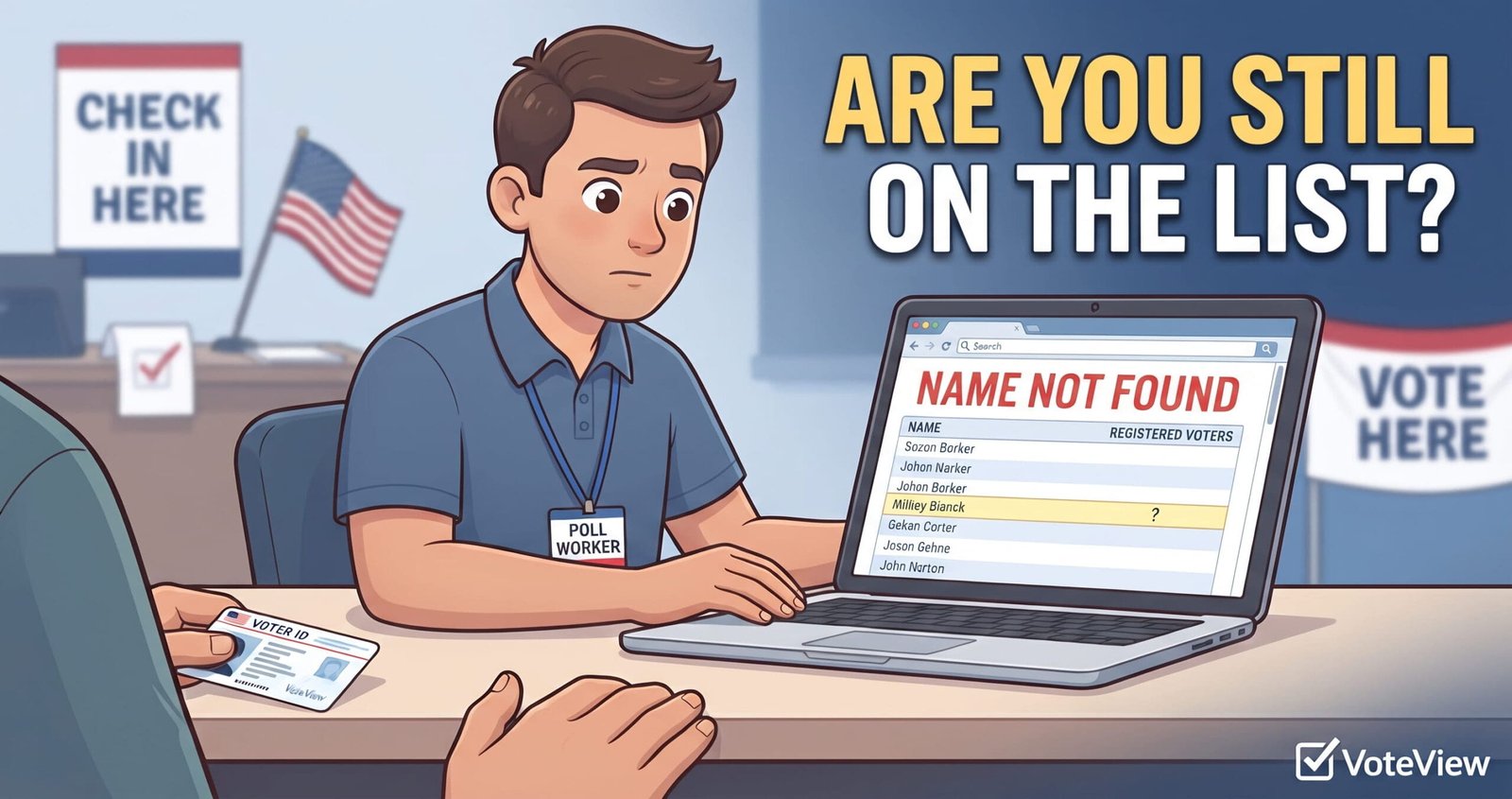
Don’t simply walk away. Ask election officials to double-check your registration and polling place. In most states, federal law provides a process for casting a provisional ballot if you say you are registered and eligible but your name isn’t on the official list.
How would you feel if, on Election Day, you walked up to your polling place, gave the poll worker your name, and waited while they checked the voter list — only to hear: “I’m sorry, but your name isn’t on the list here.”
That’s when you learn your registration is not a lifetime membership card. It’s a government record that can change — and under certain circumstances, it can be removed.
Behind that moment sits an invisible system most voters never think about: the voter roll. People move, change their names, pass away, or register in new places, and duplicate or outdated records naturally pile up. Election officials have to maintain those records and keep voter lists accurate.
That maintenance is a necessary part of running elections. The debate is over how states decide which records get flagged or removed — and how they make sure eligible voters aren’t accidentally removed in the process.
What could stop your vote from being counted before you even step into the booth?
Part 1 — What Is a Voter Roll?
Think of a voter roll as the official master guest list for an election. Just like a venue needs a list to confirm who holds a ticket, election officials need a reliable list of registered voters in each jurisdiction.
When you register, election officials create a voter record tied to information such as your name, address, and date of birth. That record can change over time. If you move, change your name, or update your registration, election officials update the record. If information indicates that you have died, moved out of the jurisdiction, or are otherwise no longer eligible, election officials may begin the process of removing your registration.
Part 2 — Why Do States Remove People From Voter Rolls?
Removing people from a voter list isn’t inherently suspicious. Keeping voter rolls accurate is a normal part of running elections. Registrations may be removed for reasons including:
- Death
- Moving out of the jurisdiction
- Duplicate registrations
- The voter’s request to cancel
- Loss of eligibility under state law, such as certain felony convictions
What Does “Voter Purge” Mean?
“Voter purge” isn’t a precise legal term. It is commonly used to describe large-scale removal of names from voter rolls — sometimes neutrally and sometimes critically. The important question isn’t the label. It’s how officials decided which records should be removed and what safeguards they used to catch mistakes.
Part 3 — How Do States Decide Someone May No Longer Be Eligible?
Election officials compare voter records with information from other sources, which can include death records, change-of-address data, motor-vehicle records, interstate data, returned election mail, and other government databases.
This brings us to a major concept: data matching.
Here’s the important lesson: a database match is a clue — not necessarily proof that two records belong to the same person.
Imagine a simple hypothetical. Maria Rodriguez moves from Texas to Florida. Coincidentally, another Maria Rodriguez with the same birth year already lives in Florida. How does a database know whether they’re the same person or two different people?
That’s the challenge of record matching. Names can be shared. Addresses change. Government records can contain outdated or incomplete information. The more information officials can compare, the easier it becomes to determine whether two records really belong to the same person.
Part 4 — The Citizenship Question
Only U.S. citizens can vote in federal elections. In most states, voter-registration applicants attest under penalty of perjury that they are U.S. citizens. Some states have adopted additional requirements known as documentary proof of citizenship, which can include documents such as a passport or birth certificate. Other states use government databases to verify citizenship or check voter rolls.
That creates an important question: What happens when the database is wrong?
Part 5 — What Is SAVE?
One federal tool became central to this debate in 2025 and 2026: SAVE (Systematic Alien Verification for Entitlements).
SAVE is a federal system originally created to help government agencies verify the immigration status or citizenship of people applying for certain benefits and licenses. It pulls information from multiple government records rather than maintaining a complete master list of every U.S. citizen.
That distinction matters. Government records can be incomplete or out of date, and a SAVE result may require additional verification. A person who has become a naturalized citizen, for example, may have older government records that still reflect a previous immigration status.
In 2025, the federal government expanded SAVE and made it easier for states to use the system to check voter rolls. Texas ran more than 18 million registered voters through SAVE and initially identified 2,724 potential noncitizens. But further review found that 578 of those voters had demonstrated U.S. citizenship. For 506 of them, passport information became available in SAVE after the state’s original check. Texas told counties to reinstate those voters if their registrations had been removed.
The expanded use of SAVE also became the subject of lawsuits. In June 2026, a federal judge blocked the federal government’s 2025 overhaul of the system for nationwide voter-eligibility checks, citing privacy and voting-rights concerns. The ruling did not eliminate SAVE, and investigations based on earlier searches continued.
SAVE can provide useful information for investigating a voter record. But a database result isn’t necessarily the final answer.
Part 6 — What Happens When a Database Can’t Give a Clear Answer?
Utah offers a useful example.
Utah’s 2025–2026 Review
Utah reviewed more than 2 million voter registrations, comparing records with driver’s-license data and SAVE. The state ultimately reported that 99.72% of registered voters were verified as U.S. citizens.
But the remaining records didn’t all fall into the same category.
Officials identified 27 confirmed noncitizens, who were removed from the voter rolls, and 25 probable noncitizens, who were given 30 days to provide proof of citizenship before removal. Another 5,007 registered voters could not be confirmed as citizens through the review. Many had registered years before driver’s-license or Social Security numbers were required as part of the process. Under Utah’s new law, those voters must provide proof of citizenship to vote in state and local races; otherwise, they receive a federal-only ballot. (Utah Lieutenant Governor’s Office)
That’s an important distinction: “not confirmed” does not automatically mean “not a citizen.”
A database can identify a record that needs another look. What happens next — additional records, human review, notice to the voter, and an opportunity to respond — can determine whether a questionable match becomes a corrected record or an improper removal.
Part 7 — What Protections Exist Before Someone Can Be Removed?
A database flag does not automatically mean a voter’s registration should be canceled. Federal and state laws set rules for how voter rolls are maintained, although the exact protections depend on why a registration is being reviewed.
For suspected moves, the National Voter Registration Act (NVRA) provides an important safeguard. In most states, officials generally cannot remove someone for moving outside the jurisdiction without either confirmation from the voter or a notice-and-waiting process.
The NVRA also has a 90-day rule: states generally must complete systematic programs to remove ineligible voters at least 90 days before a federal primary or general election. That restriction does not prevent certain individual removals, including those involving a voter’s request, death, or a disqualifying criminal conviction under state law.
Six states — Idaho, Minnesota, New Hampshire, North Dakota, Wisconsin, and Wyoming — are exempt from the NVRA because of the voter-registration systems they had when the law took effect, so their procedures can differ.
The basic balance is deliberate: states are required to maintain accurate voter rolls, while federal law also places limits on how and when eligible voters can be removed.
Can You Be Removed Just Because You Didn’t Vote?
No — not solely because you didn’t vote. Under the NVRA, however, not voting can become part of a longer process used to determine whether someone has moved.
If election officials have reason to believe you moved outside the jurisdiction, they can send a confirmation notice. If you don’t respond and don’t vote or appear to vote through the next two federal general elections, your registration can eventually be removed.
In other words, missing an election doesn’t cancel your registration. The process takes years and involves additional steps.
If You Move
Moving is one of the most common reasons voter records become outdated. Rules vary depending on where you move, so update your voter registration after a move rather than assuming your old registration follows you automatically.
Part 8 — Why Are Voter Rolls Such a Political Fight?
Across the debate, there is broad agreement on the basic goal: voter rolls should be accurate.
The disagreement is over which errors deserve the most attention — leaving outdated or ineligible records on the list, or mistakenly removing an eligible voter — and how much evidence should be required before a registration is removed.
That tension between maintaining accurate rolls and protecting eligible voters is at the heart of the policy debate.
What to Ask When You Hear “Millions Removed From Voter Rolls”
The next time you see a headline saying millions of voters were removed from the rolls, the number alone doesn’t tell you what happened. Ask:
- How many of those removals were deaths?
- How many people moved away?
- How many were duplicate records?
- How many were old, inactive records?
- How many eligible voters were removed by mistake?
- What safeguards were used before registrations were removed?
Before Election Day: Check Your Registration
Your voter registration is a government record, and records can become outdated. Check your registration well before Election Day — especially if you’ve moved, changed your name, or haven’t voted in several elections.
If you arrive at the polls and are told your name isn’t on the voter list, don’t simply walk away. Ask election officials to check your registration and polling location. In a federal election, if you believe you are registered and eligible to vote but your name isn’t on the official list, federal law provides a process for casting a provisional ballot while your eligibility is reviewed.
Voter-roll maintenance is necessary. The challenge is getting both parts right: accurate rolls and eligible voters able to cast their ballots.
Think About It
- Which mistake concerns you more: leaving an outdated registration on the voter roll or mistakenly removing an eligible voter? Why?
- How much evidence should election officials require before removing someone’s registration?
- After seeing the Texas and Utah examples, what role do you think databases should play in voter-roll maintenance?
Related Articles




No discussions yet
Be the first to join the discussion and share your thoughts with the community.